Writing x64 Shellcode: Differences, Shadow Space, and Register Conventions
Objective: Understand the architectural and ABI-level differences between x86 and x64 Windows shellcode, including the Microsoft x64 calling convention, shadow space, stack alignment, position-independent API resolution via PEB walking, and the detection surface each technique exposes.
1. From x86 to x64: What Actually Changed
Moving shellcode from x86 to x64 Windows is not a syntactic exercise of renaming EAX to RAX. The ABI changed, the segment register that anchors the TEB changed, and the addressing model changed. A snippet that “looks right” can execute cleanly, corrupt the host process, and crash three calls later inside an SSE instruction — none of which gives the author an obvious clue.
| Item | x86 | x64 |
|---|---|---|
| General-purpose registers | 8 × 32-bit (EAX…EDI) | 16 × 64-bit (RAX…R15) |
| Windows calling convention | stdcall / cdecl — all args on stack | Unified fast-call — first 4 integer args in registers |
| TEB segment register | FS; PEB at fs:[0x30] | GS; PEB at gs:[0x60] |
| Address width | 32-bit | 64-bit (48-bit canonical VA in practice) |
call pushes | 4-byte return address | 8-byte return address |
| RIP-relative addressing | Not available | Available; lea rax, [rip + offset] is idiomatic in PIC |
Two consequences dominate the rest of this tutorial. First, x64 adopts a single __fastcall-style ABI with a mandatory shadow space and 16-byte stack alignment rule. Second, the TEB is reached via GS, not FS, and every PEB offset must be updated for the 64-bit struct layout.
2. The Microsoft x64 ABI Deep-Dive
The Microsoft x64 calling convention passes the first four integer arguments in registers and floating-point arguments in the low halves of the first four XMM registers. Anything beyond that goes on the stack, above the shadow space, pushed right-to-left.
| Argument # | Integer Register | Floating-Point Register |
|---|---|---|
| 1st | RCX | XMM0L |
| 2nd | RDX | XMM1L |
| 3rd | R8 | XMM2L |
| 4th | R9 | XMM3L |
| 5th+ | Stack (above shadow space) | Stack |
The return value lives in RAX for integers and pointers, and in XMM0 for floating-point results.
Volatile vs Non-Volatile Registers
| Class | Registers |
|---|---|
| Volatile | RAX, RCX, RDX, R8, R9, R10, R11, XMM0–XMM5 |
| Non-volatile | RBX, RBP, RDI, RSI, RSP, R12, R13, R14, R15, XMM6–XMM15 |
A callee may freely destroy volatile registers; non-volatile registers must be preserved across calls. Shellcode that clobbers RBX or RDI in the host thread and then returns control corrupts the host. This is the single most common reason “working” shellcode crashes the host process several instructions after the shellcode finishes.
Side-by-Side: x86 Push vs x64 Register Load
; --- x86 stdcall: MessageBoxA(0, "msg", "title", 0) ---
push 0              ; uType
push title          ; lpCaption
push msg            ; lpText
push 0              ; hWnd
call [MessageBoxA]  ; callee cleans the stack

; --- x64 fastcall: same call ---
xor  rcx, rcx                       ; hWnd      = NULL
lea  rdx, [rel msg]                 ; lpText
lea  r8,  [rel title]               ; lpCaption
xor  r9d, r9d                       ; uType     = 0
sub  rsp, 0x28                      ; shadow space + alignment (see §4)
call [rel MessageBoxA]
add  rsp, 0x28
Note xor r9d, r9d rather than xor r9, r9 — writing to the 32-bit sub-register zero-extends to the full 64-bit register and produces a shorter, null-byte-free opcode.

3. Shadow Space: Why, What, and Where
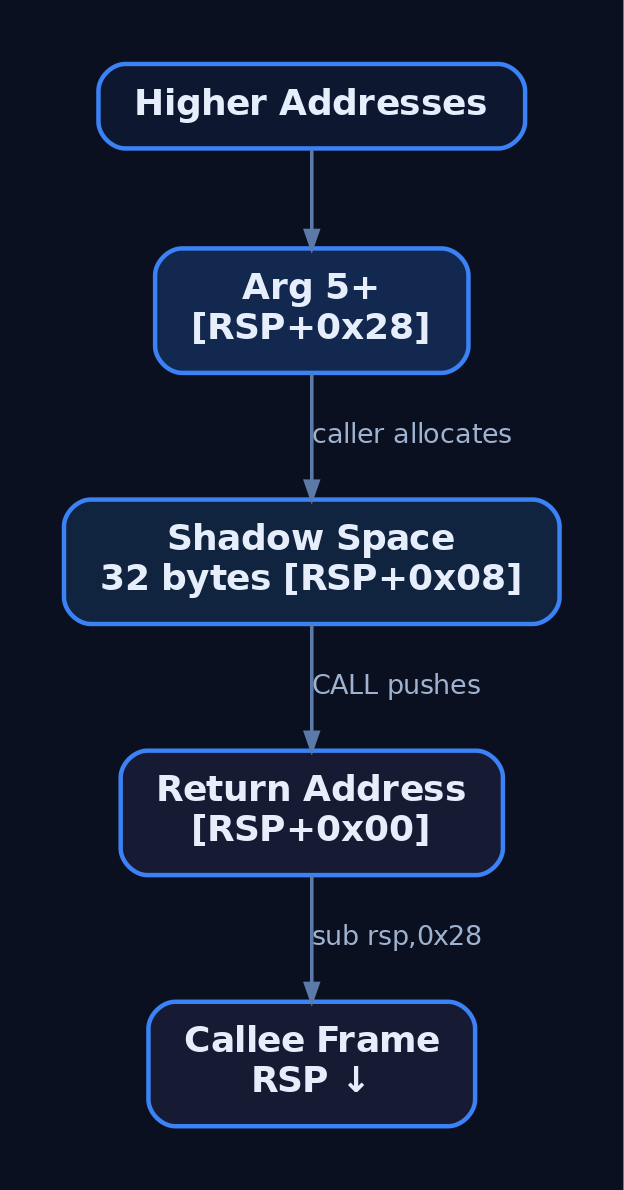
In the Microsoft x64 convention the caller must reserve 32 bytes (4 × 8) of stack immediately above the return address as shadow space (also called home space or spill space). This area exists so the callee has somewhere to spill RCX, RDX, R8, and R9 back to memory if it needs to take their addresses or free up the registers for re-use.
Critical points:
- Shadow space is always reserved, even when the callee takes fewer than four arguments and even when the callee never spills.
- It is owned by the caller. The callee may overwrite it without saving the previous contents.
- The caller does not zero or initialise it. The callee is responsible for whatever it writes there.
- Stack arguments beyond the fourth begin at
[RSP + 0x28](32 bytes shadow + 8 bytes return address).
Layout immediately after call, before callee prologue | Offset from RSP |
|---|---|
Return address (pushed by call) | [RSP + 0x00] |
Shadow slot for RCX | [RSP + 0x08] |
Shadow slot for RDX | [RSP + 0x10] |
Shadow slot for R8 | [RSP + 0x18] |
Shadow slot for R9 | [RSP + 0x20] |
| 5th argument (if any) | [RSP + 0x28] |
Skip the shadow allocation and the first thing the callee does — often a mov [rsp+8], rcx early in a Win32 prologue — clobbers your own stack frame or, worse, the saved return address you just pushed.
4. Stack Alignment in Practice
The Microsoft x64 ABI requires RSP to be 16-byte aligned at the moment of a call, except inside a prolog. The hardware call then pushes an 8-byte return address, so on entry to the callee RSP is 16N + 8 aligned. Win32 internals (memcpy, CRT, anything that uses SSE/AVX with aligned moves) will issue movaps / movdqa against stack locations and will raise EXCEPTION_ACCESS_VIOLATION (0xC0000005) if RSP is wrong by 8.
This is why the canonical shellcode prologue is sub rsp, 0x28, not 0x20:
0x20(32 bytes) for shadow space.+ 0x08to undo the misalignment the precedingcallintroduced.
; Canonical shellcode call wrapper
sub rsp, 0x28          ; 32B shadow + 8B realign
call rax               ; rax = resolved API address
add rsp, 0x28
When the shellcode entry itself was reached by a jump from unknown context, force alignment explicitly:
; Defensive entry: align RSP regardless of caller state
and rsp, 0xFFFFFFFFFFFFFFF0   ; force 16-byte alignment
sub rsp, 0x28                  ; shadow + 8 to keep call-time alignment
To diagnose alignment faults in WinDbg, dump the faulting instruction (u .) and check whether it is a movaps / movdqa referencing [rsp+…]. If rsp & 0xF == 0x8 at the call, you forgot the + 0x08.
5. Position-Independent Code Fundamentals
Shellcode does not know where it will land. Hard-coded addresses are forbidden — ASLR randomises module bases per boot, and the shellcode itself is dropped at an allocator-chosen address. Two x64 idioms enable position independence:
- RIP-relative addressing.
lea rax, [rel label]resolves tolea rax, [rip + disp32]and produces correct results regardless of load address. This is the preferred way to reference embedded data in x64 shellcode. call/popdelta trick. Acallto the next instruction pushes its return address — the runtime location of the following label. The calleepops it into a register to obtain a base for subsequent offsets.
; Obtain the runtime address of `data` without RIP-relative encoding
    call get_rip
get_rip:
    pop rbx                  ; rbx = address of next instruction
    lea rsi, [rbx + data - get_rip]
    jmp continue
data:
    db "kernel32.dll", 0
continue:
In practice, prefer lea reg, [rel label] for clarity; reach for call/pop only when an encoder demands it (for example, to avoid certain bad bytes).
6. PEB Walking: Finding kernel32.dll Without Imports
Because shellcode has no import table, it must walk the loader’s in-memory bookkeeping to find kernel32.dll and then resolve GetProcAddress / LoadLibraryA from its exports. On x64 Windows the chain starts at GS and uses these offsets:
| Step | Source | Field | Offset (x64) |
|---|---|---|---|
| 1 | GS segment | → TEB | — |
| 2 | TEB | ProcessEnvironmentBlock | +0x060 |
| 3 | PEB | Ldr → PEB_LDR_DATA | +0x018 |
| 4 | PEB_LDR_DATA | InMemoryOrderModuleList | +0x020 |
| 5 | LDR_DATA_TABLE_ENTRY link | InMemoryOrderLinks.Flink | +0x000 |
| 6 | LDR_DATA_TABLE_ENTRY | DllBase (from InMemoryOrderLinks) | +0x030 |
The InMemoryOrderModuleList on a normal process begins with the executable, then ntdll.dll, then kernel32.dll. Walking two Flinks from the head reaches the kernel32.dll entry. Production-grade shellcode hashes the BaseDllName string rather than trusting that order, both for resilience and because EDRs deliberately permute the head of the list as a tripwire (see §10).
; --- PEB walk skeleton: locate kernel32.dll base in rax ---
    xor   eax, eax
    mov   rbx, [gs:0x60]        ; TEB -> PEB
    mov   rbx, [rbx + 0x18]     ; PEB -> Ldr (PEB_LDR_DATA)
    mov   rbx, [rbx + 0x20]     ; -> InMemoryOrderModuleList.Flink
                                ;    (points into 1st LDR_DATA_TABLE_ENTRY's InMemoryOrderLinks)
    mov   rbx, [rbx]            ; advance: -> 2nd entry (ntdll)
    mov   rbx, [rbx]            ; advance: -> 3rd entry (kernel32)
    mov   rax, [rbx + 0x30]     ; DllBase relative to InMemoryOrderLinks (x64)
                                ; rax now holds kernel32.dll base address
To verify the offsets against the target OS build, drop into WinDbg on a live process and dump the structures directly:
0:000> dt nt!_TEB ProcessEnvironmentBlock
0:000> dt nt!_PEB Ldr
0:000> dt nt!_PEB_LDR_DATA InMemoryOrderModuleList
0:000> dt nt!_LDR_DATA_TABLE_ENTRY DllBase BaseDllName
0:000> !lmi kernel32
7. Parsing the Export Address Table
With kernel32.dll‘s base in hand, the shellcode walks the PE headers to the Export Directory and then iterates AddressOfNames, comparing each name against a precomputed hash. String literals like "GetProcAddress" are avoided to defeat trivial signatures and to remove embedded nulls.
Key offsets from a loaded module base:
| Field | Offset |
|---|---|
e_lfanew (RVA of PE header) | DllBase + 0x3C |
| Optional Header | PE_header + 0x18 |
| Export Directory RVA (PE32+) | OptHeader + 0x70 |
AddressOfFunctions | ExportDir + 0x1C |
AddressOfNames | ExportDir + 0x20 |
AddressOfNameOrdinals | ExportDir + 0x24 |
; --- EAT walk outline: resolve an export by ROR-13 name hash ---
; in : rax = module base, ebp = target hash (e.g. for "GetProcAddress")
; out: rax = exported function address (or 0)

    mov   ecx, [rax + 0x3C]      ; e_lfanew
    add   rcx, rax               ; rcx = PE header
    mov   edx, [rcx + 0x88]      ; Export Directory RVA (OptHdr + 0x70)
    add   rdx, rax               ; rdx = IMAGE_EXPORT_DIRECTORY
    mov   r8d,  [rdx + 0x18]     ; NumberOfNames
    mov   r9d,  [rdx + 0x20]     ; AddressOfNames RVA
    add   r9, rax
    xor   r10, r10               ; index

.next_name:
    mov   esi, [r9 + r10*4]      ; name RVA
    add   rsi, rax               ; rsi -> ASCII export name
    xor   edi, edi               ; hash accumulator

.hash_byte:
    movzx eax, byte [rsi]
    test  al, al
    jz    .check
    ror   edi, 13
    add   edi, eax
    inc   rsi
    jmp   .hash_byte

.check:
    cmp   edi, ebp               ; compare ROR-13 hash
    je    .found
    inc   r10
    cmp   r10d, r8d
    jb    .next_name
    xor   rax, rax               ; not found
    ret
.found:
    ; resolve via AddressOfNameOrdinals + AddressOfFunctions
    ; (omitted for brevity)
    ret
The ROR-13 rotate-and-add hash, popularised by the Metasploit block_api stub, is the de facto standard precisely because defenders now key on it (see §10).
8. Null-Byte and Bad-Character Avoidance
Shellcode delivered through a string-copy primitive (strcpy, lstrcatA, format-string echo) is truncated at the first null byte. x64 immediates routinely embed nulls because most useful constants and addresses do not occupy all 64 bits.
| Problem | Fix |
|---|---|
mov rax, 0x000000007FFE1234 → nulls | xor eax, eax then mov eax, 0x7FFE1234 (zero-extends) |
64-bit literal in mov r9, imm64 | lea r9, [rel label] or build via shifts/ORs |
push 0 → encodes 6A 00 | xor rcx, rcx ; push rcx |
mov rcx, 0 → 7-byte null run | xor ecx, ecx |
; --- Null-byte comparison ---
; BAD: mov rax, 0x76ab1234
;   48 B8 34 12 AB 76 00 00 00 00   <-- four null bytes
mov rax, 0x76ab1234

; GOOD: zero-extend via 32-bit sub-register
;   31 C0                            <-- xor eax, eax
;   B8 34 12 AB 76                   <-- mov eax, 0x76AB1234
xor eax, eax
mov eax, 0x76ab1234
Writing to EAX implicitly zeroes the upper 32 bits of RAX — this single architectural quirk eliminates most accidental nulls in shellcode constants.
A short Python lab to validate a candidate snippet:
from keystone import Ks, KS_ARCH_X86, KS_MODE_64

asm = b"""
    xor eax, eax
    mov eax, 0x76ab1234
    mov rbx, qword ptr gs:[0x60]
    mov rbx, qword ptr [rbx + 0x18]
"""
ks = Ks(KS_ARCH_X86, KS_MODE_64)
code, _ = ks.asm(asm)
buf = bytes(code)
print(buf.hex())
bad = [i for i, b in enumerate(buf) if b == 0x00]
print(f"length={len(buf)} bad_byte_offsets={bad}")
Run it, see exactly where nulls (or any other bad character) land, and rewrite the offending instruction.
9. Shellcode Skeleton: Putting It Together
The pieces combine into a recognisable x64 stub: align the stack, walk the PEB to find kernel32.dll, parse the EAT to resolve GetProcAddress and LoadLibraryA, and then call out through the standard ABI with proper shadow space.
[BITS 64]
_start:
    ; --- entry: defensively align stack ---
    and   rsp, 0xFFFFFFFFFFFFFFF0
    sub   rsp, 0x28                ; shadow space + alignment

    ; --- locate kernel32.dll via PEB ---
    mov   rbx, [gs:0x60]           ; TEB -> PEB
    mov   rbx, [rbx + 0x18]        ; PEB -> Ldr
    mov   rbx, [rbx + 0x20]        ; InMemoryOrderModuleList.Flink
    mov   rbx, [rbx]               ; -> ntdll entry
    mov   rbx, [rbx]               ; -> kernel32 entry
    mov   r15, [rbx + 0x30]        ; r15 = kernel32 base

    ; --- resolve GetProcAddress via ROR-13 hash (call into eat_lookup) ---
    mov   rcx, r15
    mov   edx, 0x7C0DFCAA          ; ROR-13("GetProcAddress")  (illustrative)
    call  eat_lookup               ; rax = &GetProcAddress
    mov   r14, rax

    ; --- call LoadLibraryA("user32.dll") via GetProcAddress ---
    mov   rcx, r15                 ; hModule = kernel32
    lea   rdx, [rel s_LoadLibraryA]
    call  r14                      ; rax = &LoadLibraryA
    lea   rcx, [rel s_user32]
    call  rax                      ; rax = HMODULE user32

    ; --- ... continue resolution and API calls ...

    add   rsp, 0x28
    ret

s_LoadLibraryA: db "LoadLibraryA", 0
s_user32:       db "user32.dll", 0

; eat_lookup: in rcx=module base, edx=ROR13 hash -> rax = export addr
eat_lookup:
    ; (see §7 for the inner loop)
    ret
Every block in the skeleton corresponds to one of the rules established above: sub rsp, 0x28 for shadow + alignment, gs:[0x60] for the PEB, [rbx + 0x30] for DllBase, lea + RIP-relative strings for PIC, and r14 / r15 carrying non-volatile state across calls without manual save/restore.
10. Common Attacker Techniques
| Technique | Description |
|---|---|
| PEB-walk API resolution | Locate kernel32.dll via gs:[0x60] chain, parse exports by hash |
| ROR-13 export hashing | Avoid embedded API name strings; survive static signature scans |
| RIP-relative PIC | lea reg, [rel label] to address embedded data without fixups |
| Sub-register zero-extension | mov eax, imm32 to write RAX with no null bytes |
| Shadow-space-aware call wrapping | sub rsp, 0x28 around every Win32 call from an unknown caller |
| Direct Win32 → Native API substitution | Call Nt* syscalls to bypass usermode hooks (T1106) |
| Reflective loading of a PE in memory | Shellcode bootstraps a full PE image without touching disk (T1620) |
11. Defensive Strategies & Detection
Shellcode is observable at multiple layers. The most reliable signals come from the behaviours the techniques above require, not from the byte patterns they happen to produce.
Sysmon events to enable and triage:
EventID 1— Process Create. Unusual parent/child chains (browser, Office, mail client spawningcmd.exe/powershell.exe) are the cheapest, highest-yield signal.EventID 8—CreateRemoteThread. Cross-process thread creation into LSASS, browsers, or signed Windows binaries is high-fidelity.EventID 10—ProcessAccess. WatchGrantedAccessmasks like0x1FFFFF(full access) and0x1010(read + VM-write).EventID 17/18— Pipe creation/connection, frequently used by shellcode-launched implants for C2.
ETW providers worth subscribing to in EDR pipelines:
Microsoft-Windows-Kernel-Process— kernel-side process/thread/image events.Microsoft-Windows-Threat-Intelligence(PPL-only) —NtAllocateVirtualMemory,NtProtectVirtualMemory,NtWriteVirtualMemory,NtCreateThreadExat the syscall layer, bypassed by no usermode hook.Microsoft-Windows-Security-Auditing— handle and object access.
Audit policies: Audit Process Creation (Success) and Audit Kernel Object surface the same events to the classic Security log for SIEM ingestion.
Behavioural signals defenders should hunt on:
- Threads with
StartAddressinMEM_PRIVATEregions that arePAGE_EXECUTE_*and not backed by a file image. CallTracecontainingUNKNOWNframes — the calling instruction lives in unbacked memory.gs:[0x60]opcode pattern (65 48 8B 04 25 60 00 00 00) inside executable regions of non-system modules.- ROR-13 hashing loops in memory scans.
Sigma sketch — suspicious cross-process access typical of shellcode injection:
title: Suspicious Cross-Process Access With VM-Write Rights
logsource:
  product: windows
  service: sysmon
detection:
  selection:
    EventID: 10
    GrantedAccess:
      - '0x1FFFFF'
      - '0x1410'
      - '0x1010'
  filter_legit:
    SourceImage|endswith:
      - '\MsMpEng.exe'
      - '\WmiPrvSE.exe'
  condition: selection and not filter_legit
level: high
Hardening to deploy on monitored endpoints:
- Arbitrary Code Guard (ACG) — denies the
PAGE_EXECUTE_*transition that turns aMEM_PRIVATEshellcode buffer into runnable code. - Control Flow Guard (CFG) — invalidates indirect calls into unregistered targets, which shellcode entry points always are.
- Block Win32 API calls from Office macros / child processes — Attack Surface Reduction rule that severs the most common shellcode delivery vector.
- PPL-protected EDR with kernel ETW Ti subscription — preserves syscall-layer telemetry even when userland hooks are patched out.
A useful EDR tripwire is to permute the head of InMemoryOrderModuleList with stub entries: shellcode that walks two Flinks blindly resolves the decoy module, fails to find expected exports, and crashes — producing a high-fidelity detection.
12. Tools for x64 Shellcode Analysis
| Tool | Description | Link |
|---|---|---|
| NASM | Assembler for the snippets in this tutorial; emits raw binary for direct hex inspection | nasm.us |
| Keystone Engine | Programmatic assembler (Python bindings) for bad-character analysis labs | keystone-engine.org |
| x64dbg | User-mode debugger; trace shellcode through gs:[0x60] and EAT walks | x64dbg.com |
| WinDbg | Inspect _TEB, _PEB, _PEB_LDR_DATA, _LDR_DATA_TABLE_ENTRY on the target build | learn.microsoft.com |
| Ghidra / IDA | Static analysis of shellcode-bearing samples and reflective loader stubs | ghidra-sre.org |
| Volatility 3 | Memory forensics: enumerate suspicious MEM_PRIVATE + RX regions, hunt unbacked threads | volatilityfoundation.org |
| Process Hacker | Live triage of thread start addresses and memory protections | processhacker.sourceforge.io |
| Godbolt Compiler Explorer | Inspect MSVC-emitted x64 prologues to confirm ABI assumptions | godbolt.org |
13. MITRE ATT&CK Mapping
| Technique | MITRE ID | Detection |
|---|---|---|
| Process Injection (umbrella) | T1055 | Sysmon EventID 8 + EventID 10 with VM-write GrantedAccess |
| DLL Injection | T1055.001 | Image Load (EventID 7) from MEM_PRIVATE-allocated path |
| Portable Executable Injection | T1055.002 | Volatility scans for PE headers in MEM_PRIVATE RX regions |
| APC Injection | T1055.004 | ETW Ti NtQueueApcThread to remote thread; alerted thread-start addresses |
| Process Hollowing | T1055.012 | EventID 1 with suspended child, followed by EventID 10 write + resume |
| Native API | T1106 | ETW Ti syscall provider; direct Nt* calls outside ntdll |
| Obfuscated Files or Information | T1027 | YARA on ROR-13 loops; entropy heuristics on dropped payloads |
| Reflective Code Loading | T1620 | Unbacked RX memory with PE magic / no module image record |
Summary
- x64 Windows shellcode is governed by a strict ABI: argument registers
RCX/RDX/R8/R9, return inRAX, a 32-byte shadow space, and 16-byte stack alignment at everycall. - The TEB is reached via
gs:[0x60]on x64; every PEB offset (+0x18,+0x20,+0x30) differs from the x86 layout and must be verified against the target build. - Position-independent API resolution combines a PEB walk to
kernel32.dllwith an EAT walk using ROR-13 name hashing to avoid embedded strings. - Null-byte avoidance leans on 32-bit sub-register writes that zero-extend, RIP-relative
lea, and XOR-then-push idioms. - Detection is layered: Sysmon
EventID 8/10for injection chains, ETWThreat-Intelligencefor syscall-level memory writes, behavioural hunts for unbackedRXregions, and ACG/CFG/ASR hardening to deny the primitives shellcode depends on.
Related Tutorials
- Position-Independent Code: Writing PIC Shellcode Without Hardcoded Addresses
- Writing Your First Shellcode: x86 Reverse Shell from Scratch
- x86 and x64 Calling Conventions: cdecl, stdcall, fastcall, and System V
- Egghunters: Staged Payload Delivery When Buffer Space Is Tight
- Shellcode Encoders: XOR Encoding, Custom Decoders, and Avoiding Bad Chars
References
- x64 Calling Convention — Microsoft Learn (MSVC)
- x64 ABI Conventions (Software Conventions Overview) — Microsoft Learn
- x64 Architecture Overview and Register Reference — Microsoft Learn (Windows Drivers)
- x64 Stack Usage (Shadow Space / Home Space) — Microsoft Learn
- Process Injection, Technique T1055 — MITRE ATT&CK Enterprise
- Windows x64 Shellcode — Topher Timzen (Security Research)