Adversary Emulation vs. Adversary Simulation: Definitions, Differences, and Why It Matters
Objective: Understand adversary emulation and adversary simulation as distinct offensive-security disciplines, how each maps onto MITRE ATT&CK and real tooling, and how to choose the right methodology so your detection and response controls are tested against the threat you actually care about.
1. Setting the Stage: Why Terminology Precision Matters
The words emulation, simulation, and red teaming are routinely used interchangeably in vendor decks and statements of work. That imprecision has an operational cost. If you commission a generic penetration test and believe you have validated your detection capability against a named threat actor, you have made a category error – you bought a vulnerability-finding exercise and assumed it tested your SOC’s behavioral analytics.
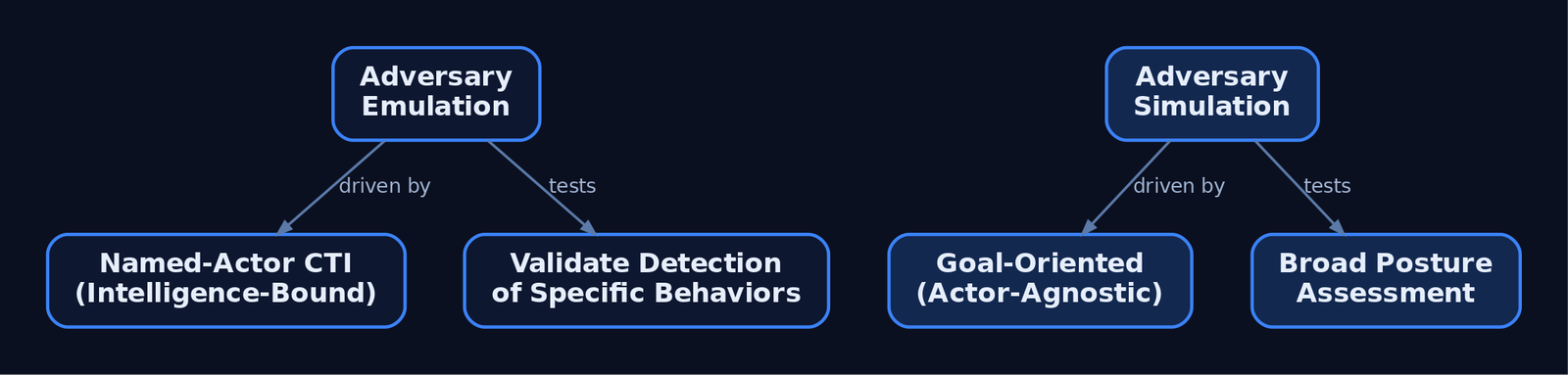
Precise language drives correct scope. Adversary emulation answers “would we detect and respond to what APT29 actually does?” Adversary simulation answers “can an attacker reach our crown jewels through any plausible path?” Both are valuable; they are not substitutes.
2. Foundational Vocabulary: TTPs and the ATT&CK Matrix
Both disciplines speak ATT&CK. The framework decomposes adversary behavior into a hierarchy that red and blue teams share as a common language.
| Term | ATT&CK Meaning | Example |
|---|---|---|
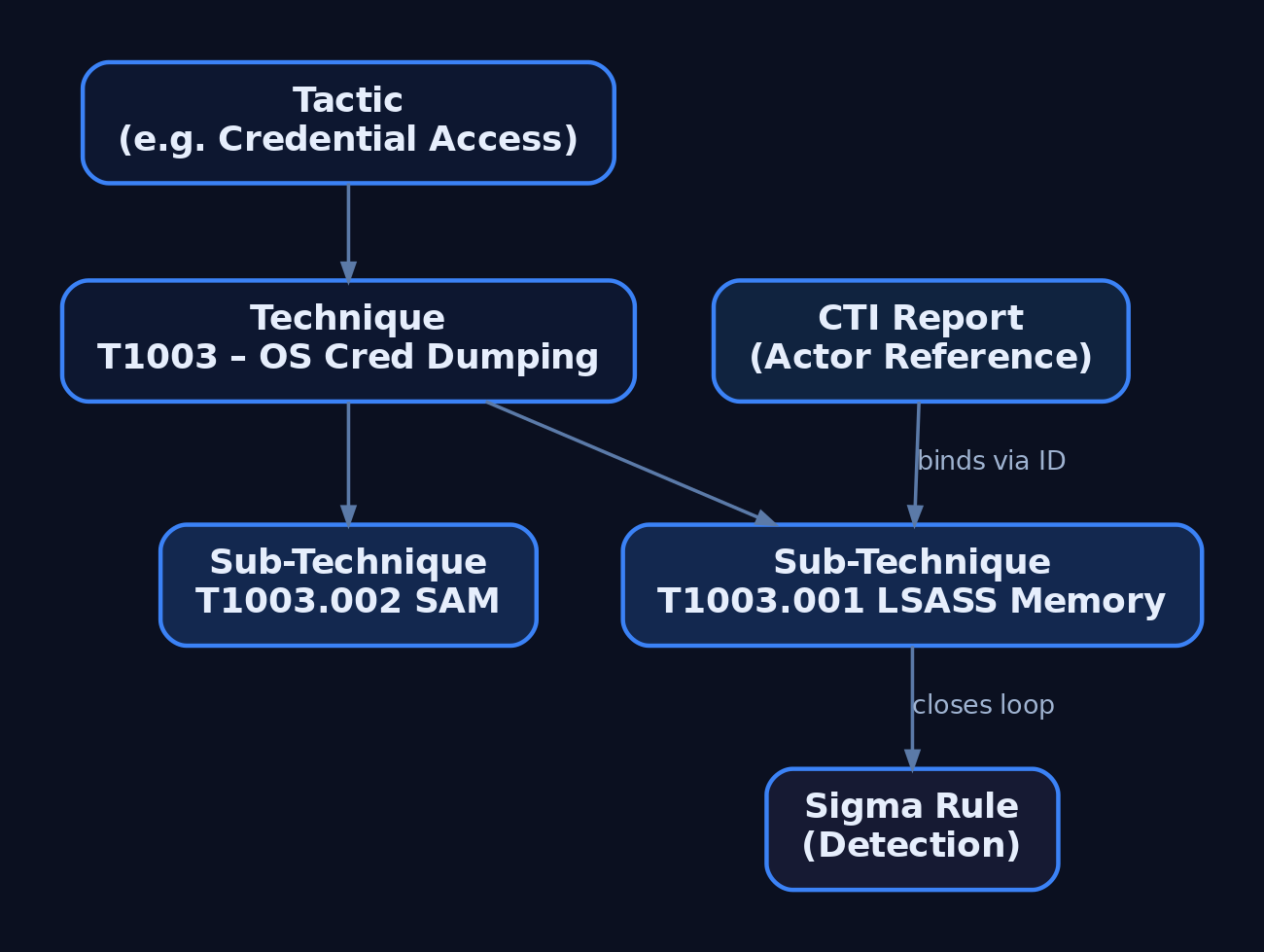
| Tactic | The why – the adversary’s tactical goal | Privilege Escalation, Lateral Movement, Exfiltration |
| Technique | The how – the method achieving the tactic | T1059.001 – PowerShell |
| Sub-technique | A more specific implementation of a technique | T1003.001 – LSASS Memory |
| Procedure | The exact hands-on-keyboard implementation, step by step | The specific commands and parameters used to dump LSASS |
ATT&CK technique IDs (T1566.001, T1078, T1021.002) function as stable identifiers that bind a CTI report, an emulation step, and a detection rule together. When a red-team finding cites T1003.001 and a Sigma rule keys on the same ID, the loop from offense to defense closes cleanly.
3. Adversary Emulation Defined
Adversary emulation is a structured offensive exercise in which the operator replicates the specific TTPs of a named threat actor – derived from cyber threat intelligence (CTI) – to test whether the organization’s controls detect, prevent, or respond to that actor’s real-world playbook.
The defining constraint is intelligence. Introduced by MITRE, the discipline shifts testing away from tools, exploits, and indicators of compromise toward adversary behaviors as described in ATT&CK. The goal is not to replay a malware sample or rebuild exact C2 infrastructure, but to emulate how a real actor selects, chains, and adapts techniques over time to reach its objective.
Because CTI rarely captures complete hands-on-keyboard detail, emulation is behavioral, not scripted. The operator exercises judgment while remaining bound by intelligence-defined objectives, tradecraft patterns, and risk tolerance. Ideally the blue team is blind – the exercise should look like a genuine intrusion, using TTPs known to work in the target environment.
4. Anatomy of an Adversary Emulation Plan
An Adversary Emulation Plan (AEP) is the deliverable that operationalizes a named actor. MITRE’s ATT&CK Evaluations (the APT29 structure) define three components:
| Component | Purpose |
|---|---|
| Intelligence Summary | Overview of the adversary with references to cited CTI |
| Operational Flow | Chains techniques into the logical major steps that recur across the actor’s operations |
| Emulation Plan | The TTP-by-TTP, command-by-command walkthrough implementing the tradecraft |
MITRE publishes AEPs for actors including APT3 (G0022), APT29 (G0016), FIN6, and menuPass through the Center for Threat-Informed Defense. A minimal AEP skeleton is intentionally a behavioral framework, not an exploit script:
# emulation-plan/generic-apt.yaml  (conceptual)
intelligence_summary:
  actor: "GENERIC-APT (illustrative)"
  references: ["G0016", "internal-cti-2024-114"]
  objective: "Access and exfiltrate finance data"

operational_flow:
  - phase: initial-access
    technique: T1566.001        # Spearphishing Attachment
  - phase: execution
    technique: T1059.001        # PowerShell
  - phase: persistence
    technique: T1547.001        # Registry Run Key
  - phase: credential-access
    technique: T1003.001        # LSASS Memory
  - phase: lateral-movement
    technique: T1021.002        # SMB / Admin Shares
  - phase: exfiltration
    technique: T1041            # Exfiltration Over C2 Channel
Each emulation step references an ATT&CK ID and a short behavioral description – never a weaponized payload.
5. Adversary Simulation Defined
Adversary simulation is a comprehensive assessment of an organization’s preparedness and responsiveness to cyber threats and incidents. It tests detection, response, and recovery procedures while replicating real-world scenarios – but it is goal-oriented and flexible rather than bound to one actor.
The simulating team acts as a hypothetical or generic threat actor and draws TTPs from the ATT&CK matrix broadly, choosing whatever path achieves the objective. Simulation is the right call when the environment is heterogeneous, the threat profile is unknown, or leadership wants a general posture assessment rather than validation against a specific named playbook.
The key axis of difference: simulation is a flexible, goal-oriented test of your security program’s ability to stop an attack path, while emulation is a rigid, intelligence-driven test of your ability to detect and respond to the behaviors of a named threat actor.
6. Side-by-Side Comparison
| Dimension | Adversary Emulation | Adversary Simulation |
|---|---|---|
| Threat actor fidelity | Named actor (APT29, FIN7, Scattered Spider) | Hypothetical / generic threat category |
| Scope | Scoped to a specific adversary or campaign | Broad; operator acts as a hypothetical actor |
| TTP source | CTI reports, AEPs, ATT&CK group pages | ATT&CK matrix broadly; goal-based |
| Blue team awareness | Ideally blind | May be announced (purple) or unannounced |
| Primary output | Evidence of which ATT&CK techniques are detected, blocked, or missed | Gap analysis across a broad attack surface |
A convergence zone exists where vendor marketing uses both terms interchangeably – particularly Breach & Attack Simulation platforms that actually perform emulation of named-actor TTPs. Read past the label: ask whether the test is bound to specific CTI (emulation) or open-ended toward a goal (simulation).
7. Red Teaming, Purple Teaming, and BAS on the Spectrum
These methodologies are not competitors; they occupy different points on a spectrum.
| Methodology | Driver | Cadence | Blue Team Role |
|---|---|---|---|
| Adversary Emulation | CTI / named actor | Periodic | Blind, reactive |
| Adversary Simulation | Goal / objective | Periodic | Blind or announced |
| Red Teaming | Open-ended objective | Periodic | Blind |
| Purple Teaming | Detection validation | Iterative, collaborative | Active, co-located |
| BAS | Automated TTP coverage | Continuous | Consumes results |
Red teaming is the parent concept: using TTPs to emulate a real-world threat and measure the effectiveness of people, processes, and technology. Purple teaming runs red and blue collaboratively to tune detections in real time. Breach & Attack Simulation (BAS) – Picus, Cymulate, AttackIQ – automates and continuously runs TTPs against deployed controls, distinguished from manual emulation by automation and cadence.

8. The Regulatory Dimension: TIBER-EU, CBEST, and DORA
Intelligence-led emulation is now mandated for critical financial infrastructure.
| Framework | Authority | Mandate |
|---|---|---|
| TIBER-EU | European Central Bank | Controlled, bespoke, intelligence-led emulation against live production systems |
| CBEST | UK financial sector | National equivalent of TIBER-EU |
| DORA | EU regulation | Threat-Led Penetration Testing (TLPT) consistent with TIBER-EU methodology |
These frameworks operationalize adversary emulation at enterprise scale: a threat-intelligence provider produces a targeting package, an independent red-team provider executes against live systems, and the engagement is governed to manage operational risk. “TLPT” is the regulatory term for exactly the intelligence-led emulation described in Section 3.
9. Tooling Landscape
| Tool | Role | Link |
|---|---|---|
| MITRE CALDERA | Automated and manual ATT&CK-mapped campaign emulation; async C2, REST API, web UI | caldera.mitre.org |
| Atomic Red Team | Red Canary’s single-technique “atomic” test scripts | atomicredteam.io |
| Picus / Cymulate / AttackIQ | Commercial BAS; continuous automated emulation | vendor |
Atomic Red Team atomics map one test to one technique, ideal for detection validation:
# atomics/T1059.001/T1059.001.yaml  (conceptual)
attack_technique: T1059.001
display_name: "Command and Scripting Interpreter: PowerShell"
atomic_tests:
  - name: "Run a benign discovery command"
    supported_platforms: [windows]
    input_arguments:
      cmd:
        description: "Command to execute"
        type: string
        default: "Get-Process"
    executor:
      name: powershell
      command: "#{cmd}"
CALDERA abilities bind a runnable action to an ATT&CK tactic and technique ID, letting the planner chain them into autonomous campaigns:
# caldera ability (conceptual)
id: 9b1f0c2e-...-illustrative
name: "Local account discovery"
tactic: discovery
technique:
  attack_id: T1087.001
  name: "Account Discovery: Local Account"
platforms:
  windows:
    psh:
      command: |
        Get-LocalUser | Select-Object Name,Enabled
Combine them pragmatically: atomics validate single-technique detections; CALDERA chains techniques into operational flows; BAS provides continuous regression testing of the controls you have already tuned.
10. Building an Emulation Plan from Threat Intelligence
The AEP authoring process turns a CTI report into an ordered operational flow. Conceptually, you extract referenced techniques, resolve them against ATT&CK STIX data, group by tactic, and order the result into the kill-chain progression.
# Conceptual CTI-to-AEP mapping (pseudocode, not tooling)
TACTIC_ORDER = ["initial-access", "execution", "persistence",
                "privilege-escalation", "defense-evasion",
                "credential-access", "lateral-movement",
                "collection", "exfiltration"]

def build_operational_flow(cti_technique_ids, attack_stix):
    steps = []
    for tid in cti_technique_ids:
        obj = attack_stix.lookup(tid)          # resolve T-ID -> ATT&CK object
        steps.append({"id": tid,
                      "tactic": obj.tactic,
                      "name": obj.name})
    # order by kill-chain phase to produce a logical flow
    return sorted(steps, key=lambda s: TACTIC_ORDER.index(s["tactic"]))
The resulting Operational Flow is the behavioral spine of the campaign:
T1566.001 ─► T1059.001 ─► T1547.001 ─► T1078 ─► T1003.001 ─► T1021.002 ─► T1041
Spearphish   PowerShell   Run Key      Valid    LSASS        SMB Admin    Exfil
Attachment   Execution    Persistence  Accounts Credentials  Lateral Mvmt over C2
Operators retain flexibility within each node – emulation constrains the what and why, not every keystroke.

11. Choosing the Right Methodology
Pick based on maturity, threat model, and blue-team readiness:
- Use emulation when you have a clear threat model (a known actor targets your sector) and want to validate detection of that actor’s specific behaviors.
- Use simulation when the threat profile is unknown, the environment is heterogeneous, or you need broad posture coverage.
- Use purple teaming when detections are immature and you want fast, collaborative tuning.
- Use BAS for continuous regression once detections exist.
Hard prerequisite: Simulation is inappropriate when logging infrastructure is insufficient to benefit from gap analysis. A small business that commissions a full simulation without Sysmon, PowerShell logging, and audit policy has wasted resources – there is nothing to see the attack with.
12. Common Attacker Techniques Exercised During Emulation
A representative AEP chains the following primitives; each is a discrete detection opportunity.
| Technique | Description |
|---|---|
| Spearphishing Attachment | Initial access via weaponized document (T1566.001) |
| PowerShell Execution | Tradecraft execution and discovery (T1059.001) |
| Registry Run Key | Autostart persistence (T1547.001) |
| Valid Accounts | Reuse of captured credentials (T1078) |
| LSASS Memory Dumping | Credential access (T1003.001) |
| SMB / Admin Shares | Lateral movement (T1021.002) |
| Process Injection | Defense evasion, featured in CALDERA/ART (T1055) |
| Exfiltration Over C2 | Terminal objective (T1041) |
The program design principle: build analytics for ATT&CK behaviors, not detections for a single IOC or tool. Behavior-based analytics outlive the infrastructure of any one campaign.
13. Defensive Strategies & Detection
Instrument before you emulate. The events below should fire during a properly logged exercise.
| Sysmon Event ID | Event | Relevance |
|---|---|---|
1 | Process Create | CommandLine, ParentImage; primary atomic-test signal |
3 | Network Connect | C2 / lateral movement; DestinationIp, DestinationPort |
7 | Image Load | DLL side-loading (T1574-series) |
8 | CreateRemoteThread | Process injection (T1055-series) |
10 | ProcessAccess | LSASS access (T1003.001); TargetImage, GrantedAccess |
11 | FileCreate | Staging / dropper artifacts |
12/13/14 | Registry Add/Set/Delete | Run-key persistence (T1547.001) |
17/18 | PipeCreate / PipeConnect | Named-pipe C2 and lateral movement |
22 | DNSEvent | C2 domain resolution |
Augment with ETW: Microsoft-Windows-Threat-Intelligence (injection, RX allocations – requires PPL/kernel consumer), Microsoft-Windows-PowerShell/Operational (4103, 4104 script-block logging for T1059.001), and WMI-Activity/Operational (5857–5861). Enable Audit Process Creation with ProcessCreationIncludeCmdLine_Enabled = 1 for full-command-line 4688, plus Audit Object Access → Kernel Object for 4656/4663 on LSASS handles.
Close the loop from finding to detection with a Sigma rule keyed on the same ATT&CK ID the emulation exercised:
title: LSASS Memory Access Consistent with Credential Dumping
logsource:
  product: windows
  service: sysmon
detection:
  selection:
    EventID: 10
    TargetImage|endswith: '\lsass.exe'
    GrantedAccess: '0x1010'
  condition: selection
level: high
tags:
  - attack.credential_access
  - attack.t1003.001
MITRE ATT&CK Mapping
| Technique | MITRE ID | Detection |
|---|---|---|
| Spearphishing Attachment | T1566.001 | Sysmon 1/11; mail-gateway telemetry |
| PowerShell | T1059.001 | ScriptBlock 4104; Sysmon 1 |
| Registry Run Keys | T1547.001 | Sysmon 13; Audit Registry |
| Valid Accounts | T1078 | 4624/4672; anomalous logon analytics |
| LSASS Memory | T1003.001 | Sysmon 10 (GrantedAccess); 4656/4663 |
| SMB / Admin Shares | T1021.002 | Sysmon 3; 4624 type 3 |
| Exfiltration Over C2 | T1041 | Sysmon 3 (Initiated: true), 22 |
14. Tools for Adversary Emulation Analysis
| Tool | Description | Link |
|---|---|---|
| MITRE CALDERA | ATT&CK-mapped autonomous campaign emulation | caldera.mitre.org |
| Atomic Red Team | Single-technique detection-validation atomics | atomicredteam.io |
| Wazuh | Open-source SIEM for ATT&CK detection validation | wazuh.com |
| Sysmon | Endpoint telemetry source for emulation monitoring | sysinternals.com |
| Sigma | Vendor-agnostic detection rule format | sigmahq.io |
| Volatility | Memory forensics for credential-access validation | volatilityfoundation.org |
Summary
- Emulation is intelligence-driven and named-actor-specific; simulation is goal-driven and actor-agnostic – they are not synonyms.
- An Adversary Emulation Plan binds CTI to behavior through three parts: Intelligence Summary, Operational Flow, and Emulation Plan – a behavioral framework, not a script.
- Red teaming, purple teaming, and BAS occupy distinct points on the spectrum; regulators (TIBER-EU, CBEST, DORA) now mandate intelligence-led emulation as TLPT.
- CALDERA chains ATT&CK-mapped abilities; Atomic Red Team validates single techniques – both speak technique IDs so findings convert directly into detections.
- Instrument before you emulate: deploy Sysmon, ScriptBlock logging, and audit policy first, then close the loop from finding → Sigma rule → SIEM, building analytics for behaviors rather than a single IOC.
Related Tutorials
- APT Profiling: How to Build a Comprehensive Adversary Profile from Open-Source Intelligence
- Writing x64 Shellcode: Differences, Shadow Space, and Register Conventions
- Mapping CTI Reports to ATT&CK TTPs: A Step-by-Step Methodology
- Cyber Threat Intelligence (CTI) Fundamentals: Sources, Types, and the Intelligence Lifecycle
- Navigating ATT&CK Navigator: Building, Annotating, and Exporting Technique Layers
References
- Adversary Emulation Plans | MITRE ATT&CK®
- Get Started: Adversary Emulation and Red Teaming | MITRE ATT&CK®
- Adversary Emulation Library | MITRE Center for Threat-Informed Defense
- MITRE Adversary Emulation Library (GitHub) | center-for-threat-informed-defense
- Welcome to MITRE Caldera’s Documentation (Official Docs)
- Introducing the All-New Adversary Emulation Plan Library | MITRE Engenuity (Medium)
Get new drops in your inbox
Windows internals, exploit dev, and red-team write-ups - no spam, unsubscribe anytime.