Active OSINT: DNS, Certificate Transparency, and Subdomain Enumeration
Objective: Understand how an authorized red teamer methodically maps an organization’s external DNS attack surface — from zero-noise passive Certificate Transparency mining to active brute-force resolution — and how defenders detect each technique at the protocol, log, and SIEM level.
1. Why Subdomain Enumeration Matters: The Attack Surface Problem
An organization’s externally reachable footprint is rarely the handful of hostnames it advertises. Missed subdomains mean missed attack surface: forgotten admin panels, staging environments, internal APIs accidentally exposed, and legacy services that were never meant to be public. Each undiscovered host is a node the defender is not monitoring and the operator can pivot through.
Enumeration is a multi-source intelligence-gathering process, not a single tool run. A mature workflow combines passive aggregation, public technical databases, and active resolution to build the most complete asset inventory possible. The skill is sequencing those techniques from quietest to loudest so the operator controls exactly how much signal they generate.
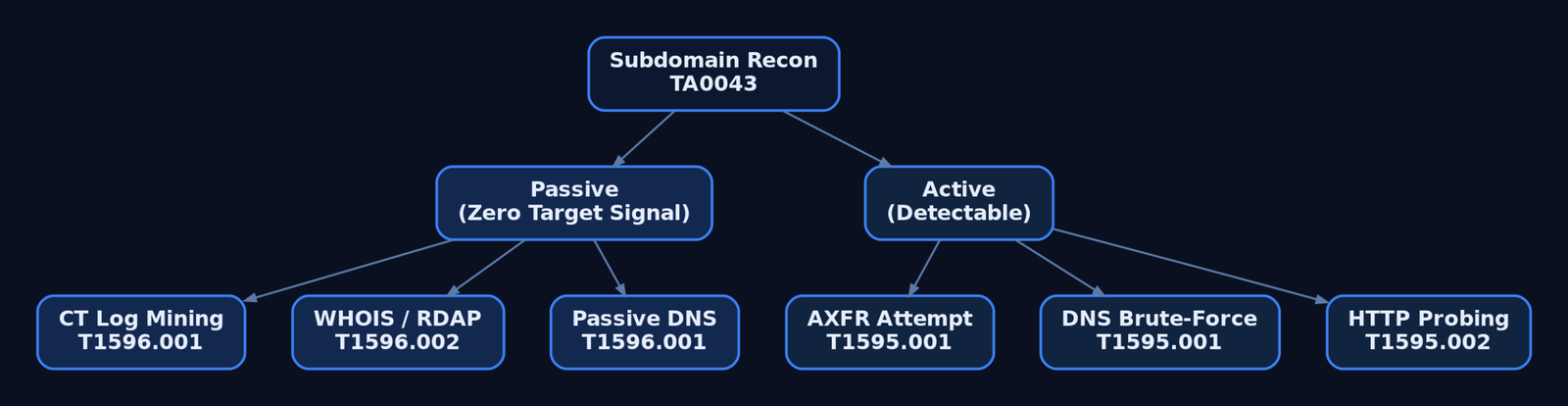
All techniques below fall under MITRE’s Reconnaissance tactic (TA0043). Run them only inside an authorized scope.
2. DNS Primer for Red Teamers: Records, Zones, and Resolvers
DNS resolution flows through a chain: a recursive resolver queries the root, then the TLD nameservers, then the authoritative NS for the zone. The authoritative server holds the records that matter to recon. Each record type leaks distinct intelligence.
| Record | Function |
|---|---|
A / AAAA | IPv4 / IPv6 address mapping for a hostname |
CNAME | Canonical name alias — critical for subdomain takeover identification |
MX | Mail exchange — reveals mail infrastructure and phishing pivot targets |
NS | Authoritative nameserver — identifies zone ownership and AXFR targets |
TXT | Freeform text — SPF (v=spf1), DKIM, DMARC (v=DMARC1), verification tokens often expose third-party services |
SOA | Start of Authority — primary NS, contact email, serial, refresh, retry, expire, minimum TTL |
PTR | Reverse DNS — maps IP → hostname, used in reverse-range sweeps |
SRV | Service locator — reveals app-layer services (_ldap._tcp, _sip._tcp) |
Enumerate record types directly with dig:
dig A target.com +short
dig NS target.com +short
dig MX target.com +short
dig TXT target.com +short          # SPF/DMARC reveal third-party SaaS
dig SOA @ns1.target.com target.com
TXT recon is high-value: SPF includes (include:_spf.salesforce.com) and verification tokens fingerprint exactly which cloud and SaaS providers an organization uses.
3. Zone Transfer Attacks (AXFR/IXFR): When DNS Gives It All Away
A zone transfer exists so a secondary nameserver can replicate a zone from the primary. A full transfer is DNS query type AXFR; an incremental transfer is IXFR. If an authoritative server answers an AXFR from an unauthorized client, it dumps the entire zone — every record, in one transaction.
dig axfr @ns1.target.com target.comA correctly hardened server returns Transfer failed. or a refusal. A misconfigured one returns the full record set. dnsrecon automates the test across all discovered nameservers:
dnsrecon -d target.com -t axfrMost modern configurations restrict AXFR to whitelisted secondary IPs, so success is rare — but the cost of the check is one query, and a hit collapses the entire enumeration phase into a single response.
4. Certificate Transparency: The Unintentional Subdomain Registry
Certificate Transparency (CT), defined in RFC 6962, is an open framework of public append-only logs recording every certificate issued by publicly trusted CAs. Browsers require that each certificate be logged to at least two CT logs before they accept it. The side effect: a comprehensive, searchable record of every subdomain any certificate ever covered.
Two fields carry the intelligence: the Common Name (CN) and the Subject Alternative Names (SANs). SANs are the modern standard for declaring which domains a certificate covers, and a single certificate can list dozens of subdomains. crt.sh exposes both through its name_value field.
Query the JSON API with a % wildcard prefix and extract uniques:
import requests

def crtsh_subdomains(domain):
    url = f"https://crt.sh/?q=%.{domain}&output=json"
    r = requests.get(url, timeout=30)
    subs = set()
    for entry in r.json():
        for name in entry["name_value"].splitlines():
            subs.add(name.lstrip("*.").lower())   # strip wildcard prefix
    return sorted(subs)

for s in crtsh_subdomains("target.com"):
    print(s)
For large zones, query the backing PostgreSQL database directly — faster and not rate-limited like the web frontend:
import psycopg2

conn = psycopg2.connect(host="crt.sh", port=5432, dbname="certwatch", user="guest")
cur = conn.cursor()
cur.execute("""
    SELECT ci.NAME_VALUE FROM certificate_identity ci
    WHERE ci.NAME_TYPE = 'dNSName'
    AND reverse(lower(ci.NAME_VALUE)) LIKE reverse(lower(%s));
""", ("%.target.com",))

subs = {row[0].lstrip("*.").lower() for row in cur.fetchall()}
print("\n".join(sorted(subs)))
NAME_TYPE = 'dNSName' filters to DNS SANs only. Other CT aggregators include Censys (search.censys.io), Facebook CT (developers.facebook.com/tools/ct/), and the Google Transparency Report. CT logs ingest within minutes of issuance; crt.sh and Certspotter typically surface new certificates within a few hours.

5. WHOIS, RDAP, and ASN Enumeration: Mapping the IP Estate
WHOIS data is held by Regional Internet Registries (RIRs) responsible for allocating domain names and IP resources. RDAP (Registration Data Access Protocol, RFC 7480) is the modern JSON-based successor. Both reveal registrar, creation/expiry dates, nameservers, and registrant organization.
whois target.com                  # registrar, NS, creation date, registrant org
curl -s https://rdap.verisign.com/com/v1/domain/target.com | jq '.nameservers, .entities'
The entities and nameservers arrays in RDAP output map cleanly to the org and infrastructure you correlate elsewhere. From the registrant org you pivot to ASN enumeration via RIPE/ARIN to discover owned IP blocks, then run reverse PTR sweeps across those ranges to recover hostnames not present in any forward record.
6. Passive DNS Aggregation: Intelligence Without Touching the Target
Passive DNS datasets store historical resolution data harvested by third parties. Querying them yields subdomains without your operator ever touching the target’s infrastructure — zero target-side signal.
| Tool | Role |
|---|---|
subfinder | Passive OSINT aggregator across CT logs, passive DNS, APIs |
amass (enum) | Deep multi-source enumeration; passive mode plus ASN enumeration |
theHarvester | OSINT gathering for emails, names, subdomains, IPs, URLs from public sources |
bbot | Recon framework that correlates infrastructure relationships, not just names |
Primary data sources include PassiveTotal/RiskIQ, VirusTotal, SecurityTrails, Shodan, and Censys. Most require API keys configured in the tool’s provider file.
subfinder -d target.com -all -o subs_passive.txt
amass enum -passive -d target.com -o subs_amass.txt
theHarvester -d target.com -b crtsh,bing,duckduckgo
amass is often misunderstood but offers unmatched depth when configured correctly; its passive mode remains a valid quiet alternative to active collection.
7. Active DNS Brute-Force: Wordlists, Resolvers, and Wildcard DNS
Active techniques directly interact with the target’s DNS infrastructure. The core mechanic: iterate a wordlist, prepend each word as a label (dev.target.com), issue an A/AAAA query, and record responses.
| Tool | Primary Mechanic |
|---|---|
massdns | High-throughput async resolver via custom resolver list |
puredns | massdns wrapper with wildcard detection and deduplication |
shuffledns | massdns brute-forcer with valid-resolver shuffling |
dnsx | DNS probing and record-type enumeration |
gobuster dns | Wordlist DNS brute force |
dnsenum | Zone transfer attempts plus brute-force |
The critical hazard is wildcard DNS: if *.target.com resolves to a catch-all IP, every guess returns a positive. Tools must detect and filter this. puredns handles wildcard detection and deduplication natively:
puredns bruteforce wordlist.txt target.com \
  -r resolvers.txt -w resolved.txt
Resolver selection matters — use a curated list of validated public resolvers (e.g., trickest/resolvers) so queries distribute and stay accurate. Wordlists drive coverage: SecLists dns-Jhaddix.txt and Commonspeak2 are standard. Distributing queries across many resolvers also smears per-source detection thresholds.
8. Permutation and Mutation: Finding What Brute-Force Misses
Brute-force only finds words in your list. Permutation generates variants of already-discovered subdomains — taking api and producing api-dev, api-v2, api-staging, internal-api. altdns and dnsgen perform this mutation.
PATTERNS = ["dev", "staging", "prod", "v2", "internal", "test"]

def mutate(known_subs, base):
    out = set()
    for host in known_subs:
        label = host.replace(f".{base}", "")
        for p in PATTERNS:
            out.add(f"{label}-{p}.{base}")   # api -> api-dev.target.com
            out.add(f"{p}-{label}.{base}")   # api -> dev-api.target.com
    return out

# feed mutations back into dnsx for resolution
Pipe the generated candidates straight into dnsx to resolve only the survivors. Permutation routinely surfaces staging hosts that follow internal naming conventions no public wordlist contains.
9. Chaining It Together: A Full Enumeration Workflow
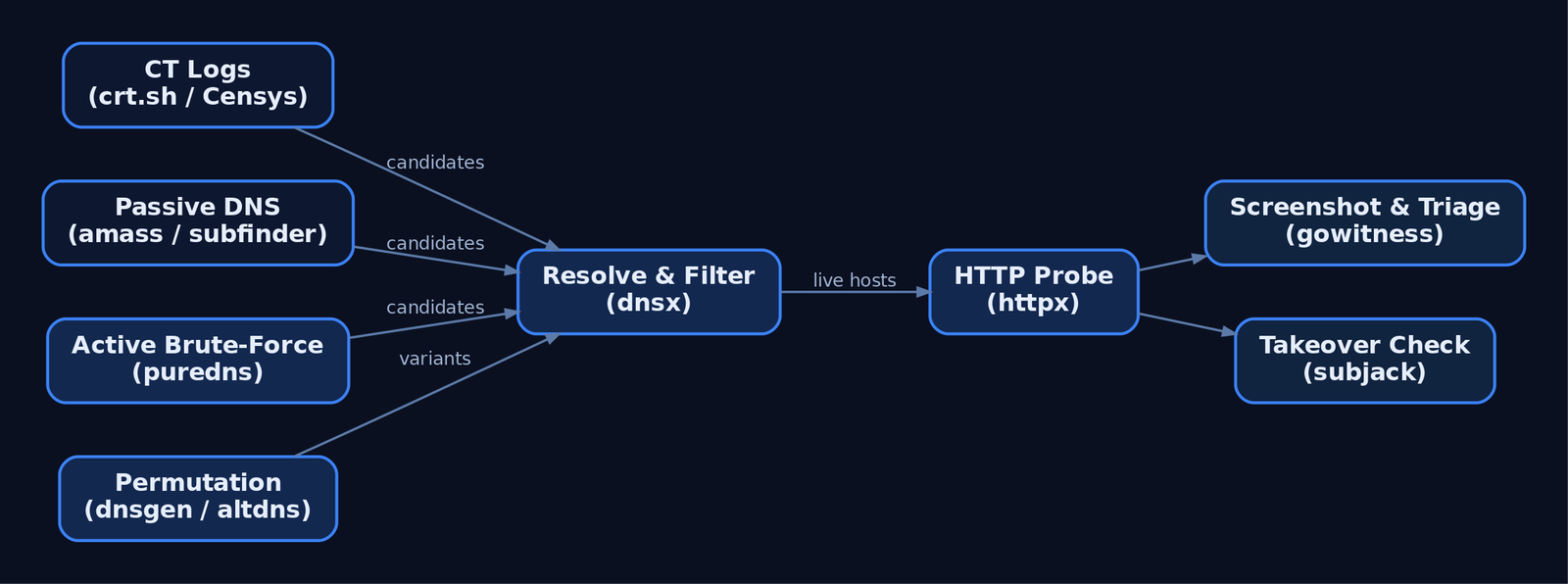
The value is in the pipeline. Aggregate names, resolve them, probe live services, then validate. Each stage adds a column of intelligence:
subfinder -d target.com -o subs.txt                       # passive aggregation
dnsx -l subs.txt -a -resp -o resolved.txt                 # keep only resolvers
httpx -l resolved.txt -title -status-code -tech-detect \
      -o live.txt                                          # live HTTP fingerprint
subfinder supplies the candidate set, dnsx discards dead names and records the answers, and httpx confirms which hosts serve HTTP, their titles, status codes, and detected technologies. Downstream, aquatone or gowitness screenshot each live host for triage at scale, and subjack checks for takeover. CT logs and passive DNS feed the top of the funnel; active brute-force and permutation widen it; HTTP probing and screenshotting prioritize what to investigate.
10. Subdomain Takeover: From Dangling CNAME to Claimed Asset
Enumeration frequently uncovers dangling CNAMEs — a subdomain whose CNAME points to a deprovisioned cloud service (GitHub Pages, Heroku, AWS S3, Azure, Fastly). If the operator can re-register that external resource, they serve content from the victim’s trusted subdomain. This is the primary takeover vector.
subjack fingerprints CNAME chains against known-vulnerable service responses:
subjack -w resolved.txt -t 100 -timeout 30 \
        -c fingerprints.json -v
A positive result means a subdomain’s CNAME chain terminates at an unclaimed external resource. In an authorized engagement, validate the finding against the can-i-take-over-xyz reference list and report it through responsible disclosure — do not claim the resource unless the rules of engagement explicitly permit proof-of-concept takeover.
11. Common Attacker Techniques
| Technique | Description |
|---|---|
| Zone transfer (AXFR) | Dump an entire zone from a misconfigured authoritative NS in one query |
| CT log mining | Harvest CN/SAN fields to recover the full historical subdomain namespace |
| Passive DNS query | Recover subdomains from third-party resolution history with zero target contact |
| DNS brute-force | Resolve a wordlist of guessed labels against the target’s resolvers |
| Permutation mutation | Generate naming variants of known hosts to find staging/internal services |
| Reverse PTR sweep | Map owned ASN/IP blocks back to hostnames |
| Subdomain takeover | Claim a deprovisioned cloud resource behind a dangling CNAME |
The progression matters operationally: CT logs, WHOIS/RDAP, and passive DNS generate zero target-side signal, while AXFR, brute-force, and HTTP probing are increasingly noisy and detectable.
12. Defensive Strategies & Detection
CT mining, WHOIS/RDAP, and passive DNS queries occur entirely outside the target’s infrastructure and generate no SIEM-visible events at collection time. Detection therefore concentrates on the active phases.
| Activity | Signal Generated |
|---|---|
| AXFR attempt | Single large TCP/53 transaction to authoritative NS; refusals still log |
| DNS brute-force | High-volume NXDomain responses from one source IP in a short window |
| CT / WHOIS / passive DNS | None — third-party or public registry |
Active resolution (massdns) | High NXDomain rate; resolver-distributed queries may evade per-source detection |
HTTP probing (httpx) | Web server access logs; WAF hits on rapid host sweeps |
Sysmon and ETW
Sysmon Event ID 22 (DNSEvent) logs DNS queries made through the Windows DnsQuery_* API calls in dnsapi.dll, supported on Windows 8.1 and above via ETW. This catches recon tooling run from a compromised Windows host, recording QueryName, QueryStatus, and QueryResults. The underlying provider is Microsoft-Windows-DNS-Client (GUID {1C95126E-7EEA-49A9-A3FE-A378B03DDB4D} — verify against current Windows documentation).
Network and Resolver-Side Detection
- Flag source IPs generating more than N
NXDomainresponses per minute; brute-force tools generate hundreds per second. - DNS Response Policy Zones (RPZ) and authoritative server logs capture all inbound queries, including refused AXFR attempts.
- Restrict AXFR with
allow-transfer(BIND) or transfer ACLs (Windows DNS Server) to whitelisted secondaries only. - Enable Response Rate Limiting (RRL) to slow brute-force resolution.
Sigma Rule (DNS brute-force via Sysmon EID 22)
title: DNS Subdomain Brute-Force (High NXDomain Rate)
logsource:
  product: windows
  category: dns_query          # maps to Sysmon EventID 22
detection:
  selection:
    QueryStatus: 'NXDOMAIN'    # DNS_ERROR_RCODE_NAME_ERROR (9003)
  condition: selection | count() by SourceIp > 200 within 1m
fields:
  - QueryName
  - QueryStatus
  - QueryResults
  - Image
level: medium
CT Log Monitoring (Defensive)
Defenders can flip CT against the attacker: subscribe to Certspotter (SSLMate), crt.sh alerts, or the Facebook CT monitoring API to receive near-real-time alerts on certificates newly issued for your domain tree. Combined with regular self-enumeration to detect unauthorized subdomain creation, dangling-CNAME audits, and accurate published SPF/DMARC/DKIM TXT records, this closes most of the gaps recon exploits.
13. Tools for Subdomain Enumeration Analysis
| Tool | Description | Link |
|---|---|---|
dig / dnsrecon | Record enumeration and AXFR testing | — |
crt.sh | Certificate Transparency search and JSON/PostgreSQL API | crt.sh |
subfinder | Passive multi-source subdomain aggregation | github.com |
amass | Deep enumeration plus ASN mapping | github.com |
puredns / massdns | Wildcard-aware high-throughput brute-force | github.com |
dnsx / httpx | Resolution and live HTTP probing | github.com |
theHarvester | OSINT email/host/IP gathering | github.com |
subjack | Subdomain takeover fingerprinting | github.com |
Censys / Shodan | Internet-wide scan and certificate databases | search.censys.io |
Certspotter | Defensive CT certificate monitoring | sslmate.com |
14. MITRE ATT&CK Mapping
| Technique | MITRE ID | Detection |
|---|---|---|
| Active Scanning | T1595 | High NXDomain rate; resolver and firewall logs |
| Active Scanning: Scanning IP Blocks | T1595.001 | Reverse PTR sweeps across ASN ranges |
| Gather Victim Network Information | T1590 | Umbrella — DNS/network infrastructure gathering |
| Gather Victim Network Information: DNS | T1590.002 | AXFR attempts logged at authoritative NS |
| Search Open Technical Databases | T1596 | No target-side signal; out-of-band collection |
| Open Technical Databases: DNS/Passive DNS | T1596.001 | Third-party passive DNS — no local visibility |
| Open Technical Databases: WHOIS | T1596.002 | Public registry query — no local visibility |
| Open Technical Databases: Scan Databases | T1596.005 | CT log / Shodan / Censys mining; verify against live ATT&CK page |
All map to Reconnaissance (TA0043). The defining split: T1595 is active and detectable, while the T1596 family is passive and invisible to the target at collection time.
Summary
- External DNS attack surface is far larger than what an organization advertises, and missed subdomains are missed attack surface.
- DNS records, AXFR misconfigurations, and Certificate Transparency CN/SAN fields each leak distinct, attack-relevant intelligence about hosts and infrastructure.
- Passive sources (CT logs, WHOIS/RDAP, passive DNS) generate zero target-side signal; active brute-force and HTTP probing are detectable through high
NXDomainrates and access logs. - Detect active recon via Sysmon Event ID 22 DNS query logging, resolver
NXDomainrate thresholds, and RPZ/AXFR refusal logs. - Defend by restricting AXFR, removing dangling CNAMEs, rate-limiting resolvers, and monitoring your own domains in CT logs with Certspotter for near-real-time certificate alerts.
Related Tutorials
- OSINT for People and Credentials: LinkedIn, Breach Data, and Email Harvesting
- Passive OSINT: Mapping the Target Without Touching It
- Phishing Campaign Design: Pretexting, Lures, and Target Profiling
- Building a Red Team Lab: Infrastructure, VMs, and C2 Setup
- OPSEC Principles for Red Teamers: Staying Undetected
References
- MITRE ATT&CK: Gather Victim Network Information: DNS (T1590.002)
- MITRE ATT&CK: Search Open Technical Databases: DNS/Passive DNS (T1596.001)
- MITRE ATT&CK: Search Open Technical Databases: Digital Certificates (T1596.003)
- MITRE ATT&CK: Search Open Technical Databases: Scan Databases (T1596.005)
- RFC 9162: Certificate Transparency Version 2.0 (IETF)
- RFC 6962: Certificate Transparency (IETF RFC Editor)