Windows Scheduler Internals: Priority Levels, Quantum, and Thread Selection
Objective: Understand how the Windows kernel selects, preempts, and rotates threads — the 32-level priority model, dispatcher ready queues, quantum accounting, boost/decay logic, and the multiprocessor dispatch path — so defenders can baseline normal scheduling behavior and detect attacker manipulation of priority and affinity.
1. The Scheduling Contract: Threads, Not Processes
Windows schedules threads, not processes. Every executable unit of work is represented by a KTHREAD (the Thread Control Block embedded in ETHREAD.Tcb), and the scheduler operates exclusively against that structure. A process supplies the address space, the base priority class, the quantum reset value, and the affinity mask — but it never itself runs on a CPU.
Scheduling is preemptive and priority-based with round-robin at the highest priority. Two rules dominate:
- The thread with the highest priority in the Ready state always wins.
- If a running thread has a lower priority than a newly Ready thread, the running thread is immediately preempted at the next dispatch point.
Quantum only matters as a tiebreaker between threads of the same highest priority — it does not arbitrate across priority levels.
2. The 32-Level Priority Model and Priority Classes
Priorities range from 0 (zero-page thread only) to 31 (highest real-time). The space splits into two bands with very different semantics.
| Range | Type | Description |
|---|---|---|
0 | Zero-page thread | Reserved for the memory zero-page thread |
1–15 | Dynamic (variable) | Normal user-mode threads; subject to boost/decay |
16–31 | Real-time | Fixed priorities; no boost, no decay; drivers and RT tasks |
Win32 exposes two functions to set scheduling parameters: SetPriorityClass on the process and SetThreadPriority on the thread. The two combine to produce the thread’s base priority in the kernel.
SetPriorityClass constant | Class | Base priority range |
|---|---|---|
IDLE_PRIORITY_CLASS | Idle | 1–6 |
BELOW_NORMAL_PRIORITY_CLASS | Below Normal | 4–9 |
NORMAL_PRIORITY_CLASS | Normal | 6–10 |
ABOVE_NORMAL_PRIORITY_CLASS | Above Normal | 8–13 |
HIGH_PRIORITY_CLASS | High | 11–15 |
REALTIME_PRIORITY_CLASS | Real-time | 16–31 |
Crossing into the real-time band (>=16) requires the SeIncreaseBasePriorityPrivilege privilege. NT-native equivalents are NtSetInformationThread (information class ThreadBasePriority = 3) and ZwSetInformationProcess.
// Pin this process and one of its threads to real-time scheduling.
SetPriorityClass(GetCurrentProcess(), REALTIME_PRIORITY_CLASS);
SetThreadPriority(GetCurrentThread(), THREAD_PRIORITY_TIME_CRITICAL);
// Base priority now sits at 31 — preempts essentially everything in user mode.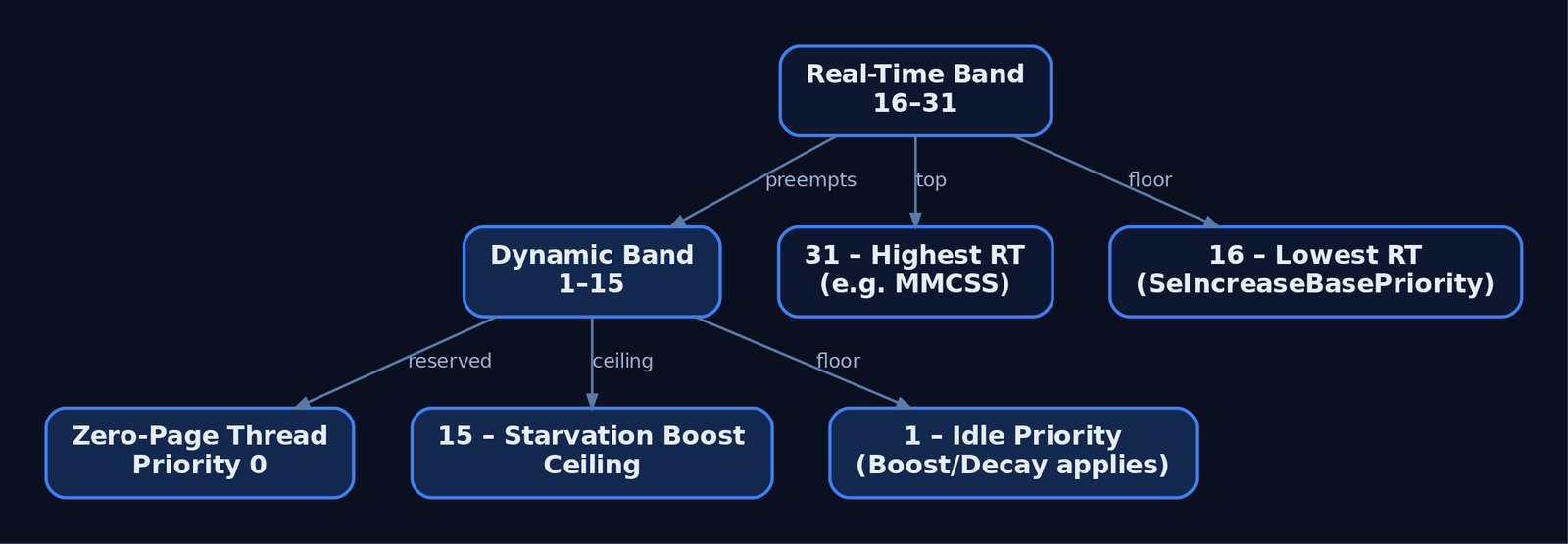
3. Key Kernel Structures
Three structures carry the scheduler’s state: _KTHREAD per thread, _KPROCESS per process, and _KPRCB per logical processor.
_KTHREAD (Thread Control Block)
typedef struct _KTHREAD {
    DISPATCHER_HEADER  Header;          // +0x000 dispatcher object header
    // ...
    ULONGLONG          QuantumTarget;   // +0x020 quantum expiration target
    PVOID              InitialStack;    // +0x028 top of kernel stack
    // ...
    volatile UCHAR     State;           // Ready/Running/Waiting/...
    BOOLEAN            Preempted;
    UCHAR              DeferredProcessor;
    SCHAR              Priority;        // current (dynamic) priority
    ULONG              WaitTime;
    LIST_ENTRY         WaitListEntry;
    SINGLE_LIST_ENTRY  SwapListEntry;
    KSPIN_LOCK         ThreadLock;
} KTHREAD, *PKTHREAD;
The embedded DISPATCHER_HEADER is the same header found at the top of every waitable kernel object and is what ties the thread into wait queues.
_KPRCB (Kernel Processor Control Block)
Each logical processor has a KPCR; inside it sits a KPRCB carrying that CPU’s scheduling state.
typedef struct _KPRCB {
    // ...
    PKTHREAD    CurrentThread;       // executing thread on this CPU
    PKTHREAD    NextThread;          // pending preemption candidate
    PKTHREAD    IdleThread;          // per-CPU idle thread
    LIST_ENTRY  ReadyListHead[32];   // dispatcher ready queues (per priority)
    ULONG       ReadySummary;        // bitmask of non-empty ready queues
    // ...
} KPRCB, *PKPRCB;
_KPROCESS (Process Control Block)
Embedded as EPROCESS.Pcb, it provides the per-process scheduling defaults:
| Field | Purpose |
|---|---|
BasePriority | Process base priority; seeds new threads |
QuantumReset | Quantum value assigned to new threads |
ThreadListHead | Doubly-linked list of all _KTHREADs in the process |
ReadyListHead | Ready-but-swapped-out threads |
4. Dispatcher Ready Queues and ReadySummary
The Dispatcher Ready Queue is the per-CPU array KPRCB.ReadyListHead[32] — one LIST_ENTRY per priority level. Each non-empty entry is a FIFO of KTHREAD structures in the Ready state.
To avoid scanning all 32 queues, the kernel maintains a 32-bit ReadySummary bitmask: bit n is set when ReadyListHead[n] is non-empty. The dispatcher then selects the next thread in O(1):
// Conceptual scheduler inner loop (pseudo-code; not a real symbol).
ULONG mask = Prcb->ReadySummary;
if (mask) {
    ULONG idx;
    _BitScanReverse(&idx, mask);              // highest set bit = top priority
    PKTHREAD next = CONTAINING_RECORD(
        RemoveHeadList(&Prcb->ReadyListHead[idx]),
        KTHREAD, WaitListEntry);
    if (IsListEmpty(&Prcb->ReadyListHead[idx]))
        Prcb->ReadySummary &= ~(1u << idx);
    return next;
}
return Prcb->IdleThread;
5. Quantum Mechanics
A quantum is the slice of CPU time a thread is allowed to consume before the scheduler considers rotating it. WMI exposes two relevant properties: QuantumLength (clock ticks per quantum) and QuantumType (fixed vs. variable). Windows client SKUs default to variable quantum, giving the foreground process longer slices; server SKUs default to fixed long quantum to favor batch throughput.
Internally, quantum is tracked in units of 3 per clock tick — a “full” quantum is 18 units (client) or 36 units (server). KTHREAD.QuantumTarget holds the cycle target; on each clock tick, the kernel decrements and, on expiry, transfers control to KiQuantumEnd().
The foreground boost is governed by the registry value:
HKLM\SYSTEM\CurrentControlSet\Control\PriorityControl\Win32PrioritySeparationThe lowest six bits encode foreground-vs-background quantum behavior; bits 0–1 specifically choose the foreground boost level (0 none, 1 medium, 2 high). The kernel mirrors this into the global PsPrioritySeparation.
Internal scheduler routines you will see in symbols:
| Function | Purpose |
|---|---|
KiQuantumEnd | Invoked at clock interrupt when quantum expires |
KiSelectNextThread | Selects next Ready thread for the current CPU |
KiDeferredReadyThread | Places a thread in DeferredReady before final dispatch |
KxQueueReadyThread | Inserts a thread into the per-CPU ready queue |
KiReadyThread | Transitions a thread to the Ready state |
KiSwapThread / KiSwapContext | Performs the actual context switch |
6. Thread Selection: The Dispatch Path
A typical preemption follows this path:
- Clock interrupt fires on the local CPU.
KiQuantumEnd()decrementsKTHREAD.Quantum; if it has reached zero, the thread is moved out of Running.KiSelectNextThread()consultsKPRCB.ReadySummaryto find the highest non-empty queue.- The chosen thread is removed from
ReadyListHead[idx]and routed throughKiDeferredReadyThread(). KxQueueReadyThread()places the preempted thread back intoReadyListHead[oldPrio](FIFO tail) so round-robin holds within its level.KiSwapThread()→KiSwapContext()saves outgoing register state, loads the incoming thread’s stack and registers, and returns into the new thread.
If a wake event makes a higher-priority thread Ready while another thread is Running, the dispatcher instead writes the candidate into KPRCB.NextThread, raises an IPI on the target CPU, and the preemption fires on return-from-interrupt — without waiting for quantum expiry.

7. Priority Boosts and Decay
Dynamic-band threads (1–15) do not stay at their base priority. The kernel temporarily boosts them in response to events and decays the boost as they consume CPU.
| Event | Boost |
|---|---|
| I/O completion (keyboard / mouse) | +6 |
| I/O completion (disk / network) | +1 |
| Foreground window activation | controlled by PsPrioritySeparation |
| Wait satisfied on executive event | +1 |
| Starvation avoidance (Balance Set Manager) | up to 15 for one quantum |
| Decay (CPU-bound thread at quantum end) | −1 toward base |
The Balance Set Manager (KeBalanceSetManager) periodically scans ready queues and elevates threads that have been Ready but never running for ~4 seconds to priority 15 for a single quantum — preventing indefinite starvation by higher-priority work. Real-time threads (16–31) are never boosted or decayed; their priority is exactly what was set.
8. Multiprocessor Scheduling, Affinity, and NUMA
Each CPU has its own ready queues, so dispatch decisions are mostly local. To preserve cache and NUMA locality, the scheduler picks an ideal processor per thread and prefers to dispatch on that CPU, falling back to other CPUs in the thread’s affinity mask when the ideal is busy.
// Pin a worker thread to CPU 2, with CPU 2 as its ideal processor.
DWORD_PTR mask = (DWORD_PTR)1 << 2;
SetThreadAffinityMask(hThread, mask);
SetThreadIdealProcessor(hThread, 2);
For >64 logical processors, threads belong to processor groups, set via SetThreadGroupAffinity. Kernel-mode equivalents are KeSetSystemAffinityThread and KeSetIdealProcessorThread. Misconfigured affinity is a real performance and detection hazard — a thread pinned off-node walks remote memory and pollutes another CPU’s cache.
9. Thread States: The Full State Machine
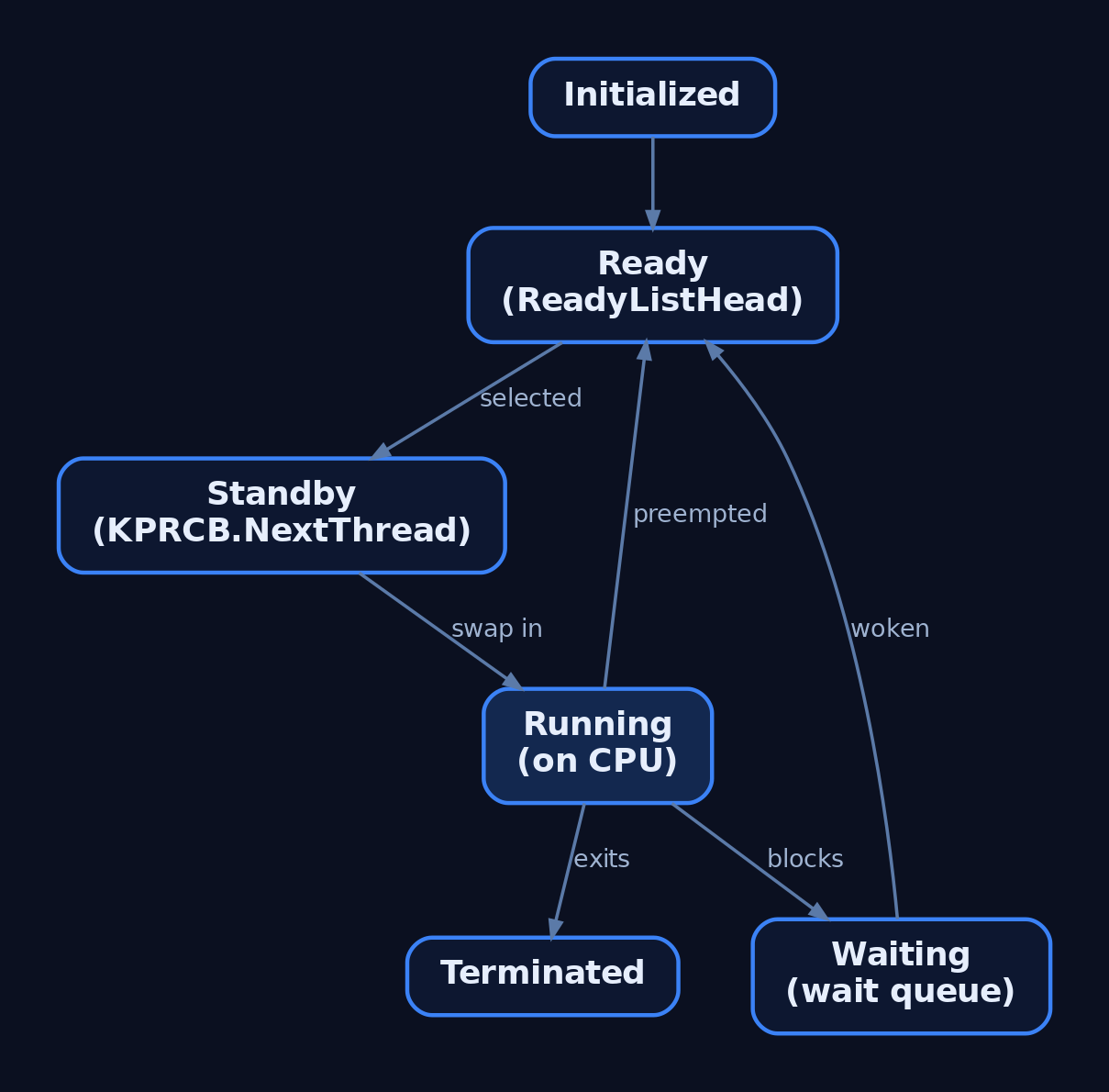
The KTHREADSTATE enum tracks every transition. The values you will see in KTHREAD.State:
| State | Meaning |
|---|---|
Initialized | Thread structure created, not yet schedulable |
Ready | Schedulable; sitting on ReadyListHead[priority] |
Standby | Selected as KPRCB.NextThread, about to run |
Running | Currently executing on a CPU |
Waiting | Blocked on a dispatcher object |
Transition | Wait satisfied, but kernel stack is paged out |
DeferredReady | Will be made Ready on a specific CPU |
Terminated | Final state before structure teardown |
A normal cycle looks like Initialized → Ready → Standby → Running → Waiting → Ready …. KPRCB.NextThread is non-NULL exactly while a target CPU has a Standby thread queued.
10. Observing the Scheduler with WinDbg and ETW
Live kernel inspection in WinDbg:
0: kd> !pcr                          ; current processor control region
0: kd> !prcb                         ; current processor control block
0: kd> dt nt!_KPRCB CurrentThread NextThread ReadySummary @$prcb
0: kd> dt nt!_KTHREAD Priority Quantum State Preempted @$thread
0: kd> !ready                        ; all ready threads, sorted by priority
0: kd> !thread <addr> 1f             ; full thread state including stack
The ReadyListHead walk per-priority:
0: kd> dx -r1 ((nt!_KPRCB*)@$prcb)->ReadyListHead
0: kd> !list "-t nt!_KTHREAD.WaitListEntry.Flink -e -x \"dt nt!_KTHREAD @$extret Priority\" \
        ((nt!_KPRCB*)@$prcb)->ReadyListHead[15].Flink"
For live system-wide capture, use ETW:
xperf -on PROC_THREAD+LOADER+CSWITCH+DISPATCHER -stackwalk CSwitch
xperf -d sched.etl
The primary providers carrying scheduler telemetry:
| Provider | GUID | Key events |
|---|---|---|
Microsoft-Windows-Kernel-Process | {22FB2CD6-0E7B-422B-A0C7-2FAD1FD0E716} | CSwitch (36), ReadyThread (50) |
Microsoft-Windows-Kernel-Thread | {3D6FA8D1-FE05-11D0-9DDA-00C04FD7BA7C} | Thread create/terminate, priority change |
NT Kernel Logger | {9E814AAD-3204-11D2-9A82-006008A86939} | CSWITCH, DISPATCHER groups |
A user-mode helper to enumerate per-thread priority without OpenProcess:
import ctypes
from ctypes import wintypes

ntdll = ctypes.WinDLL("ntdll")
# SystemProcessInformation = 5; walks _SYSTEM_PROCESS_INFORMATION entries
# Each entry trails an array of SYSTEM_THREAD_INFORMATION with Priority/BasePriority.
buf = (ctypes.c_byte * (1024 * 1024))()
ret_len = wintypes.ULONG()
ntdll.NtQuerySystemInformation(5, buf, ctypes.sizeof(buf), ctypes.byref(ret_len))
# parse _SYSTEM_PROCESS_INFORMATION + _SYSTEM_THREAD_INFORMATION here
11. Common Attacker Techniques
Scheduler manipulation is rarely a standalone objective — it is a force multiplier for injection, evasion, and defense impairment.
| Technique | Description |
|---|---|
| Thread execution hijacking | OpenThread → SuspendThread → VirtualAllocEx + WriteProcessMemory → SetThreadContext → ResumeThread. Post-resume, attacker controls priority and CPU affinity of the hijacked thread. |
| Real-time priority abuse | Set malicious thread to THREAD_PRIORITY_TIME_CRITICAL under REALTIME_PRIORITY_CLASS (priority 31) to dominate the CPU and starve EDR scanners. Requires SeIncreaseBasePriorityPrivilege. |
| EDR/AV starvation | Open handles to defender process threads with THREAD_SET_INFORMATION and downgrade them via SetThreadPriority(THREAD_PRIORITY_IDLE) to delay real-time detection. |
| Affinity pinning for evasion | Pin malicious threads to a CPU not covered by an EDR’s per-CPU sampling profiler, or off-NUMA-node, to skew profilers and ETW stack walks. |
Win32PrioritySeparation tampering | Modify the registry value to alter foreground boost behavior, hurting interactive defensive tooling. |
| Quantum throttling via Job Objects | Apply JOB_OBJECT_CPU_RATE_CONTROL to constrain a defender process’s CPU budget. |

12. Defensive Strategies & Detection
Scheduler-level abuse is observable through ETW context-switch streams, sensitive-privilege auditing, registry auditing, and process-access telemetry. Sysmon alone is insufficient — pair it with kernel ETW.
| Sysmon Event ID | Name | Relevance |
|---|---|---|
1 | Process Create | Captures process priority class and parent lineage |
8 | CreateRemoteThread | Cross-process thread creation; often precedes priority manipulation |
10 | ProcessAccess | OpenThread with THREAD_SET_INFORMATION indicates intent to alter priority/context |
13 | RegistryValueSet | Modification of Win32PrioritySeparation and other PriorityControl values |
Critical Windows audit events:
4673— Sensitive Privilege Use. CatchesSeIncreaseBasePriorityPrivilegeinvocation, required for real-time priority.4656/4663— Handle/Object Access. Catches handles opened to thread objects withTHREAD_SET_INFORMATION.4657— Registry value modified. CatchesWin32PrioritySeparationchanges.4688— Process creation (with command-line auditing enabled).
Conceptual Sigma rule for unexpected real-time priority use:
title: Sensitive Privilege Use - SeIncreaseBasePriorityPrivilege from Non-System Process
logsource:
  product: windows
  service: security
detection:
  selection:
    EventID: 4673
    PrivilegeList|contains: 'SeIncreaseBasePriorityPrivilege'
  filter_system:
    SubjectUserSid:
      - 'S-1-5-18'   # LocalSystem
      - 'S-1-5-19'   # LocalService
      - 'S-1-5-20'   # NetworkService
  condition: selection and not filter_system
level: high
Hardening checklist:
- Restrict
SeIncreaseBasePriorityPrivilegevia Group Policy → User Rights Assignment to only the accounts that require it. - Audit
Win32PrioritySeparationwith Sysmon Event ID13or registry SACL → Event ID4657. - Baseline
CSwitchpriority distributions via ETW; alert on sustained user-mode threads scheduled at priority ≥ 16 outside an allowlist. - Deploy EDR that registers
PsSetCreateThreadNotifyRoutineandObRegisterCallbacksto observe thread creation, handle stripping, and priority changes in kernel. - Enclose untrusted code in Job Objects with
JobObjectCpuRateControlInformationand basic UI restrictions to prevent it from starving other processes.
13. Tools for Scheduler Analysis
| Tool | Description | Link |
|---|---|---|
| WinDbg (kernel) | !ready, !thread, !pcr, !prcb, dt nt!_KTHREAD/_KPRCB for live scheduler inspection | learn.microsoft.com |
| Windows Performance Recorder / xperf | Captures CSwitch, ReadyThread, DISPATCHER ETW events with stack walks | learn.microsoft.com |
| Windows Performance Analyzer | Visualizes CPU usage, context switches, and per-thread priority timelines | learn.microsoft.com |
| Process Hacker / System Informer | Live per-thread state, base priority, dynamic priority, ideal CPU, affinity mask | systeminformer.sourceforge.io |
| Process Explorer | Per-thread CPU, priority class, kernel/user stacks | sysinternals.com |
| Process Monitor | Captures Process Create, registry writes (Win32PrioritySeparation) | sysinternals.com |
| Sysmon | Events 1, 8, 10, 13 for thread creation, cross-process access, registry edits | sysinternals.com |
| Volatility 3 | Offline thread enumeration (windows.threads) and priority analysis from memory dumps | volatilityfoundation.org |
14. MITRE ATT&CK Mapping
| Technique | MITRE ID | Detection |
|---|---|---|
| Process Injection | T1055 | Sysmon 10 (ProcessAccess), ETW thread create with foreign-process parentage |
| Thread Execution Hijacking | T1055.003 | Sysmon 10 with THREAD_SET_INFORMATION / THREAD_SET_CONTEXT access; SuspendThread/ResumeThread pairs in EDR telemetry |
| Scheduled Task / Job | T1053 | Audit 4698 for task creation; monitor Job Object CPU-rate limits applied to defensive processes |
| Impair Defenses: Disable or Modify Tools | T1562.001 | Sysmon 10 against AV/EDR lsass.exe, MsMpEng.exe with THREAD_SET_INFORMATION; priority drops via ETW Microsoft-Windows-Kernel-Thread |
Note: ATT&CK does not currently track “Thread Priority Manipulation” as a standalone technique. Treat priority abuse as a sub-mechanism of
T1055.003andT1562.001.
15. Summary
- Windows is a preemptive, priority-based thread scheduler with 32 levels and per-CPU ready queues — priority always wins, quantum only rotates equal-priority threads.
- The dispatcher uses
KPRCB.ReadySummaryplusReadyListHead[32]to pick the next thread in O(1) via highest-set-bit scan. - Quantum is tracked in 3-unit-per-tick increments on
KTHREAD.QuantumTarget, with foreground boost governed byWin32PrioritySeparation/PsPrioritySeparation. - Dynamic threads (1–15) are subject to I/O, foreground, and starvation boosts plus decay; real-time threads (16–31) are not.
- Attackers abuse the scheduler via thread hijacking, real-time priority escalation, EDR starvation, and affinity pinning — detect via ETW
CSwitch, Sysmon8/10/13, and Event ID4673forSeIncreaseBasePriorityPrivilege.
Related Tutorials
- APCs: Asynchronous Procedure Calls and Thread Hijacking Surface
- IRQL Levels: Interrupt Request Priorities Explained
- Threads and the TEB (Thread Environment Block)
- Access Tokens and Privileges: The Kernel’s Security Context
- SIDs and Security Descriptors: Identity in Windows Security
References
- Scheduling Priorities – Win32 Apps | Microsoft Learn
- Priority Boosts – Win32 Apps | Microsoft Learn
- SetThreadPriority function (processthreadsapi.h) – Win32 Apps | Microsoft Learn
- Windows Kernel Internals: Thread Scheduling (Microsoft / U-Tokyo Lecture PDF)
- SetPriorityClass function (processthreadsapi.h) – Win32 Apps | Microsoft Learn