APT Profiling: How to Build a Comprehensive Adversary Profile from Open-Source Intelligence
Objective: Learn how to systematically collect, structure, and operationalize open-source intelligence into a complete, ATT&CK-mapped adversary profile — a defensible dossier that drives realistic adversary emulation, detection-gap analysis, and threat-informed defense.
1. What Is an Adversary Profile and Why Build One
An adversary profile is a structured dossier describing who a threat actor is, what they target, how they operate, and which tools and infrastructure they favor — all normalized to a shared taxonomy. It is the durable opposite of an IOC-only feed.
An IOC feed gives you hashes and IP addresses that expire in days. A profile captures the actor’s tactics, techniques, and procedures (TTPs), which change slowly and cost the adversary real effort to alter. A finished profile is the source artifact for three downstream activities:
- Adversary emulation — sequencing a real group’s TTPs into a test plan.
- Detection engineering — overlaying the profile against your sensor coverage to find gaps.
- Risk communication — translating actor capability and intent for leadership.
Threat intelligence comes in four flavors, and a good profile feeds all of them: strategic (executive risk), tactical (SOC TTPs), operational (incident-response context), and technical (machine-readable indicators).
2. The Intelligence Lifecycle Applied to APT Profiling
Cyber threat intelligence is produced through a six-phase lifecycle. Profiling is just this lifecycle scoped to a single actor.
| Phase | Profiling Activity |
|---|---|
| Planning / Direction | Define the intelligence requirement: “Which APT threatens our sector, and can we detect its TTPs?” |
| Collection | Gather vendor reports, advisories, passive DNS, malware samples |
| Processing | Normalize raw reports; extract candidate TTPs and IOCs |
| Analysis | Map to ATT&CK, assess confidence, resolve naming conflicts |
| Dissemination | Publish as STIX bundle, Navigator layer, and emulation plan |
| Feedback | Refine the profile as new reporting and red-team results arrive |
Start with an explicit Priority Intelligence Requirement (PIR) or Request for Information (RFI). Without a scoped question, collection sprawls and the profile never converges.
3. Analytical Frameworks: Diamond Model, Kill Chain, and ATT&CK
Three frameworks provide complementary lenses. Use all three — they are not interchangeable.
| Framework | Role in APT Profiling |
|---|---|
| MITRE ATT&CK | Maps observed TTPs to a standardized taxonomy for comparison and emulation |
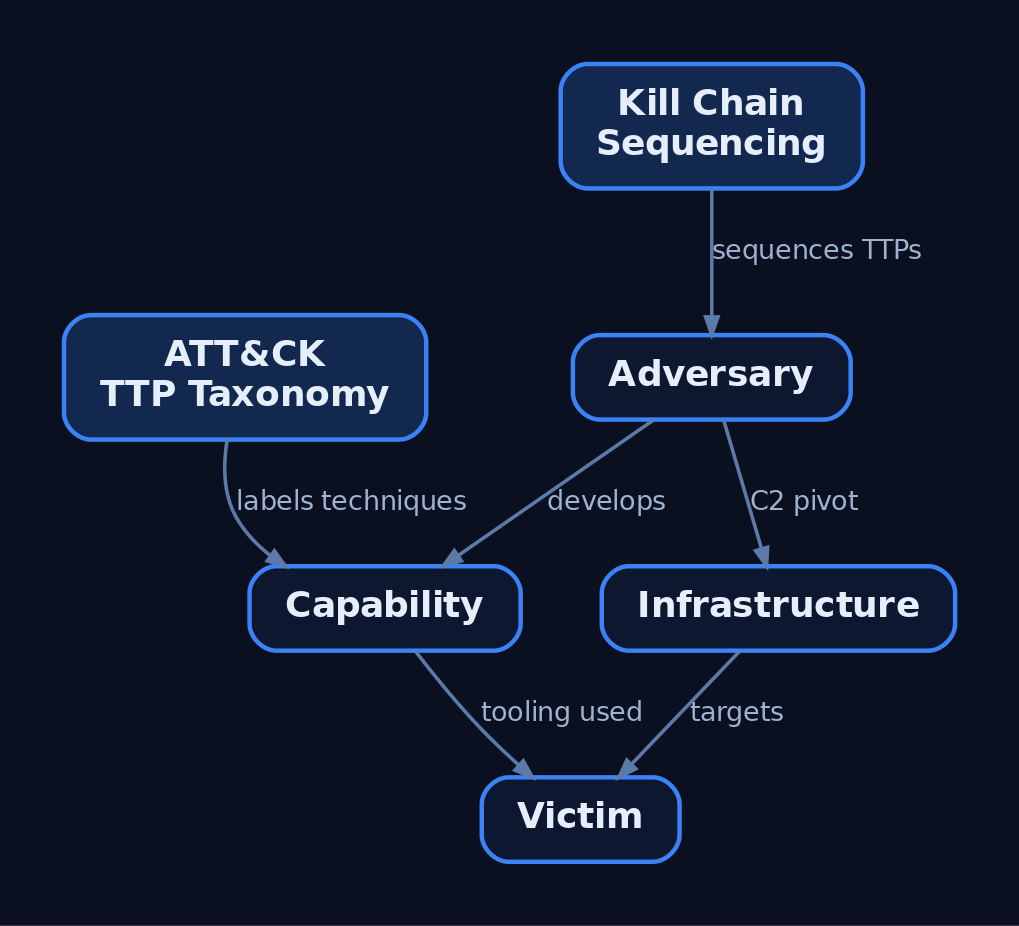
| Cyber Kill Chain (Lockheed Martin) | Sequences behaviors across reconnaissance, weaponization, delivery, exploitation, installation, command and control, and actions on objectives |
| Diamond Model | Relates the four core intrusion elements: Adversary, Infrastructure, Capability, Victim |
The Diamond Model is the pivoting engine. Each intrusion event has four interconnected vertices, and the relationships between them drive investigation. The adversary–infrastructure edge reveals how operators stand up C2; the victim–capability edge exposes which tooling is used against which target. Unlike the sequential Kill Chain, the Diamond Model excels at attribution and visualizing relationships — pivot from a known malware sample to the infrastructure that served it, then to other victims of the same infrastructure.
ATT&CK then supplies the granular vocabulary that makes those pivots comparable across reports and across teams.
4. OSINT Collection: Primary Source Taxonomy
OSINT spans news media, social media, public records, government publications, academic research, commercial data, and the deep/dark web. For APT profiling, prioritize these primary source classes and score each for reliability.
| Source Type | Description |
|---|---|
| Vendor threat reports | Mandiant, CrowdStrike Intelligence, Microsoft MSTIC, Secureworks CTU, Elastic Security Labs, SpecterOps |
| Government advisories | CISA advisories (often with embedded ATT&CK mappings), NSA/CISA joint advisories, FBI Flash |
| MITRE ATT&CK Groups | Curated, attributed group profiles at attack.mitre.org/groups/ |
| Malware repositories | VirusTotal, MalwareBazaar, Hybrid Analysis for tooling attribution |
| Infrastructure / passive DNS | Shodan, Censys, DomainTools, WHOIS/RDAP, certificate transparency logs |
| Code repositories | GitHub/GitLab for leaked tooling and infrastructure-as-code patterns |
Infrastructure pivoting is largely passive. The example below queries Shodan for hosts matching a documented C2 fingerprint — a benign illustration of the adversary–infrastructure edge.
import shodan

API_KEY = "YOUR_API_KEY"      # placeholder — never commit real keys
api = shodan.Shodan(API_KEY)

# Pivot on a publicly documented C2 framework fingerprint
query = 'product:"Cobalt Strike Beacon" ssl.cert.subject.CN:"example-c2.test"'
results = api.search(query)

for host in results["matches"]:
    print(host["ip_str"], host.get("port"), host.get("org"))
Rate every source with the Admiralty Code: source reliability (A–F) and information credibility (1–6). A single vendor blog is B2 at best; corroboration across two independent vendors plus a government advisory raises confidence.
5. Building the Adversary Dossier
Capture the profile in a fixed schema so that every actor is described the same way and TTP heatmaps are comparable. Use this template as your reference document.
| Field | Content |
|---|---|
Actor ID | Canonical tracker (e.g., ATT&CK G0016) |
Aliases | Associated group names and vendor designations |
Nexus | Suspected country of origin / state sponsorship |
Motivation | Espionage, financial, ideological, destructive |
Active Since | First reported activity date |
Targeting | Sectors, geographies, victim profile |
Tooling | Malware families and offensive tools |
Infrastructure Patterns | Registrar habits, ASN clusters, cert reuse, C2 conventions |
ATT&CK Techniques | Normalized technique-ID list with frequency |
IOCs | Hashes, domains, IPs (with confidence and decay date) |
Confidence | Admiralty rating per claim |
Sources | Cited reports with retrieval dates |
ATT&CK’s Group object aligns directly with several of these fields, so anchor your dossier to it.
| Field | Description |
|---|---|
Group ID | Unique identifier (e.g., G0016 for APT29) |
Associated Groups | Publicly reported overlapping names (formerly “Aliases”) |
Description | Activity dates, suspected attribution, targeted industries |
Techniques Used | Techniques with a note on how the group used each |
Software | Malware and tool families attributed to the group |
Campaigns | Named, time-bounded intrusion clusters |
ATT&CK currently tracks 176 groups, each with attribution, targeted geographies, and targeted sectors.

6. ATT&CK Mapping: Extracting and Normalizing Techniques
Follow CISA’s Best Practices for MITRE ATT&CK Mapping: read the report, find the behavior, then map to the most specific technique the evidence supports. The cardinal sin is over-mapping — claiming a sub-technique when the text only justifies a tactic.
A conceptual keyword-to-technique pass illustrates semi-automated extraction. This is not a production NLP classifier; treat it as a triage aid that an analyst validates.
import json

# Local ATT&CK Enterprise snapshot (STIX bundle) loaded for ID validation
with open("enterprise-attack.json") as f:
    bundle = json.load(f)

# Illustrative keyword -> technique lookup, manually curated
keyword_map = {
    "spearphishing attachment": "T1566.001",
    "powershell":               "T1059.001",
    "wmi":                      "T1047",
    "scheduled task":          "T1053.005",
    "lsass":                   "T1003.001",
}

report = """The actor sent a spearphishing attachment, used PowerShell to
run a loader, registered a scheduled task for persistence, and dumped
credentials from LSASS."""

report_l = report.lower()
hits = sorted({tid for kw, tid in keyword_map.items() if kw in report_l})
print(hits)   # ['T1003.001', 'T1053.005', 'T1059.001', 'T1566.001']
Every machine-suggested ID gets human confirmation against the report sentence before it enters the profile.
7. Querying ATT&CK Group Data Programmatically
MITRE publishes ATT&CK as STIX. Pull a group’s techniques directly with mitreattack-python rather than scraping the website.
from mitreattack.stix20 import MitreAttackData

mitre = MitreAttackData("enterprise-attack.json")

# Resolve the documented group by alias (use real, attributed groups only)
group = mitre.get_groups_by_alias("APT29")[0]   # G0016

techniques = mitre.get_techniques_used_by_group(group.id)
for entry in techniques:
    tech = entry["object"]
    attack_id = mitre.get_attack_id(tech.id)
    print(attack_id, tech.name)
You can also reach the live TAXII 2.1 server and walk the relationship graph yourself — pivoting intrusion-set → uses → attack-pattern.
from taxii2client.v21 import Server
from stix2 import TAXIICollectionSource, Filter

server = Server("https://attack-taxii.mitre.org/api/v21/")
collection = server.api_roots[0].collections[0]   # Enterprise ATT&CK
src = TAXIICollectionSource(collection)

group = src.query([Filter("type", "=", "intrusion-set"),
                   Filter("name", "=", "APT29")])[0]

for rel in src.relationships(group.id, "uses", source_only=True):
    if rel.target_ref.startswith("attack-pattern"):
        print(src.get(rel.target_ref).name)
8. ATT&CK Navigator Layers and Coverage Gap Analysis
The ATT&CK Navigator renders technique sets as a heatmap. Export a group’s techniques as a layer JSON, score each by observed frequency, and drag the file into the Navigator web app. Below is a v4 layer for a documented group.
{
  "name": "G0016 APT29 - Observed TTPs",
  "versions": { "attack": "14", "navigator": "4.9.1", "layer": "4.5" },
  "domain": "enterprise-attack",
  "techniques": [
    { "techniqueID": "T1566.001", "score": 5, "color": "#fc3b3b",
      "comment": "Spearphishing attachment - multiple campaigns" },
    { "techniqueID": "T1059.001", "score": 4, "color": "#fc6b3b",
      "comment": "PowerShell loaders" },
    { "techniqueID": "T1003.001", "score": 3, "color": "#fc9d3b",
      "comment": "LSASS credential access" }
  ],
  "gradient": {
    "colors": ["#ffffff", "#fc3b3b"], "minValue": 0, "maxValue": 5
  }
}
The power move is layer arithmetic: load the actor layer and your team’s detection coverage layer, then compute their difference. Techniques the actor uses that your sensors do not cover are your prioritized hardening backlog. Overlaying two actor layers instead reveals shared TTPs worth emulating once to cover multiple threats.
9. Structuring the Profile in STIX 2.1
To make the profile machine-readable and shareable over TAXII, serialize it as STIX. Platforms such as MISP, OpenCTI, ThreatConnect, and Anomali ThreatStream ingest this directly.
| STIX SDO | Maps To |
|---|---|
threat-actor | Actor identity, aliases, motivation, sophistication |
intrusion-set | Named activity cluster (e.g., “APT29”) |
attack-pattern | An ATT&CK technique via external_references |
malware | Family with malware_types, is_family |
tool | Legitimate software used offensively |
campaign | A time-bounded activity cluster |
indicator | A STIX pattern, e.g. [file:hashes.'SHA-256' = '...'] |
relationship | Links SDOs (uses, attributed-to) |
{
  "type": "bundle", "id": "bundle--6f3a...",
  "objects": [
    { "type": "intrusion-set", "spec_version": "2.1",
      "id": "intrusion-set--1a2b...", "name": "APT29",
      "aliases": ["Cozy Bear"] },
    { "type": "attack-pattern", "spec_version": "2.1",
      "id": "attack-pattern--3c4d...", "name": "Spearphishing Attachment",
      "external_references": [
        { "source_name": "mitre-attack", "external_id": "T1566.001" } ] },
    { "type": "malware", "spec_version": "2.1",
      "id": "malware--5e6f...", "name": "WELLMESS",
      "is_family": true, "malware_types": ["backdoor"] },
    { "type": "relationship", "spec_version": "2.1",
      "id": "relationship--7a8b...", "relationship_type": "uses",
      "source_ref": "intrusion-set--1a2b...",
      "target_ref": "attack-pattern--3c4d..." }
  ]
}
10. The Pyramid of Pain and Attribution Confidence
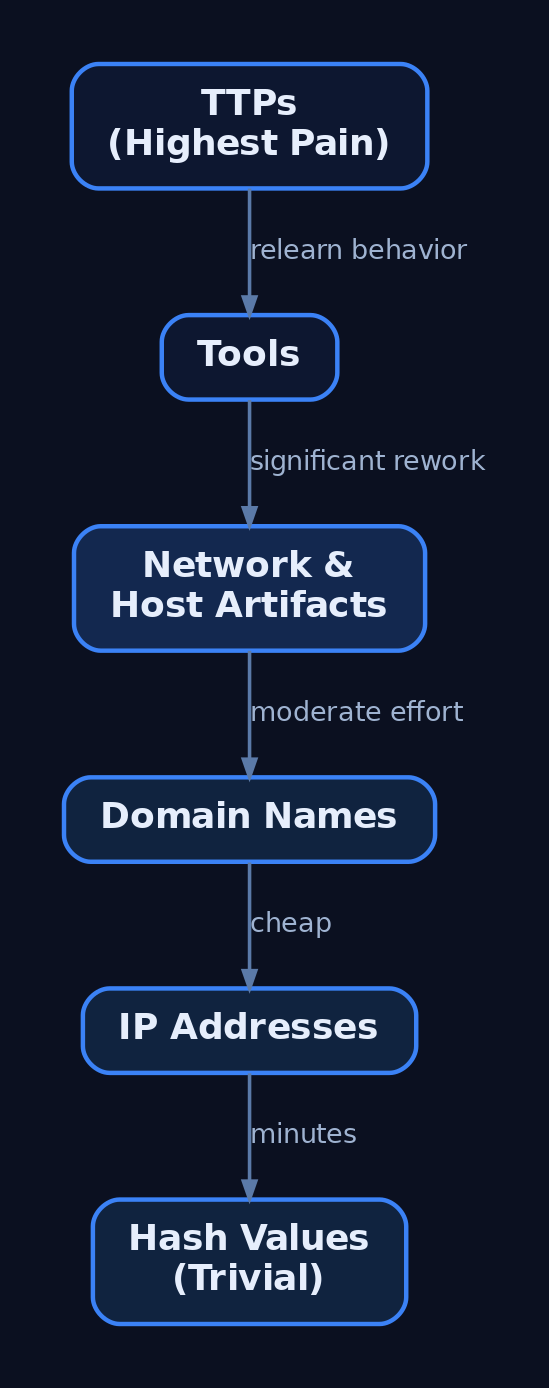
David Bianco’s Pyramid of Pain (2013) explains why TTP-based profiling outlasts IOC-based profiling. From the bottom (trivial for the adversary to change) to the top (expensive and painful):
- Hash values → trivially recompiled
- IP addresses → rotated in minutes
- Domain names → re-registered cheaply
- Network/host artifacts → moderate effort
- Tools → significant rework
- TTPs → the adversary must relearn how they operate
Profiling for the top of the pyramid forces the adversary to change behavior, not just infrastructure. That is the entire defensive case for TTP-centric profiles.
Treat attribution skeptically. Multiple vendors track overlapping activity under different names, and their group boundaries may disagree. Record an explicit confidence rating (Admiralty Code or an Assessed/Confirmed scale) per claim, and never collapse two vendor clusters into “the same actor” without corroboration.
11. From Profile to Emulation Plan
The finished profile drives an emulation plan in the style of the CTID Adversary Emulation Library. Translate the TTP heatmap into a prioritized, sequenced scenario:
- Sequence techniques along the Kill Chain — initial access, execution, persistence, credential access, exfiltration.
- Prioritize by impact, current detection coverage (from the Navigator gap analysis), and business relevance.
- Constrain the plan to documented behaviors; emulate procedures, not improvised tradecraft.
The output is a runnable, scoped test that exercises exactly the techniques your real adversary uses — and validates the detections you built from the same profile.

12. Common Attacker Techniques
A profile must capture what the adversary does during its own reconnaissance and resource development — the pre-attack behaviors you study and emulate.
| Technique | Description |
|---|---|
| Gather identity information | Harvest credentials, emails, employee names (T1589) |
| Gather network information | Enumerate DNS, IP ranges, topology (T1590) |
| Gather org information | Identify roles, business tempo, relationships (T1591) |
| Gather host information | Fingerprint software, hardware, configs (T1592) |
| Search open websites | Social media, search engines, code repos (T1593) |
| Active scanning | Port, vulnerability, wordlist scanning (T1595) |
| Acquire / develop capabilities | Register infra, build or buy tooling (T1583, T1587, T1588) |
13. Defensive Strategies & Detection
Profiling cuts both ways: detect adversaries profiling you, and validate coverage against a finished profile. Correlate weak recon signals across categories — perimeter scanning (T1595), web fingerprinting (T1592), and email harvesting (T1589) together indicate targeted pre-attack planning.
| Detection Area | Specifics |
|---|---|
| Web server logs | Scanner user-agents (Masscan, ZGrab); sequential 404 bursts (T1595.003) |
| DNS monitoring | AXFR zone-transfer attempts; unusual PTR sweeps (T1590.002) |
| Honeytokens | Planted career-page emails that fire on first contact (T1589.002) |
| Cert Transparency | Alerts on lookalike-domain issuance (T1583/T1584) |
| Identity logs | Event ID 4624 correlated with 4662 for LDAP/AD enumeration |
Host-based recon once inside is visible to Sysmon: Event ID 1 (Process Create) catches nslookup, nltest, net view; Event ID 3 (Network Connection) surfaces internal scanning; Event ID 22 (DNS Query) enumerates lookups. Enable Audit Directory Service Access and command-line auditing (4688).
title: Domain Trust and Group Reconnaissance via Built-in Tools
logsource:
  product: windows
  service: sysmon
detection:
  selection:
    EventID: 1
    CommandLine|contains:
      - 'nltest /domain_trusts'
      - 'net group "domain admins"'
      - 'net view /domain'
  condition: selection
level: medium
Centralize network, endpoint, identity, and threat-intel telemetry into one analytics platform, and ingest the profile’s STIX into a TIP (MISP/OpenCTI) so IOCs correlate against live data automatically. Reduce your OSINT attack surface: prune public DNS records, enable WHOIS privacy, and strip version banners.
14. Tools for Adversary Profiling
| Tool | Description | Link |
|---|---|---|
| MITRE ATT&CK Navigator | Technique heatmaps and layer arithmetic | mitre-attack.github.io |
mitreattack-python | Programmatic ATT&CK STIX queries | github.com |
| MISP | Threat-intel platform, STIX/TAXII ingestion | misp-project.org |
| OpenCTI | Knowledge graph for actors and TTPs | opencti.io |
| Shodan / Censys | Passive internet asset discovery | shodan.io |
| DomainTools / RDAP | WHOIS and passive DNS pivoting | domaintools.com |
| VirusTotal / MalwareBazaar | Tooling attribution from samples | virustotal.com |
15. MITRE ATT&CK Mapping
| Technique | MITRE ID | Detection |
|---|---|---|
| Gather Victim Identity Information | T1589 | Honeytoken email triggers; phishing telemetry |
| Email Addresses | T1589.002 | Planted-address alerting |
| Gather Victim Network Information | T1590 | AXFR / PTR sweep monitoring |
| DNS | T1590.002 | Microsoft-Windows-DNS-Client ETW |
| Gather Victim Org Information | T1591 | LinkedIn exposure review |
| Gather Victim Host Information | T1592 | Web fingerprinting in server logs |
| Search Open Websites/Domains | T1593 | Code-repo secret scanning |
| Search Victim-Owned Websites | T1594 | Anomalous crawl patterns |
| Active Scanning | T1595 | Perimeter scan / 404 burst detection |
| Acquire Infrastructure | T1583 | Cert Transparency lookalike alerts |
| Compromise Infrastructure | T1584 | Passive DNS pivoting |
| Develop / Obtain Capabilities | T1587 / T1588 | Malware-repo attribution |
Summary
- An adversary profile is a structured, ATT&CK-mapped dossier of actor identity, targeting, tooling, and TTPs — the durable artifact IOC feeds cannot replace.
- Run the six-phase intelligence lifecycle and fuse three frameworks: the Diamond Model for pivoting, the Kill Chain for sequencing, and ATT&CK for the TTP taxonomy.
- Collect from vendor reports, government advisories, passive DNS, and malware repositories — and score every source with the Admiralty Code.
- Serialize the result as STIX 2.1 and a Navigator layer so it feeds TIPs, gap analysis, and CTID-style emulation plans.
- Detect adversaries profiling you with correlated recon signals — Sysmon Event IDs
1/3/22, honeytokens, and Cert Transparency monitoring — and profile for the top of the Pyramid of Pain, where changing TTPs costs the adversary the most.
Related Tutorials
- Cyber Threat Intelligence (CTI) Fundamentals: Sources, Types, and the Intelligence Lifecycle
- Threat-Informed Defense: Principles, Frameworks, and the Intelligence-Driven Security Cycle
- Adversary Emulation vs. Adversary Simulation: Definitions, Differences, and Why It Matters
- Phishing Campaign Design: Pretexting, Lures, and Target Profiling
- Mapping CTI Reports to ATT&CK TTPs: A Step-by-Step Methodology
References
Mapping CTI Reports to ATT&CK TTPs: A Step-by-Step Methodology
Objective: Learn to parse a real-world cyber threat intelligence (CTI) report and systematically translate its narrative behaviors into precise MITRE ATT&CK tactics, techniques, and sub-techniques — producing an accurate, reusable TTP layer that drives detection engineering, threat hunting, and adversary emulation planning.
1. Why TTP Mapping Matters More Than IOCs
Traditional Indicators of Compromise (IOCs) — hashes, IP addresses, domains — are brittle. An adversary rotates infrastructure and recompiles payloads cheaply, so a hash-based detection expires the moment the campaign moves. Tactics, Techniques, and Procedures (TTPs) describe behavior, which is far costlier for an adversary to change. Re-tooling how you dump LSASS or beacon over HTTPS is expensive; swapping a C2 IP is trivial.
MITRE ATT&CK encodes this behavioral layer into a shared vocabulary. When you map a CTI report to ATT&CK, you convert prose (“the actor ran an encoded PowerShell loader”) into a stable, machine-referenceable identifier (T1059.001) that every tool, team, and report understands. That identifier outlives the campaign and feeds detection, hunting, and emulation directly.
2. ATT&CK Architecture: Tactics, Techniques, Sub-techniques, and Procedures
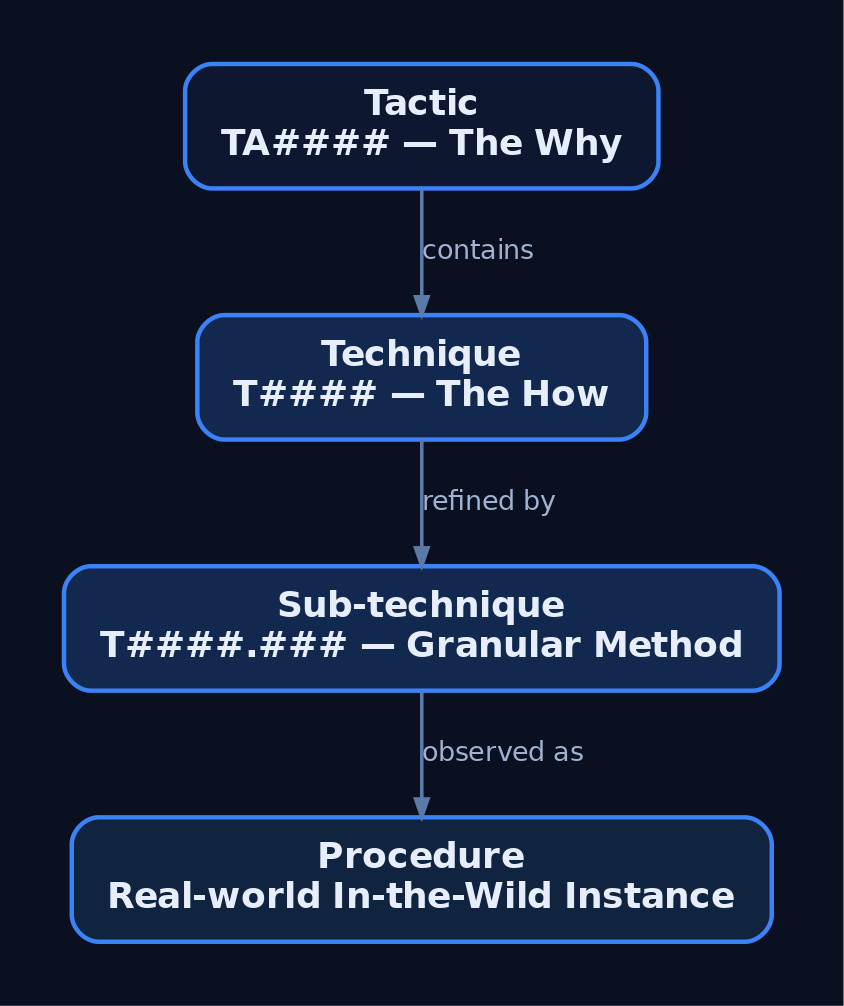
ATT&CK is a knowledge base of adversary behavior built on three structural levels.
| Level | Description |
|---|---|
| Tactic | The adversary’s why — the tactical goal (e.g., TA0001 Initial Access, TA0002 Execution). |
| Technique | The how — a specific behavior used to achieve a tactical goal; one step in a string of activity completing the mission. |
| Sub-technique | A more granular description of a technique. T1003 OS Credential Dumping has sub-techniques such as T1003.001 LSASS Memory. |
A procedure is the real-world, in-the-wild instance of a technique — the exact way a named group performed it. Procedures appear on each technique page as cited examples.
The 14 Enterprise Tactics
| Tactic ID | Name |
|---|---|
TA0043 | Reconnaissance |
TA0042 | Resource Development |
TA0001 | Initial Access |
TA0002 | Execution |
TA0003 | Persistence |
TA0004 | Privilege Escalation |
TA0005 | Defense Evasion |
TA0006 | Credential Access |
TA0007 | Discovery |
TA0008 | Lateral Movement |
TA0009 | Collection |
TA0011 | Command and Control |
TA0010 | Exfiltration |
TA0040 | Impact |
Technique IDs follow the T#### convention; sub-techniques append .### (e.g., T1021, T1059.003). These identifiers standardize communication across detection engineering, intelligence reporting, and red team planning. ATT&CK is versioned — IDs can be deprecated or renumbered across major releases — so always verify against the live matrix at attack.mitre.org.
3. Sourcing and Preparing a CTI Report for Analysis
CTI arrives at three altitudes. Strategic intelligence describes who and why at a board level. Operational intelligence describes campaign-level capability and intent. Tactical intelligence — vendor incident reports, CISA advisories, ISAC bulletins, OSINT write-ups — describes the granular actions you can actually map.
A report is mappable when it describes what the adversary did, not just what it was. Strip attribution bias: the goal is behavior, not a flag. Before mapping, read the full report once end-to-end, then segment the narrative into discrete adversary actions. Each action is a candidate for one or more ATT&CK techniques.
4. The Four-Step Mapping Methodology
CISA’s Best Practices for MITRE ATT&CK Mapping defines a canonical four-step loop. Run it once per behavior.
- Identify the behavior — extract what the adversary did from the narrative, quoting the source verbatim.
- Research the behavior — understand the technical action being described; resolve vendor jargon to a concrete mechanism.
- Translate the behavior into a tactic — identify the adversary’s goal (the why).
- Identify the technique and sub-technique — match the how against the matrix.
Worked example. Take the narrative: “The actor delivered a spearphishing attachment, then executed an obfuscated PowerShell loader and accessed LSASS memory with a renamed procdump binary.”
| Behavior | Tactic | Technique |
|---|---|---|
| Spearphishing attachment | TA0001 Initial Access | T1566.001 |
| Obfuscated PowerShell loader | TA0002 Execution + TA0005 Defense Evasion | T1059.001, T1027 |
| LSASS access via procdump | TA0006 Credential Access | T1003.001 |
Automation helps the first pass. The script below surfaces candidate tactics from raw text — a triage aid, never a final answer.
# First-pass triage only — surfaces CANDIDATE tactics for manual review.
TACTIC_KEYWORDS = {
    "TA0001": ["phishing", "spearphishing", "supply chain", "exploited public"],
    "TA0002": ["powershell", "executed", "ran script", "command interpreter"],
    "TA0005": ["obfuscated", "base64", "encoded", "disabled logging"],
    "TA0006": ["lsass", "credential", "dumped", "mimikatz"],
    "TA0011": ["beacon", "c2", "https post", "command and control"],
}

def candidate_tactics(report_text: str):
    text = report_text.lower()
    return {ta: [w for w in words if w in text]
            for ta, words in TACTIC_KEYWORDS.items()
            if any(w in text for w in words)}

excerpt = ("The actor used a spearphishing attachment, then ran an "
           "obfuscated PowerShell loader and dumped LSASS memory.")
for ta, words in candidate_tactics(excerpt).items():
    print(ta, "->", words)
If a sub-technique is not easily identifiable — and there may not be one in every case — review the procedure examples on the technique page. They link the source CTI reports behind the original mapping and may affirm your choice or suggest an alternative. There is always a possibility a behavior is a new technique not yet covered in ATT&CK.

5. Disambiguation: Choosing the Right Technique When Multiple Apply
Ambiguity is the hard part. One behavior frequently maps to several tactics. T1078 Valid Accounts spans Initial Access (TA0001), Persistence (TA0003), Privilege Escalation (TA0004), and Defense Evasion (TA0005) — the correct tactic depends on what the account was used for in that step, not the account itself.
Rules of thumb:
- Map to the tactic that matches the adversary’s goal at that moment, not every goal the technique can serve.
- Prefer the technique level when the report lacks the detail to justify a sub-technique. Forcing
T1003.001when the report only says “stole credentials” is over-mapping. - Use the procedure examples to calibrate. If your behavior reads nothing like the cited procedures, re-investigate.
T1218System Binary Proxy Execution andT1027Obfuscated Files or Information often co-occur with execution techniques — record them as distinct Defense Evasion entries rather than collapsing them.
6. The Analyst Mapping Worksheet
The core analyst deliverable is a worksheet that preserves the audit trail from quote to ID. Confidence and rationale columns make the mapping reviewable.
| Raw Behavior Quote | Tactic | Technique | Sub-technique | Confidence | Rationale |
|---|---|---|---|---|---|
| “delivered a spearphishing attachment” | TA0001 | T1566 | T1566.001 | H | Explicit attachment delivery |
| “ran an obfuscated PowerShell loader” | TA0002 | T1059 | T1059.001 | H | Interpreter named explicitly |
| “loader was Base64-encoded” | TA0005 | T1027 | — | M | Obfuscation implied, method unstated |
| “accessed LSASS with renamed procdump” | TA0006 | T1003 | T1003.001 | H | Target process named |
| “injected into svchost.exe” | TA0005 | T1055 | T1055.001 | M | Injection cited; DLL method inferred |
| “beaconed over HTTPS” | TA0011 | T1071 | T1071.001 | H | Web protocol C2 explicit |
This worksheet becomes the source of truth that all downstream artifacts — Navigator layers, Sigma rules, emulation plans — derive from.
7. Tooling: ATT&CK Navigator, Decider, and the STIX/TAXII API
ATT&CK Navigator is MITRE’s web tool for visually annotating the matrix. You represent a mapped TTP set as a versioned layer JSON — a portable, diff-able artifact you commit to version control.
{
  "name": "APT-Sample CTI Mapping",
  "versions": { "attack": "16", "navigator": "5.1.0", "layer": "4.5" },
  "domain": "enterprise-attack",
  "description": "TTPs extracted from CTI report; scored by confidence.",
  "techniques": [
    { "techniqueID": "T1566.001", "score": 100, "color": "#e60d0d",
      "comment": "Spearphishing attachment delivered loader (High)" },
    { "techniqueID": "T1059.001", "score": 100, "color": "#e60d0d",
      "comment": "Obfuscated PowerShell stager (High)" },
    { "techniqueID": "T1003.001", "score": 75, "color": "#e68a0d",
      "comment": "LSASS access via renamed procdump (Medium)" }
  ]
}
CISA Decider eases disambiguation by asking a series of guided questions about adversary activity, walking you to the correct tactic, technique, or sub-technique — invaluable when an analyst is uncertain.
For programmatic work, query the public read-only TAXII 2.1 endpoint (https://attack-taxii.mitre.org/, Enterprise collection x-mitre-collection--1f5f1533-f617-4ca8-9ab4-6a02367fa019). The ATT&CK dataset is STIX 2.1 JSON: techniques are attack-pattern objects, groups are intrusion-set, software is malware / tool. Pull techniques attributed to a group to cross-check your mapping against MITRE’s own group profile.
from mitreattack.stix20 import MitreAttackData

# Load the Enterprise STIX 2.1 bundle (download once from attack-stix-data)
attack = MitreAttackData("enterprise-attack.json")

# Resolve a threat group alias to its intrusion-set object
group = attack.get_groups_by_alias("APT29")[0]

# Enumerate every technique attributed to the group
for t in attack.get_techniques_used_by_group(group["id"]):
    obj = t["object"]
    print(attack.get_attack_id(obj["id"]), "\t", obj["name"])
8. From TTP Map to Adversary Profile
Aggregate worksheets across an entire campaign to build an adversary profile. Correlate your mapped techniques against the relevant ATT&CK Groups page to validate consistency and surface techniques the actor is known to use but the report omitted. Score the aggregated layer by frequency or confidence to produce a TTP heat map, then prioritize against your priority intelligence requirements (PIRs). The heat map feeds directly into detection gap analysis.
import csv, json

# Load the mapped TTP layer and the internal detection inventory
layer = json.load(open("cti_layer.json"))
covered = set()
with open("detection_coverage.csv") as fh:            # cols: technique_id, rule_name
    for row in csv.DictReader(fh):
        covered.add(row["technique_id"])

print("TechniqueID\tCovered")
for t in layer["techniques"]:
    tid = t["techniqueID"]
    print(f"{tid}\t{tid in covered}")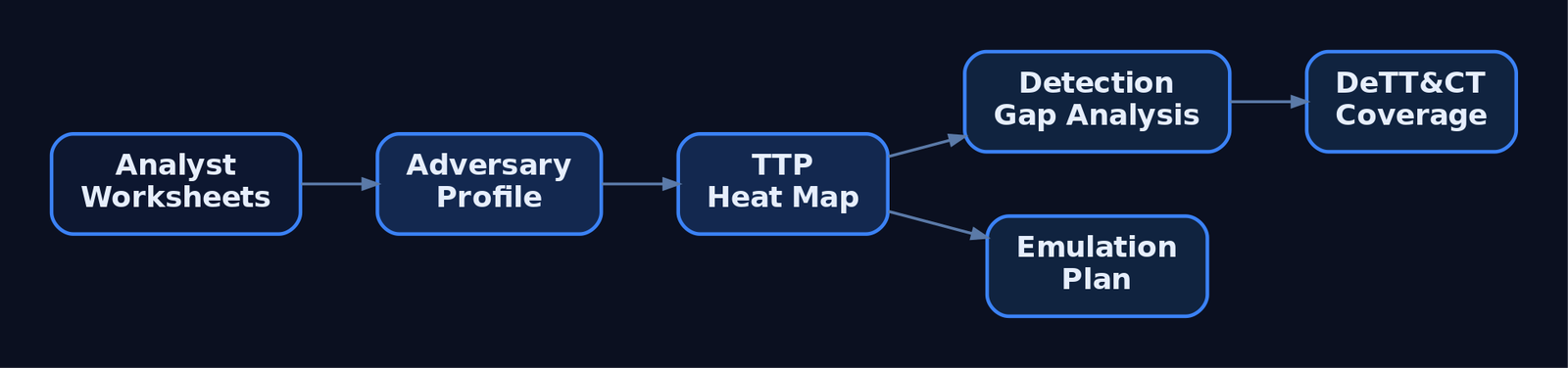
9. Quality Assurance: Peer Review and Common Mapping Errors
A formal peer review of an annotated report shares perspectives, promotes learning, and improves accuracy. A second analyst routinely catches TTPs missed in the first pass and enforces mapping consistency across the team.
Watch for these recurring errors:
- Over-mapping — assigning techniques the report does not support.
- Under-mapping — missing key behaviors buried in the narrative.
- Conflating technique with tactic — recording a goal where a behavior belongs.
- Misidentifying sub-techniques — forcing
.###granularity the source lacks. - Mapping to deprecated techniques — always validate against the current ATT&CK version.
10. Common Attacker Techniques in CTI Reports
These behaviors dominate tactical CTI and should be in every analyst’s recognition vocabulary.
| Technique | Description |
|---|---|
T1566.001 Spearphishing Attachment | Malicious attachment delivers initial loader |
T1195 Supply Chain Compromise | Trusted software/update channel weaponized |
T1059.001 PowerShell | Scripted execution, often encoded |
T1569.002 Service Execution | Code run via a Windows service |
T1078 Valid Accounts | Legitimate credentials reused across tactics |
T1027 Obfuscated Files or Information | Encoding/packing to evade detection |
T1218 System Binary Proxy Execution | Signed LOLBins proxy malicious execution |
T1055.001 DLL Injection | Code injected into a remote process |
T1003.001 LSASS Memory | Credential material dumped from lsass.exe |
T1071.001 Web Protocols | HTTP/S used for command and control |
11. Defensive Strategies & Detection
The output of mapping is a prioritized list of behaviors to detect. Each ATT&CK technique page lists Data Sources (e.g., DS0009 Process, DS0011 Module, DS0017 Command, DS0022 File, DS0028 Logon Session, DS0029 Network Traffic) and Mitigations (e.g., M1038 Execution Prevention, M1026 Privileged Account Management). Pull these per technique to convert the map into telemetry requirements and hardening tasks.
Sysmon Events Tied to Mapped Behaviors
| Sysmon Event ID | Description | Example Technique |
|---|---|---|
Event ID 1 | Process Create | T1059.001, T1218 |
Event ID 3 | Network Connection | T1071.001 |
Event ID 7 | Image Loaded (DLL) | T1055.001 |
Event ID 8 | CreateRemoteThread | T1055 |
Event ID 10 | Process Access | T1003.001 |
Event ID 11 | File Create | T1027 |
Event ID 13 | Registry Value Set | T1547.001 |
Event ID 22 | DNS Query | T1071.001 |
Enable the supporting Windows audit policies: Audit Process Creation (Event ID 4688 with command line), Audit Logon Events (4624/4625/4648 for T1078), Audit Object Access → SAM (4661 for T1003), and PowerShell Script Block Logging (4104 for T1059.001).
A Sigma rule operationalizes one mapped technique. Tags follow attack.t1003_001 (lowercase, underscore for the sub-technique separator) and attack.ta0006 for the tactic.
title: Cross-Process Access to LSASS Memory
logsource:
  product: windows
  service: sysmon
detection:
  selection:
    EventID: 10
    TargetImage|endswith: '\lsass.exe'
    GrantedAccess: '0x1410'
  condition: selection
tags:
  - attack.t1003_001
  - attack.ta0006
level: high
Feed the completed layer into DeTT&CT (Detect Tactics, Techniques & Combat Threats) to align mapped TTPs against your data source visibility and detection coverage — the natural follow-on to mapping. The same layer drives the red team emulation plan, ensuring offensive testing exercises the exact behaviors the CTI reported.
12. Tools for CTI Mapping Analysis
| Tool | Description | Link |
|---|---|---|
| ATT&CK Navigator | Visual matrix annotation and layer export | mitre-attack.github.io |
| CISA Decider | Guided Q&A to reach the correct technique | cisa.gov |
mitreattack-python | Programmatic STIX query of the ATT&CK dataset | github.com |
| ATT&CK TAXII 2.1 | Public read-only API for STIX collections | attack-taxii.mitre.org |
| DeTT&CT | Maps data source visibility to detection coverage | github.com |
| Sigma | Vendor-agnostic detection rules with ATT&CK tags | sigmahq.io |
| Sysmon | Endpoint telemetry feeding mapped detections | sysinternals.com |
13. MITRE ATT&CK Mapping Reference
| Technique | MITRE ID | Detection |
|---|---|---|
| Spearphishing Attachment | T1566.001 | Mail gateway logs, Event ID 11 on attachment write |
| PowerShell | T1059.001 | Script block logging 4104, Event ID 1 |
| Obfuscated Files or Information | T1027 | Event ID 1/11, entropy/decoder heuristics |
| Valid Accounts | T1078 | Logon auditing 4624/4648, anomalous session |
| LSASS Memory | T1003.001 | Event ID 10 GrantedAccess to lsass.exe, 4661 |
| DLL Injection | T1055.001 | Event ID 7/8 remote thread + image load |
| System Binary Proxy Execution | T1218 | Event ID 1 LOLBin parent/child anomalies |
| Web Protocols (C2) | T1071.001 | Event ID 3/22, JA3/TLS and DNS analytics |
| Supply Chain Compromise | T1195 | Software integrity, unexpected update behavior |
Summary
- CTI-to-ATT&CK mapping converts perishable IOCs into durable, behavioral TTPs that survive across campaigns and standardize defensive communication.
- ATT&CK is structured as tactics (the why), techniques (the how), and sub-techniques (granular methods), each with stable
TA####/T####.###identifiers. - The CISA four-step loop — identify, research, translate to tactic, identify technique — produces an auditable mapping worksheet that anchors every downstream artifact.
- Navigator layers, CISA Decider, and the public TAXII 2.1 STIX endpoint operationalize and version-control the mapping; peer review guards against over-mapping, under-mapping, and tactic/technique confusion.
- The finished TTP map drives detection engineering directly — pulling ATT&CK Data Sources, Sysmon Event IDs, audit policies, and Sigma rules per technique, and feeding DeTT&CT coverage analysis and emulation plans.
Related Tutorials
- Cyber Threat Intelligence (CTI) Fundamentals: Sources, Types, and the Intelligence Lifecycle
- Navigating ATT&CK Navigator: Building, Annotating, and Exporting Technique Layers
- Introduction to MITRE ATT&CK: Structure, Tactics, Techniques, and Sub-Techniques
- APT Profiling: How to Build a Comprehensive Adversary Profile from Open-Source Intelligence
- Passive OSINT: Mapping the Target Without Touching It
References
- Best Practices for MITRE ATT&CK® Mapping (CISA)
- MITRE ATT&CK® – Get Started: Threat Intelligence
- MITRE ATT&CK® – Get Started: Adversary Emulation and Red Teaming
- MITRE ATT&CK® – Adversary Emulation Plans
- Getting Started with ATT&CK: Threat Intelligence (Official MITRE ATT&CK® Blog)
- Center for Threat-Informed Defense – Adversary Emulation Library (GitHub)