DPCs: Deferred Procedure Calls and Interrupt Deferral
Objective: Understand how the Windows kernel uses Deferred Procedure Calls (DPCs) to move work out of high-IRQL interrupt service routines down to
DISPATCH_LEVEL, covering theKDPCstructure, IRQL mechanics, the full queue-to-callback lifecycle, threaded and timer DPCs, the DPC watchdog, and how defenders detect kernel-mode abuse of the DPC mechanism.
1. The Interrupt Deferral Problem
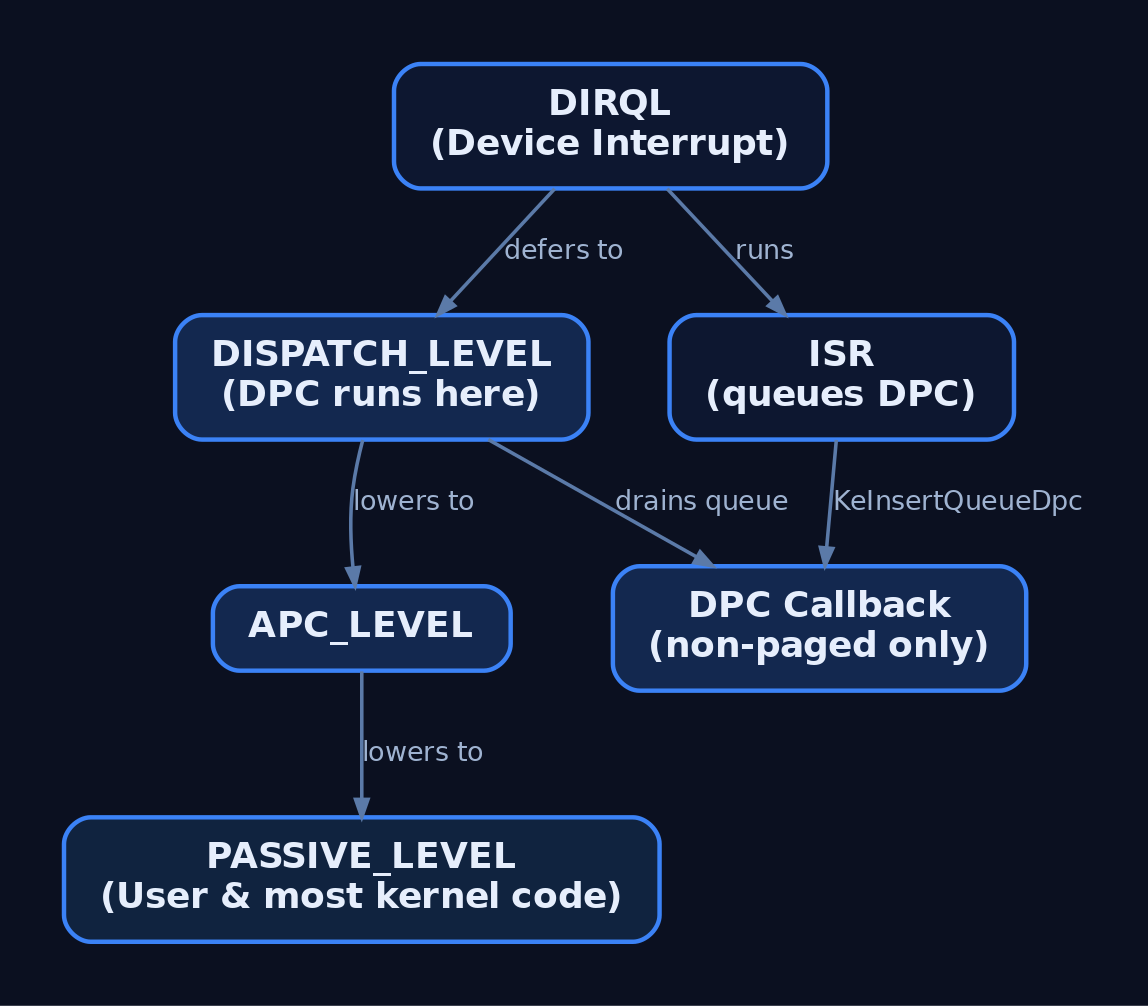
When a hardware device raises an interrupt, the kernel dispatches to an Interrupt Service Routine (ISR) running at DIRQL — a device IRQL higher than the scheduler itself. At that level the processor cannot wait, cannot touch pageable memory, and blocks all lower-priority interrupts on that CPU. An ISR that lingers degrades the entire system; the guidance is that ISRs should not run longer than 25 microseconds.
Windows therefore uses a two-phase interrupt model. The ISR does the minimum work needed to quiesce the device (acknowledge the interrupt, snapshot status), then schedules a Deferred Procedure Call to perform the heavier processing later, at a gentler IRQL. The DPC executes at DISPATCH_LEVEL, which is still too high for anything that touches pageable memory — but it is low enough to run the bulk of device servicing without starving other interrupts.
The essence of the DPC is deferring execution to gentler circumstances. It is the kernel’s primary tool for keeping ISRs short.
2. IRQL Levels: A Precise Map
The Interrupt Request Level (IRQL) is a per-processor priority that determines what code may run and what it may do. Any routine running at DISPATCH_LEVEL or above is not preemptable, runs to completion, and must reside in non-paged memory.
| IRQL Name | Value | Notes |
|---|---|---|
PASSIVE_LEVEL | 0 | Normal user/kernel thread execution; paging and waiting allowed |
APC_LEVEL | 1 | Asynchronous Procedure Calls |
DISPATCH_LEVEL | 2 | DPC execution, scheduler, spin locks; no paging, no waiting |
DIRQL | 3–11 (device-dependent) | Hardware ISRs run here |
An ISR at DIRQL cannot call functions that require PASSIVE_LEVEL. It instead schedules a DPC, which the kernel later runs at DISPATCH_LEVEL. Because DISPATCH_LEVEL still forbids page faults and blocking waits, a DPC routine and all data it touches must be non-paged.
3. The KDPC Structure Dissected
The KDPC is the structure in which the kernel keeps the state of a Deferred Procedure Call. It has always been explicitly undocumented — Microsoft labels it an opaque structure and warns drivers not to set members directly. The published layout from WDK/OSR headers is:
typedef struct _KDPC {
    UCHAR                 Type;            // DpcObject or ThreadedDpcObject
    UCHAR                 Importance;      // Low / Medium / High
    USHORT                Number;          // target processor (directed DPCs)
    LIST_ENTRY            DpcListEntry;    // links into per-processor DPC queue
    PKDEFERRED_ROUTINE    DeferredRoutine; // pointer to the callback function
    PVOID                 DeferredContext; // driver-supplied context value
    PVOID                 SystemArgument1; // extra arg passed to callback
    PVOID                 SystemArgument2; // extra arg passed to callback
    __volatile PVOID      DpcData;         // internal; pointer to KDPC_DATA
} KDPC, *PKDPC, *PRKDPC;| Field | Purpose |
|---|---|
Type | Distinguishes a normal DpcObject from a ThreadedDpcObject |
Importance | Controls queue insertion: MediumImportance = tail, HighImportance = head |
Number | Target logical processor, set via KeSetTargetProcessorDpc |
DeferredRoutine | Pointer to the KDEFERRED_ROUTINE callback |
DeferredContext | Opaque context the driver receives back in the callback |
SystemArgument1/2 | Caller-supplied arguments passed through to the callback |
DpcData | Volatile internal pointer to the per-processor KDPC_DATA; non-NULL while queued |
The DpcData field is the kernel’s bookkeeping anchor: before Windows 8.1 it pointed directly at a KDPC_DATA structure, and its non-NULL state indicates the DPC is currently queued. Because DeferredRoutine is a raw function pointer inside a writable structure, it is also a corruption target — covered in §10.
4. The DPC Lifecycle: From ISR to Callback
A DPC moves through four stages: allocate → initialize → queue → drain.
| API Function | Purpose |
|---|---|
KeInitializeDpc | Initializes a KDPC, binding a DeferredRoutine and DeferredContext |
KeInsertQueueDpc | Inserts the KDPC into the per-processor queue; returns FALSE if already queued |
IoRequestDpc | Convenience wrapper called from ISR context for the DpcForIsr pattern |
KeRemoveQueueDpc | Removes a pending (not-yet-fired) DPC from the queue |
Kernel code first allocates a KDPC in non-paged pool (or the device extension) so the object is resident when referenced from the ISR.
// C1 — allocate and initialize a DPC object
PKDPC pDpc = ExAllocatePool2(POOL_FLAG_NON_PAGED, sizeof(KDPC), 'cpDD');
if (pDpc) {
    KeInitializeDpc(pDpc, MyCustomDpc, DeviceContext);  // routine + context
}
The callback must match the KDEFERRED_ROUTINE signature and runs at DISPATCH_LEVEL:
// C2 — DPC callback stub
VOID MyCustomDpc(
    _In_     PKDPC Dpc,
    _In_opt_ PVOID DeferredContext,
    _In_opt_ PVOID SystemArgument1,
    _In_opt_ PVOID SystemArgument2)
{
    UNREFERENCED_PARAMETER(Dpc);
    ASSERT(KeGetCurrentIrql() == DISPATCH_LEVEL);   // invariant
    // Non-paged, bounded work only — no waits, no page faults.
}
The ISR queues the DPC. The return value of KeInsertQueueDpc enforces the single-instantiation guarantee: only one instance of a given KDPC can be queued at a time, so queuing it twice before it fires runs the routine once.
// C3 — queue from a mock ISR
BOOLEAN queued = KeInsertQueueDpc(pDpc, Arg1, Arg2);
if (!queued) {
    // Already pending on a queue — the earlier request still stands.
}
Device drivers commonly use the wrapper from inside their InterruptService routine:
// C4 — DpcForIsr pattern
BOOLEAN MyIsr(_In_ PKINTERRUPT Interrupt, _In_ PVOID Context) {
    PDEVICE_OBJECT devObj = (PDEVICE_OBJECT)Context;
    // ...acknowledge hardware quickly...
    IoRequestDpc(devObj, devObj->CurrentIrp, NULL);  // schedules DpcForIsr
    return TRUE;
}
When the processor returns from the interrupt, it checks its DPC queue; if entries are pending, the kernel raises IRQL to DISPATCH_LEVEL, drains the queue by invoking each DeferredRoutine, then lowers IRQL back down.

5. Per-Processor DPC Queues and KPRCB
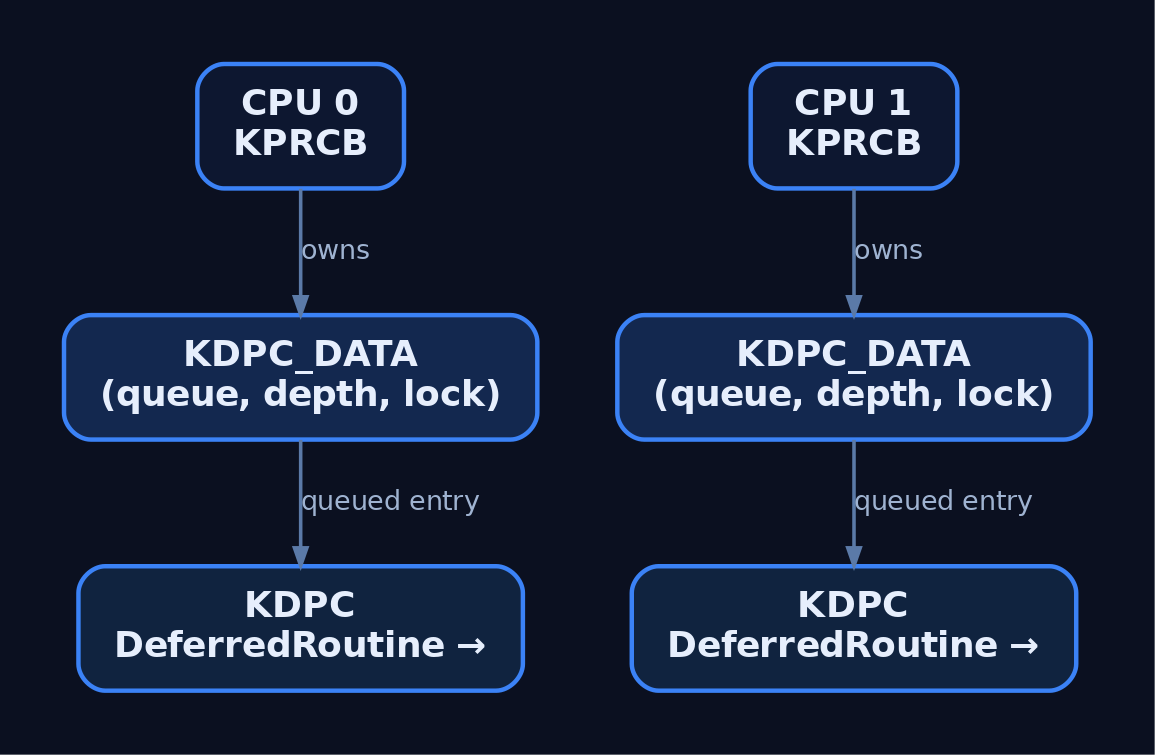
Each logical processor owns a separate DPC queue, stored as a KDPC_DATA structure inside the processor’s KPRCB (Kernel Processor Control Block). This avoids cross-CPU locking on the common path.
KDPC_DATA carries the queue head, depth, count, and a spin lock:
typedef struct _KDPC_DATA {
    LIST_ENTRY DpcListHead;   // queued KDPC objects
    ULONG      DpcLock;       // spin lock protecting the list
    volatile ULONG DpcQueueDepth;  // pending DPCs
    ULONG      DpcCount;      // running total
} KDPC_DATA, *PKDPC_DATA;
Exact
KDPC_DATAfield names vary by kernel build — confirm against a live PDB withdt nt!_KDPC_DATAbefore relying on offsets.
Because each queue is per-processor, the target processor of a DPC determines which CPU drains it. By default a DPC runs on the CPU that queued it, but it can be pinned elsewhere (§6) — a property attackers exploit to manipulate specific cores.
6. Controlling DPC Behaviour
| API Function | Purpose |
|---|---|
KeSetImportanceDpc | Sets Importance; HighImportance inserts at the queue head |
KeSetTargetProcessorDpc | Pins the DPC to a specific logical processor (directed DPC) |
KeRemoveQueueDpc | Dequeues a pending DPC; fails once the routine is already running |
DPCs have three priority levels — low, medium, high. Importance influences KeInsertQueueDpc: high-importance DPCs go to the head of the queue and are serviced first.
A directed DPC is created by binding it to a CPU before queuing. The pattern below — iterating over KeNumberProcessors and targeting each core — is the same primitive a rootkit weaponizes for CPU lockdown, so treat it as an educational illustration only:
// C5 — directed DPC setup (educational pattern)
for (CCHAR cpu = 0; cpu < KeNumberProcessors; cpu++) {
    KeInitializeDpc(&pDpcArray[cpu], MyCustomDpc, NULL);
    KeSetTargetProcessorDpc(&pDpcArray[cpu], cpu);  // pin to logical CPU
    KeSetImportanceDpc(&pDpcArray[cpu], HighImportance);
}
Once a DPC begins executing it cannot be removed; KeRemoveQueueDpc only rescinds a still-pending entry.
7. Threaded DPCs
Since Windows Server 2003, a KDPC can represent either a normal DPC or a threaded DPC. In the threaded variant, the kernel — if it can arrange it — calls the routine back at PASSIVE_LEVEL from a highest-priority thread, allowing more flexible work. Support can be disabled, in which case the threaded DPC falls back to running at DISPATCH_LEVEL exactly like a normal DPC.
You initialize one with KeInitializeThreadedDpc and a CustomThreadedDpc routine. Because that routine can run at either PASSIVE_LEVEL or DISPATCH_LEVEL, it must synchronize correctly at both IRQLs:
// C7 — threaded DPC with dual-IRQL guard
KeInitializeThreadedDpc(&g_ThreadedDpc, MyThreadedDpc, NULL);

VOID MyThreadedDpc(_In_ PKDPC Dpc, _In_opt_ PVOID Ctx,
                   _In_opt_ PVOID A1, _In_opt_ PVOID A2) {
    ASSERT(KeGetCurrentIrql() <= DISPATCH_LEVEL);   // may be PASSIVE or DISPATCH
    // Use locks valid at both levels.
}
Threaded DPCs should be preferred over ordinary DPCs unless a particular DPC must never be preempted — not even by another DPC.
8. Timer DPCs and KTIMER
A DPC is also the callback mechanism for kernel timers. You associate a KDPC with a KTIMER and arm it; on expiry the kernel queues the DPC. KeSetTimerEx supports both one-shot and periodic timers.
// C6 — periodic timer DPC
KeInitializeTimerEx(&g_Timer, NotificationTimer);
KeInitializeDpc(&g_TimerDpc, MyCustomDpc, NULL);

LARGE_INTEGER due;
due.QuadPart = -10LL * 1000 * 1000;     // 1 second, relative
KeSetTimerEx(&g_Timer, due, 1000 /* ms period */, &g_TimerDpc);
Windows uses special timer DPCs internally for timer expiration and context switching. The same primitive — a recurring timer pointed at a non-paged callback — is the cleanest way a driver schedules background work, and the cleanest way a malicious driver re-enters its payload (§10).
9. The DPC Watchdog and Debugging
The kernel runs a DPC watchdog. Bug Check 0x00000133 (DPC_WATCHDOG_VIOLATION) fires when the watchdog detects either a single long-running DPC or a prolonged time spent at DISPATCH_LEVEL or above. The timing budgets are 100 microseconds for a DPC and 25 microseconds for an ISR. A malicious DPC spin-loop can therefore inadvertently trip the watchdog and crash the host.
Inspect live DPC state in the kernel debugger:
kd> !dpcs                 ; list pending DPCs per processor
kd> dt nt!_KDPC           ; KDPC layout for this build
kd> dt nt!_KDPC_DATA      ; per-processor queue structure
kd> !prcb                 ; processor control block (contains DpcData)
kd> !pcr                  ; processor control region
!dpcs reveals each queued DPC’s DeferredRoutine address — the single most useful artifact, since an unknown or non-image-backed routine address is a strong anomaly.
10. Common Attacker Techniques
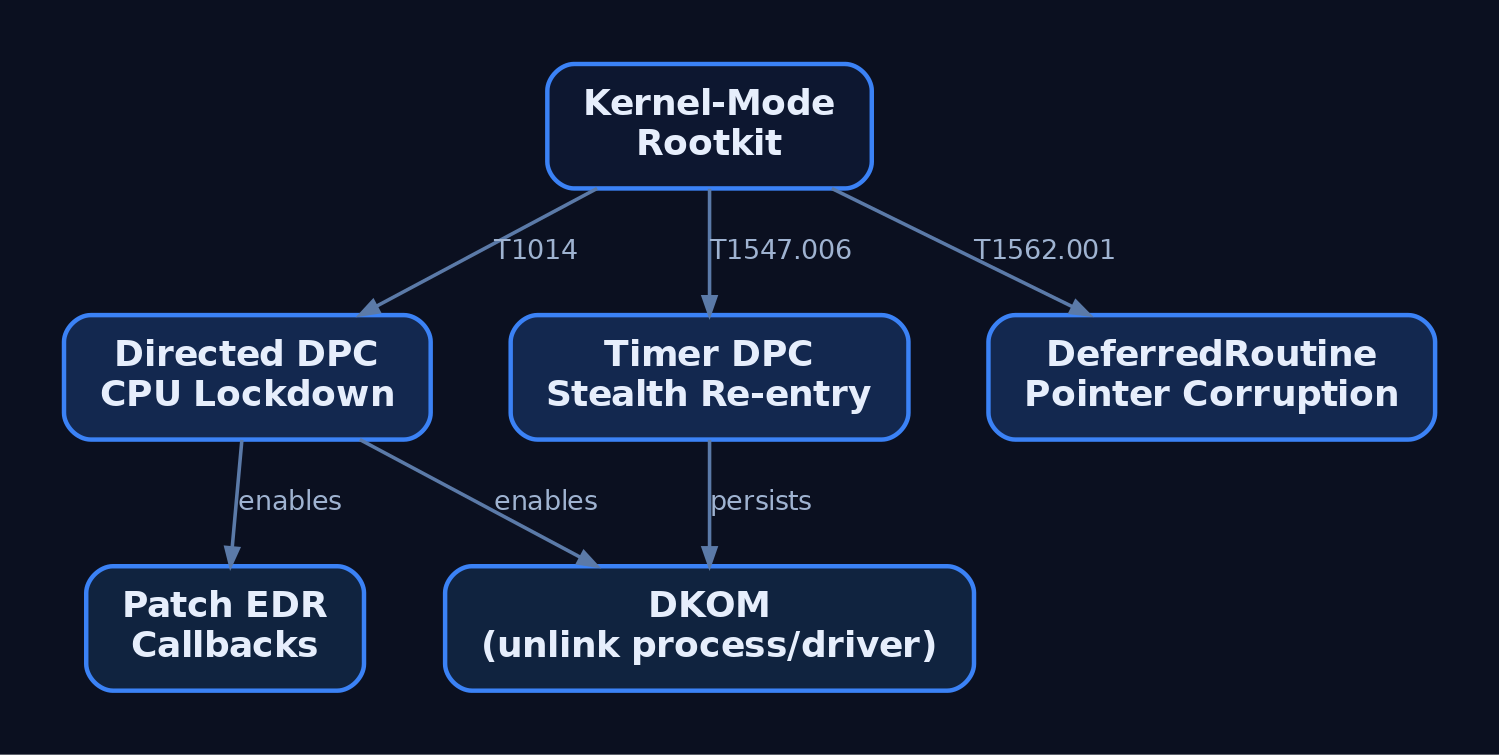
DPCs give kernel-mode malware a high-IRQL execution surface. Because code at DISPATCH_LEVEL is non-preemptable and runs to completion, it is ideal cover for Direct Kernel Object Manipulation (DKOM).
| Technique | Description |
|---|---|
| CPU lockdown / freeze-other-CPUs | Queue a directed KDPC to every non-current CPU via KeSetTargetProcessorDpc and spin, raising all secondary cores to DISPATCH_LEVEL to block interruption during a DKOM patch |
| Timer DPC payload | Arm a KTIMER whose DeferredRoutine points at attacker-controlled non-paged code, for recurring stealth execution |
| KDPC hijacking | Overwrite DeferredRoutine in a legitimate queued KDPC to redirect execution to a payload |
| Driver-based persistence | Load a malicious signed/BYOVD driver that registers a recurring timer DPC at load time |
The CPU-lockdown pattern is especially relevant to defenders: by parking every other core at DISPATCH_LEVEL, the rootkit can unlink processes, patch EDR callbacks, or hide drivers while no scheduler or AV thread can run.
11. Defensive Strategies & Detection
DPC objects live entirely in kernel memory and are not directly observable from user mode, so detection focuses on the driver that installs them and on kernel ETW timing telemetry.
Sysmon and Windows event telemetry:
| Event ID | Source | Relevance |
|---|---|---|
6 | Sysmon — Driver Loaded | Fires on every driver load; primary signal for kernel modules that register DPC routines |
7 | Sysmon — Image Loaded | Catches unsigned/anomalous modules entering kernel space |
7045 | Service Control Manager | New kernel-mode driver, especially from a non-standard path |
7040 | Service Control Manager | Service start-type change — driver persistence |
ETW providers: The NT Kernel Logger session with EVENT_TRACE_FLAG_DPC and EVENT_TRACE_FLAG_INTERRUPT records per-DPC timing and the routine address, exposing abnormally long-running or unknown-address DPC routines. Microsoft-Windows-Kernel-Processor-Power surfaces IRQL/watchdog events. Verify the exact flag constants against the current WDK evntrace.h.
Sigma anchor — unsigned/expired driver load:
title: Suspicious Kernel Driver Load (Unsigned or Expired)
logsource:
  product: windows
  service: sysmon
detection:
  selection_unsigned:
    EventID: 6
    Signed: 'false'
  selection_expired:
    EventID: 6
    SignatureStatus: 'Expired'
  selection_path:
    EventID: 6
    ImageLoaded|contains: '\Temp\'
  condition: selection_unsigned or selection_expired or selection_path
level: high
Hunt additionally for EventID 6 where ImageLoaded resolves outside \SystemRoot\System32\drivers\.
Hardening:
| Mitigation | Description |
|---|---|
| Driver Signature Enforcement (DSE) | Default on 64-bit Windows; blocks unsigned drivers that would install DPC routines |
| HVCI | Protects kernel code pages, raising the bar for DPC shellcode and DeferredRoutine overwrite |
| Kernel CET | Hardware shadow stack mitigates ROP-based DPC hijacking |
| DPC Watchdog | Built-in; Bug Check 0x133 catches long-running DPC loops, including malicious spin-locks |
| Vulnerable Driver Blocklist | HKLM\SYSTEM\CurrentControlSet\Control\CI\Config\VulnerableDriverBlocklistEnable blocks known BYOVD primitives |
| WDAC / Memory Integrity | Restrict which drivers may load, shrinking the DPC-abuse attack surface |
12. Tools for DPC Analysis
| Tool | Description | Link |
|---|---|---|
| WinDbg | !dpcs, dt nt!_KDPC, !prcb, !pcr live queue inspection | microsoft.com |
| Process Hacker | Driver/service enumeration and kernel module listing | processhacker.sourceforge.io |
| Windows Performance Recorder / xperf | Captures DPC/ISR ETW timing and routine addresses | microsoft.com |
| Sysmon | Driver-load (EID 6) and image-load (EID 7) telemetry | sysinternals.com |
| Volatility | Memory-forensic enumeration of drivers and kernel callbacks | volatilityfoundation.org |
| Ghidra | Static analysis of suspect drivers for KeInsertQueueDpc usage | ghidra-sre.org |
13. MITRE ATT&CK Mapping
| Technique | MITRE ID | Detection |
|---|---|---|
| Rootkit | T1014 | ETW DPC routine-address anomalies; !dpcs unknown routines |
| Boot/Logon Autostart: Kernel Modules | T1547.006 | Sysmon EID 6 / Event 7045 driver loads |
| Exploitation for Privilege Escalation | T1068 | HVCI/CET violations; KDPC.DeferredRoutine corruption |
| Impair Defenses: Disable/Modify Tools | T1562.001 | CPU-freeze DPC pattern halting EDR threads; watchdog 0x133 |
| Native API | T1106 | Driver use of KeInitializeDpc / KeInsertQueueDpc |
No dedicated ATT&CK sub-technique exists for DPC abuse as of ATT&CK v15; the techniques above are the parents. Verify current IDs at attack.mitre.org before publishing.
Summary
- DPCs are the kernel’s mechanism for deferring interrupt work from high-IRQL ISRs down to
DISPATCH_LEVEL, keeping ISRs under their 25 µs budget. - The opaque
KDPCstructure carries theDeferredRoutine, context, arguments, and aDpcDatapointer that marks whether it is queued on a per-processorKDPC_DATAlist in theKPRCB. - The lifecycle runs allocate →
KeInitializeDpc→KeInsertQueueDpc/IoRequestDpc→ per-CPU drain atDISPATCH_LEVEL, with a single-instantiation guarantee per object. - Rootkits abuse directed DPCs for CPU lockdown, timer DPCs for stealth re-entry, and
DeferredRoutinecorruption for hijacking — mapping toT1014,T1547.006, andT1562.001. - Detect via Sysmon Event ID 6 driver loads, NT Kernel Logger DPC timing telemetry, and the DPC watchdog (
0x133); harden with DSE, HVCI, Kernel CET, and the vulnerable driver blocklist.
Related Tutorials
- APCs: Asynchronous Procedure Calls and Thread Hijacking Surface
- IRQL Levels: Interrupt Request Priorities Explained
- System Calls and SSDT: How User Mode Reaches the Kernel
- Access Tokens and Privileges: The Kernel’s Security Context
- SIDs and Security Descriptors: Identity in Windows Security
References
- Introduction to DPC Objects – Windows Kernel Drivers | Microsoft Learn
- Managing Hardware Priorities (IRQL) – Windows Kernel Drivers | Microsoft Learn
- Deferred Procedure Call (DPC) – Kernel API Reference | Geoff Chappell, Software Analyst
- Deferred Procedure Call Details (KDPC Internals & Queuing Mechanisms) | OSR Online NT Insider
- Understanding Deferred Procedure Calls (DPCs) for Windows Vulnerability Research & Exploit Development | Medium / WaterBucket
- IRQLs: Close Encounters of the Rootkit Kind (DPCs & IRQL Abuse) | OffSec Blog