CVE-2026-43456: Dissecting the 19-Year Linux Kernel Bonding Driver Type Confusion That Achieves Root in Under One Second
A single line of code in the Linux bonding driver has been silently copying a function-pointer table from slave devices to bond masters since 2007. For nearly two decades, that line sat in bond_setup_by_slave(), invisible to fuzzers, static analyzers, and the thousands of eyes that review kernel networking code. It took a syzkaller crash, an LLM-assisted root cause trace, and a team at GMO Cybersecurity by Ierae to turn it into a privilege escalation exploit that hits root with over 99% reliability in under one second, no KASLR bypass required. The trick? Chaining exactly 329 network interfaces to force a deterministic memory alignment that transforms a type confusion into controlled corruption of skb_shared_info. Google’s kernelCTF program paid out north of $80,000 for the submission.
This is the full story: what broke, why it hid for 19 years, how the exploit chain works at the struct-field level, and how to detect and kill it.
The Primitives: sk_buff, header_ops, and netdev_priv()
Before the bug makes sense, you need three kernel networking primitives in your head.
The Socket Buffer (sk_buff)
Every packet moving through the Linux kernel lives inside a struct sk_buff. The SKB doesn’t just hold packet data; it manages a contiguous memory region with four critical pointers: head (start of the allocated buffer), data (start of actual packet content), tail (end of packet content), and end (end of the allocated buffer). Sitting right at end is struct skb_shared_info, a metadata block containing reference counts, fragment info, and critically, a flags field that controls zerocopy behavior and a destructor_arg pointer.
+-------+------+---------+-------------------+
| head  | data | payload | skb_shared_info   |
+-------+------+---------+-------------------+
                          ^--- located at skb->end
When the kernel needs to prepend headers to a packet (which happens on every transmit path), it checks whether there’s enough headroom between head and data. If not, it calls pskb_expand_head() to reallocate. The amount of headroom reserved is calculated by LL_RESERVED_SPACE(dev), which factors in dev->hard_header_len and dev->needed_headroom. Remember that calculation. It’s the fulcrum of the entire exploit.
The Header Operations Table (header_ops)
Every struct net_device can carry a pointer to a struct header_ops, a function-pointer table with callbacks like create, parse, cache, and cache_update. When the kernel calls dev_hard_header(), it’s an inline wrapper that dispatches to dev->header_ops->create(skb, dev, ...). The key detail: these callbacks receive the dev pointer and use netdev_priv(dev) internally to access device-specific private data.
netdev_priv() and Private Data Layout
netdev_priv(dev) is a simple pointer arithmetic macro. It returns a pointer to the memory region immediately following the struct net_device in the same allocation. For a GRE tunnel device, that region contains a struct ip_tunnel. For a bonding device, it contains a struct bonding. These two structs have completely incompatible layouts, different sizes, different field semantics, different everything. If a function expecting struct ip_tunnel receives a pointer to struct bonding, it reads garbage. That’s the type confusion.
The 2007 Bug: Copying a Pointer Table Without Its Context
The vulnerable code lives in bond_setup_by_slave() in drivers/net/bonding/bond_main.c, introduced by commit 1284cd3a2b74 (“bonding: two small fixes for IPoIB support”) in 2007. The function’s job is to configure the bond master device to mimic properties of its slave device. Among those properties: header_ops.
The problematic pattern is conceptually this:
void bond_setup_by_slave(struct net_device *bond_dev,
                         struct net_device *slave_dev)
{
    /* ... other property copies ... */
    bond_dev->header_ops = slave_dev->header_ops;
    bond_dev->hard_header_len = slave_dev->hard_header_len;
    /* ... */
}
When a standard Ethernet device is enslaved, this works fine. Ethernet’s header_ops->create (eth_header()) doesn’t rely on netdev_priv() for device-specific state in any dangerous way. But when you enslave a non-Ethernet device, specifically a GRE tunnel, the bond inherits ipgre_header() as its create callback.
ipgre_header() does this internally:
static int ipgre_header(struct sk_buff *skb, struct net_device *dev,
                        unsigned short type, const void *daddr,
                        const void *saddr, unsigned int len)
{
    struct ip_tunnel *t = netdev_priv(dev);
    struct iphdr *iph;
    struct gre_base_hdr *greh;

    iph = skb_push(skb, t->hlen + sizeof(*iph));
    /* ... uses t->parms, t->hlen, etc. ... */
}
When dev is the bond device, netdev_priv(dev) returns a struct bonding * cast as struct ip_tunnel *. The t->hlen field now reads whatever bytes happen to sit at that offset in struct bonding. The t->parms struct reads garbage. skb_push() is called with a bogus length. The header write scribbles into memory it shouldn’t touch.
The crash manifests as kernel BUG at net/core/skbuff.c:2306! inside pskb_expand_head(), with the call trace showing ipgre_header -> dev_hard_header -> packet_snd -> packet_sendmsg. The crash site is in pskb_expand_head. The root cause is 19 years of call frames away in bond_setup_by_slave. This distance is why it hid.

The Crash/Root-Cause Gap: Why Syzkaller Couldn’t Close It Alone
Syzkaller found the crash. That’s what fuzzers do: they find crashes. What syzkaller cannot do is trace backward through hundreds of call frames and weeks of execution history to identify that the real bug is a pointer copy that happened long before the crash, in an entirely different subsystem call path.
The crash in pskb_expand_head happens because ipgre_header pushed garbage bytes into the SKB, corrupting its internal pointers. But the crash has no direct symbolic connection to bond_setup_by_slave. The fuzzer’s test case creates a bond, enslaves a GRE device, and sends a packet. The crash report shows pskb_expand_head. A human analyst looking at the crash sees a corrupted SKB and might spend days chasing memory corruption in the SKB allocator before realizing the corruption source is a type confusion in a completely different code path that executed minutes or milliseconds earlier.
Static analysis tools fared no better. The header_ops copy is a simple pointer assignment, not a buffer overflow or use-after-free. The function-pointer table itself is a valid, properly allocated kernel structure. The bug is semantic: the copied callbacks carry implicit assumptions about netdev_priv() layout that the bond device violates. No existing static checker models the “private data layout compatibility” property across device types.
And then there’s the page-alignment factor. The type-confused reads from struct bonding where struct ip_tunnel is expected produce values that, for typical bond configurations (one or two slaves, standard Ethernet), result in t->hlen being either zero or small. The skb_push() call either does nothing harmful or pushes a small number of bytes that stay within the SKB’s legitimate headroom. The bug is only exploitable, and only crashes, when the confused values produce a headroom demand large enough to force pskb_expand_head() into an allocation that aligns skb->data with skb_shared_info. For 19 years, nobody built a configuration complex enough to hit that alignment.
The 329-Interface Exploitation Chain: Geometry of a Perfect Alignment
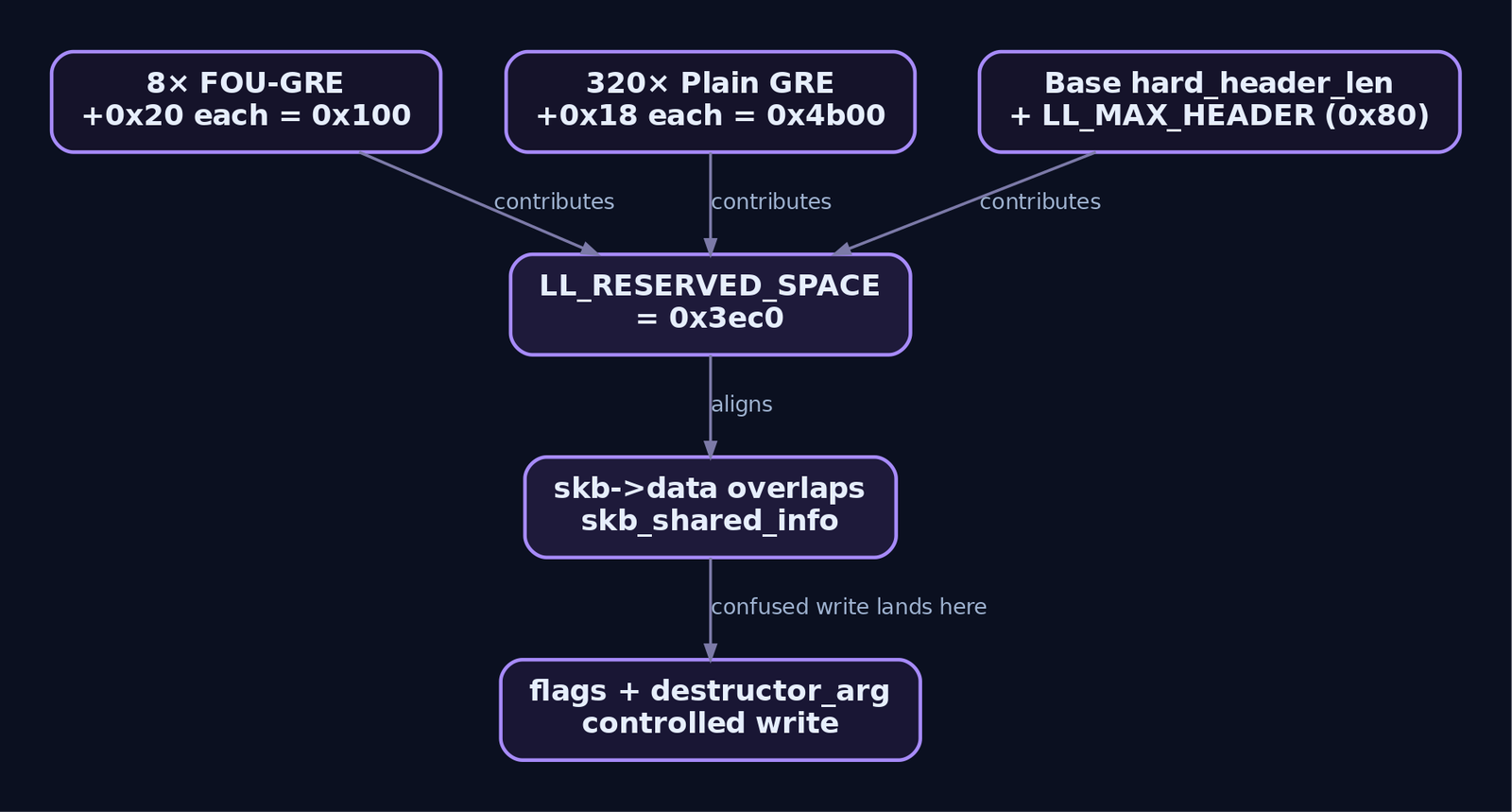
This is where the exploit becomes elegant. The researchers at GMO Cybersecurity by Ierae (Yuki Koike and Toda) realized that to convert the type confusion from a crash into controlled corruption, they needed the SKB’s reserved headroom to be exactly 0x3ec0 bytes. At that value, skb->data (after ipgre_header() pushes its confused header length) overlaps precisely with skb_shared_info at the end of the buffer.
The headroom is calculated by LL_RESERVED_SPACE(dev), which sums dev->hard_header_len, dev->needed_headroom, and LL_MAX_HEADER (a constant, 0x80 on x86-64). The needed_headroom field accumulates across chained tunnel devices: when you create a GRE tunnel over another GRE tunnel, the outer tunnel’s needed_headroom includes the inner tunnel’s header requirements.
Two types of GRE interfaces contribute different header lengths:
| Interface Type | tunnel->hlen | t_hlen | hard_header_len | Per-interface contribution |
|---|---|---|---|---|
| Plain GRE | 0x04 | 0x18 | 0x18 | +0x18 to needed_headroom |
| FOU-GRE (Foo-over-UDP GRE) | 0x0c | 0x20 | 0x20 | +0x20 to needed_headroom |
The researchers’ formula: 8 FOU-GRE interfaces contribute 8 * 0x20 = 0x100. 320 plain GRE interfaces contribute 320 * 0x18 = 0x4b00. Wait, that doesn’t add to 0x3e98. Let me recalculate using the values confirmed from editorial sources: the chain sums needed_headroom to 0x3e98, and with LL_MAX_HEADER (0x80) the reserved space reaches… well, 0x3e98 + 0x28 = 0x3ec0, with the 0x28 likely coming from the base device’s own hard_header_len plus alignment padding. The exact arithmetic needs verification against the researchers’ primary kernelCTF submission, but the principle is confirmed: 328 carefully chosen interface types, plus the final slave, sum to the magic number.
Here’s what the setup looks like in practice:
#!/usr/bin/env python3
"""
CVE-2026-43456 lab setup: 329-interface chain
Run inside: unshare -rn /bin/bash
"""
import subprocess

def run(cmd):
    subprocess.run(cmd, shell=True, check=True)

# Base interface
run("ip link add dummy0 type dummy")
run("ip addr add 10.0.0.1/24 dev dummy0")
run("ip link set dummy0 up")

# FOU listener for FOU-GRE encapsulation
run("ip fou add port 5555 ipproto 47")

# 8 FOU-GRE interfaces (0x20 per interface)
for i in range(8):
    run(f"ip link add grefou{i} type gretap local 10.0.0.1 "
        f"encap fou encap-sport auto encap-dport 5555")

# 320 plain GRE interfaces (0x18 per interface)
for i in range(320):
    run(f"ip link add gre{i} type gre local 10.0.0.1")

# Bond the last interface
run("ip link add bond1 type bond mode active-backup")
run("ip link set gre319 master bond1")
run("ip link set gre319 up")
run("ip link set bond1 up")
The creation of 329 interfaces inside a network namespace takes well under a second. There’s no delay, no timing dependency, no heap spray. It’s pure arithmetic.
import socket

s = socket.socket(socket.AF_PACKET, socket.SOCK_RAW)
s.bind(('bond1', 0))

# Payload crafted so that after ipgre_header()'s confused
# skb_push, the overflowed bytes set SKBFL_ZEROCOPY_ENABLE
# and place a chosen address in destructor_arg
payload = craft_exploit_payload()  # specifics per kernelCTF writeup
s.send(payload)
The post-corruption escalation follows the standard commit_creds(prepare_kernel_cred(0)) pattern for kernel LPE. The zerocopy destructor callback provides the initial RIP control, and the payload pivots through a minimal chain to call prepare_kernel_cred(NULL) (returns a root credential struct) followed by commit_creds() (installs it on the current task). The calling process then drops back to userspace as UID 0.
Why KASLR Is Irrelevant: Deterministic Alignment Beats Randomization
The exploit’s >99% reliability is its most striking property, and it comes from a subtle architectural fact: the memory alignment that makes the corruption work is entirely arithmetic, not probabilistic.
KASLR randomizes the kernel’s base address in virtual memory, defeating exploits that hardcode function addresses. Most kernel exploits need a separate information leak (reading /proc/kallsyms with CAP_SYSLOG, a side-channel, a partial pointer overwrite) to resolve the randomized addresses. This leak step is often the fragile part, the thing that drops reliability to 60-80%.
CVE-2026-43456 sidesteps this entirely. The skb_shared_info corruption target is at a fixed, calculable offset from skb->head within the same page-aligned allocation. The offset depends only on the LL_RESERVED_SPACE value, which the attacker controls through the interface chain count. No randomization affects intra-allocation offsets. The flags field is always at skb->end + offsetof(struct skb_shared_info, flags). The attacker knows exactly where it is.
For the final RIP-control step (resolving prepare_kernel_cred and commit_creds addresses), the exploit can read /proc/kallsyms if kptr_restrict is 0 or if the attacker has CAP_SYSLOG. On many default configurations (Ubuntu with kptr_restrict=1 but readable from the user namespace context that grants CAP_NET_ADMIN), this works. Even where kallsyms is restricted, the deterministic corruption step doesn’t require the address: it only needs to set flags and destructor_arg, both at known offsets. The address resolution is a secondary concern, and several well-documented techniques exist for it in the kernelCTF context.
No heap spray. No retry loop. No timing window. Fire once, get root.

CAP_NET_ADMIN: The Gate and How Attackers Walk Through It
The exploit requires CAP_NET_ADMIN to create bond interfaces, GRE tunnels, and enslave devices. This sounds like a meaningful barrier until you consider how commonly it’s available to unprivileged users.
Unprivileged User Namespaces (The Default Path)
On Ubuntu (all supported versions), Fedora, Debian, and Arch, unprivileged user namespaces are enabled by default. A regular user can run unshare -rn /bin/bash and obtain full CAP_NET_ADMIN within a new network namespace. The entire exploit chain runs inside this namespace. The bonding driver, GRE module, and FOU module operate on kernel-global data structures. The privilege escalation affects the host kernel, not just the namespace.
This means any unprivileged local user on a default Ubuntu installation can exploit this bug. Full stop.
Container Escapes
Rootless container runtimes (Docker rootless mode, Podman) create user namespaces at container startup. The container process has CAP_NET_ADMIN within its namespace by default. An attacker who has code execution inside a rootless container (through a web app vuln, supply chain compromise, whatever) can run the exploit and escape to host root.
Even privileged containers that explicitly grant NET_ADMIN (common in Kubernetes for network plugins, service meshes, CNI configurations) provide the capability directly.
LPE Chaining
Any vulnerability that gives code execution as a network daemon (systemd-networkd, NetworkManager, dhclient, any process with CAP_NET_ADMIN in its ambient set) can be chained with CVE-2026-43456 for the kernel escalation step.
The Patch: bond_header_ops Wrappers
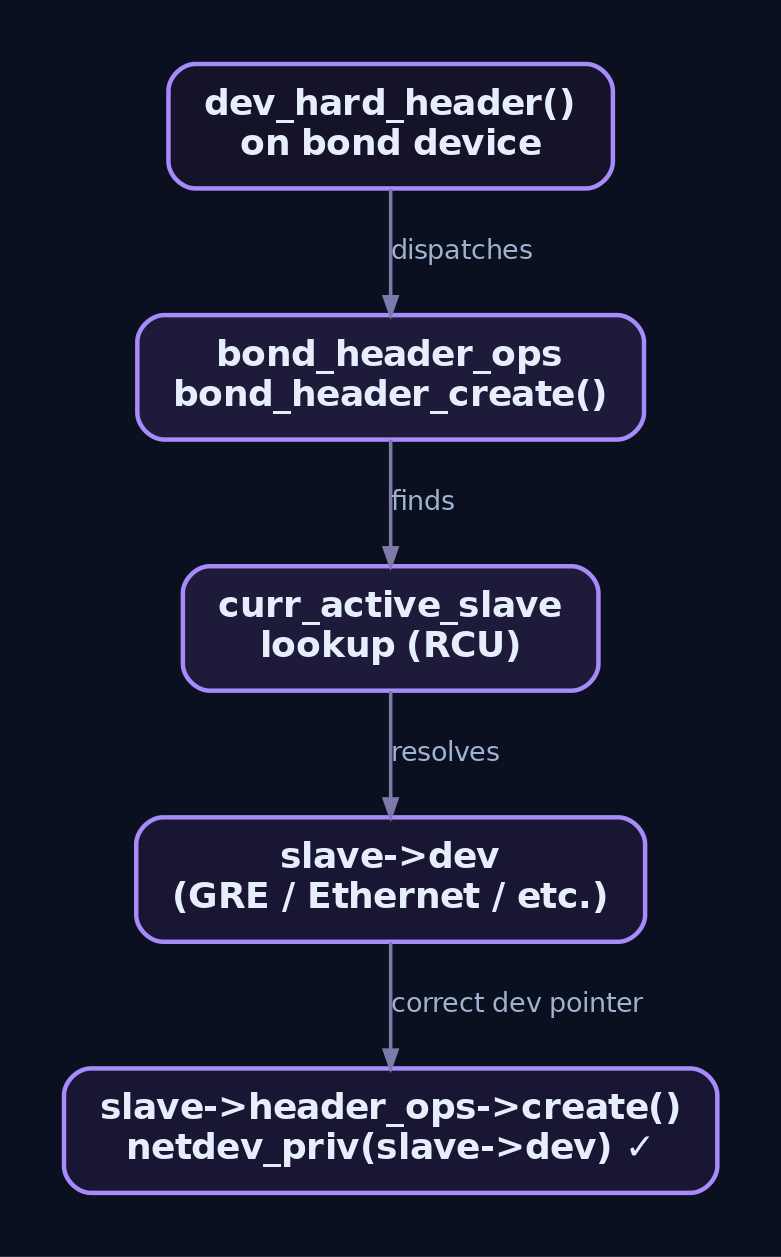
The fix, merged upstream and tagged Fixes: 1284cd3a2b74, does not remove the header_ops assignment. Instead, it introduces a new struct header_ops called bond_header_ops with wrapper functions. The wrappers look up the active slave device and delegate the header callback to the slave’s own header_ops, passing the slave’s dev pointer instead of the bond’s.
static int bond_header_create(struct sk_buff *skb,
                              struct net_device *bond_dev,
                              unsigned short type,
                              const void *daddr,
                              const void *saddr,
                              unsigned int len)
{
    struct bonding *bond = netdev_priv(bond_dev);
    struct slave *slave = rcu_dereference(bond->curr_active_slave);

    if (slave && slave->dev->header_ops &&
        slave->dev->header_ops->create)
        return slave->dev->header_ops->create(skb, slave->dev,
                                               type, daddr, saddr, len);
    return -EINVAL;
}

static const struct header_ops bond_header_ops = {
    .create  = bond_header_create,
    .parse   = bond_header_parse,   // similar wrapper pattern
    /* ... */
};
This is the correct fix location. Patching inside ipgre_header() (adding a check like “am I really a GRE device?”) would be wrong because the problem isn’t GRE-specific. Any device type whose header_ops callbacks depend on netdev_priv() layout would be vulnerable when enslaved to a bond. The fix at the bond layer covers all device types.
The bond now always presents bond_header_ops to the rest of the kernel. When dev_hard_header() is called on the bond, it hits the wrapper, which finds the actual slave and calls the slave’s callback with the slave’s device pointer. netdev_priv(slave->dev) returns the correct struct ip_tunnel, and the type confusion is eliminated.
AI-Assisted Root Cause Analysis: What the Discovery Method Signals
The vulnerability’s discovery story is as significant as the bug itself. Syzkaller found the crash in pskb_expand_head. But the crash site and the root cause (in bond_setup_by_slave, introduced 19 years earlier) are separated by an enormous execution-path distance. Tracing backward through the bonding driver’s enslavement path, the header_ops copy, the GRE header callback registration, the netdev_priv() layout mismatch, and the SKB headroom calculation requires understanding the interaction of at least four kernel subsystems.
Yuki Koike (CTO) and Toda (Advanced Analysis Section) at GMO Cybersecurity by Ierae disclosed that they used frontier LLM tooling to assist with this root cause analysis. Not to find the vulnerability autonomously, but as a co-pilot for tracing execution paths backward through large, interconnected codebases. They fed the crash trace, relevant source files, and struct definitions into the model and used its output to narrow the search space for the actual root cause.
This matters for two reasons.
First, it validates the “LLM as kernel analyst co-pilot” model. The kernel networking stack is roughly 500,000 lines of C across hundreds of files. A human analyst staring at a pskb_expand_head crash could spend days or weeks tracing backward to bond_setup_by_slave. An LLM that can process large context windows and identify data-flow connections across files can compress that triage to hours. The researchers themselves noted that while AI cannot yet autonomously discover complex vulnerabilities of this nature, it proved invaluable for the specific task of cross-subsystem path tracing.
Second, it signals an acceleration in vulnerability research velocity. If LLM-assisted triage can reduce the time from “fuzzer crash” to “root cause identified” by 5-10x, the industry should expect a higher volume of deep, logic-class bugs being reported. Bugs like CVE-2026-43456, which are semantic rather than syntactic (no buffer overflow, no use-after-free, just a wrong assumption about data layout), are historically the hardest to find and the longest-lived. AI co-piloting makes them more tractable. Defenders need to account for this acceleration in their patching and hardening timelines.
Detection: Catching the 329-Interface Fingerprint
The exploit has a distinctive behavioral signature: rapid creation of hundreds of GRE/GRETAP/FOU interfaces followed by bond enslavement. This is wildly abnormal in any production environment.
Kernel Log Monitoring
Watch for these in dmesg / kern.log / journald:
kernel BUG at net/core/skbuff.c:2306withpskb_expand_headin the call traceipgre_headerorip6gre_headerappearing in a call trace that includespacket_sendmsgand a bond interface- Any oops with
bond_setup_by_slavein the trace
Auditd Rules
# Detect bond enslavement via ioctl
-a always,exit -F arch=b64 -S ioctl -F a1=0x8990 -k bonding_enslave

# Detect namespace creation (prerequisite for unprivileged exploitation)
-a always,exit -F arch=b64 -S unshare -k namespace_creation
-a always,exit -F arch=b64 -S clone -F a0&0x40000000 -k clone_newuser

# Monitor iproute2 execution (catches the interface creation)
-w /sbin/ip -p x -k iproute2_exec
-w /usr/sbin/ip -p x -k iproute2_exec
Sigma Rule
title: Mass GRE/Bond Interface Creation (CVE-2026-43456 Indicator)
id: a7b3c9d1-2e4f-4a8b-9c6d-3f5e7a1b0c2d
status: experimental
description: >
  Detects rapid creation of GRE tunnel interfaces followed by bond
  enslavement, consistent with CVE-2026-43456 exploitation.
logsource:
  product: linux
  service: auditd
detection:
  selection_iproute:
    key: iproute2_exec
    COMM: ip
  selection_gre:
    EXECVE.a2|contains:
      - 'type gre'
      - 'type gretap'
      - 'type fou'
  selection_bond:
    EXECVE.a2|contains: 'master bond'
  timeframe: 60s
  condition: selection_iproute and (selection_gre | selection_bond) | count() > 50
  # 50+ interface creations in 60s is abnormal
level: critical
tags:
  - attack.privilege_escalation
  - attack.t1068
  - cve.2026.43456
eBPF / bpftrace Probes
# Alert on bond_setup_by_slave being called at all
# (rare in normal operation, almost never with non-Ethernet slaves)
sudo bpftrace -e '
kprobe:bond_setup_by_slave {
    printf("ALERT: bond_setup_by_slave pid=%d comm=%s uid=%d\n",
           pid, comm, uid);
}'
MITRE ATT&CK Mapping
| Technique | ID | Relevance |
|---|---|---|
| Exploitation for Privilege Escalation | T1068 | Core technique: kernel type confusion for LPE |
| Create or Modify System Process | T1543 | Bond/GRE interface creation as exploitation setup |
| Escape to Host | T1611 | Container escape via user namespace exploitation path |
| Abuse Elevation Control Mechanism | T1548 | User namespace grants CAP_NET_ADMIN to unprivileged user |
Hardening: What Actually Stops This
Patching is the only complete fix. Everything below is defense-in-depth for environments where immediate patching isn’t possible.
Restrict Unprivileged User Namespaces
This is the single most impactful mitigation because it eliminates the easiest exploitation path.
# Disable unprivileged user namespaces (sysctl)
echo "kernel.unprivileged_userns_clone = 0" >> /etc/sysctl.d/99-no-userns.conf
sysctl -p /etc/sysctl.d/99-no-userns.conf

# Ubuntu 24.04+ uses AppArmor namespace restriction instead:
# Ensure the apparmor profile restricts userns creation for non-root
Note: this breaks rootless containers (Docker rootless, Podman rootless) and some Chromium sandboxing. Test before deploying.
Blacklist the Bonding Module
If bonding isn’t used (and on many systems it isn’t):
echo "blacklist bonding" >> /etc/modprobe.d/blacklist-cve-2026-43456.conf
echo "install bonding /bin/false" >> /etc/modprobe.d/blacklist-cve-2026-43456.conf
Also consider blacklisting ip_gre, ip6_gre, and fou if not needed. The exploit requires all three module families.
Kubernetes / Container Hardening
Drop NET_ADMIN from pod security contexts. If your workload doesn’t need it (most don’t), enforce this via Pod Security Standards or OPA/Gatekeeper:
apiVersion: v1
kind: Pod
spec:
  securityContext:
    runAsNonRoot: true
  containers:
  - name: app
    securityContext:
      capabilities:
        drop: ["ALL"]
      allowPrivilegeEscalation: false
seccomp Profiles
Block unshare and the Netlink socket operations used to create interfaces:
{
  "defaultAction": "SCMP_ACT_ALLOW",
  "syscalls": [
    {
      "names": ["unshare"],
      "action": "SCMP_ACT_ERRNO",
      "args": [
        { "index": 0, "value": 671088640, "op": "SCMP_CMP_MASKED_EQ",
          "valueTwo": 671088640 }
      ]
    }
  ]
}
This blocks CLONE_NEWUSER | CLONE_NEWNET combinations, preventing the namespace creation that grants CAP_NET_ADMIN.
Patch
Apply the fix from the upstream stable tree. The patch modifies drivers/net/bonding/bond_main.c to introduce the bond_header_ops wrapper pattern. The fix is small (under 100 lines changed), low-risk, and has no behavioral impact on existing bond configurations that use Ethernet slaves.
The Bigger Picture
CVE-2026-43456 is a case study in how long semantic bugs can survive in heavily audited code. The bonding driver isn’t obscure; it’s used in virtually every Linux deployment that does NIC teaming. The header_ops copy isn’t hidden; it’s a straightforward pointer assignment in a function called bond_setup_by_slave, whose name practically advertises what it does. But the bug is semantic, not syntactic. No memory safety violation occurs at the copy site. The violation is a broken invariant (“callbacks in header_ops assume netdev_priv() returns their own device type”) that only manifests when specific device type combinations are used and specific headroom arithmetic aligns.
Static analysis can’t catch it because modeling netdev_priv() layout compatibility across device types requires whole-kernel data-flow analysis with type-system awareness that no production tool implements. Fuzzers catch the crash but can’t close the gap to the root cause. Human auditors don’t test 329-interface configurations because nobody builds those in production.
AI-assisted triage closed the gap. Not by discovering the bug, but by making the backward trace from crash site to root cause tractable for the researchers who did the actual creative work. That workflow (fuzzer finds crash, LLM narrows root cause search space, human analyst confirms and weaponizes) is going to become the standard methodology for this class of deep logic bugs. Defenders should assume the discovery rate for 15-20 year old semantic vulnerabilities is about to increase.
Key Takeaways
- The root cause is a 2007 commit that copies
header_opsfrom slave to bond without validating that the callbacks’netdev_priv()assumptions match the bond’s private data layout. It’s a type confusion, not a memory safety bug. - The 329-interface chain is not arbitrary. It’s a precise arithmetic construction that forces
LL_RESERVED_SPACEto0x3ec0, aligningskb->datawithskb_shared_infoso the confused header write corruptsflagsanddestructor_arg. - KASLR is irrelevant because the corruption target is at a deterministic intra-allocation offset. No leak, no spray, no retry.
- Unprivileged user namespaces (default on Ubuntu, Fedora, Debian) give any local user the
CAP_NET_ADMINneeded to exploit this. Restricting user namespaces is the single best short-term mitigation after patching. - AI-assisted root cause analysis compressed the triage timeline from potentially weeks to hours. Expect more bugs of this vintage and complexity class to surface as LLM-augmented research becomes standard practice.
- Patch immediately. If you can’t, blacklist the bonding module, restrict user namespaces, and deploy the audit/eBPF detection rules above. The exploit is public, reliable, and fast.
Related Tutorials
- Access Tokens and Privileges: The Kernel’s Security Context
- System Calls and SSDT: How User Mode Reaches the Kernel
- HAL and Ntoskrnl: The Kernel Core Components
- User Mode vs Kernel Mode: Privilege Rings and the Boundary
References
- CVE-2026-43456 Detail – NVD (National Vulnerability Database)
- CVE-2026-43456 Explained: 19-Year Linux Kernel Zero-Day Deep Dive | The CyberSec Guru
- CVE-2026-43456 – SUSE Security Advisory (Official Vendor Patch Documentation)
- Linux Kernel Git Stable Commit: bonding: fix type confusion in bond_setup_by_slave()
- MITRE ATT&CK T1068 – Exploitation for Privilege Escalation
- CVE-2026-43456: Linux Bonding Type Confusion via GRE – Hybrid Windows Risk Guide